Our system will evaluate the answer based on this AI-generated description.
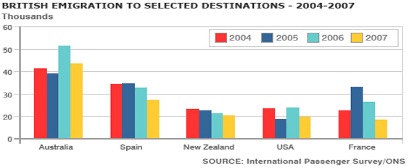
The image depicts a bar graph illustrating British emigration to selected destinations between 2004-2007, with thousands on the y-axis and destination countries on the x-axis. Each country has four bars representing the years, with blue for 2004, red for 2005, green for 2006, and yellow for 2007. Australia had the highest emigration numbers, starting around 50,000 in 2004, decreasing steadily each year to just over 30,000 in 2007. Spain's numbers ranged from just over 40,000 in 2004 to around 35,000 in 2007. New Zealand saw a consistent decrease from just over 20,000 in 2004 to around 10,000 in 2007. The USA had an increase from 20,000 in 2004 to nearly 30,000 in 2006 before dropping to around 20,000 in 2007. France's numbers remained relatively stable, starting at just over 10,000 in 2004, peaking at around 15,000 in 2005, and settling at just under 10,000 in 2007. The data source is the International Passenger Survey/ONS.
Given the complexity of the image, the above description may not be entirely accurate.
Skyrocket your IELTS band score by 1-2 points in under a month with our premium plan!
Note: Both the topic and the answer were created by one of our users.
The bar chart provides information concerning five destinations of British people between 2004 and 2007. The data can be divided into two groups, namely the number that experienced an upward trend and a downward trend.
It can be clearly seen that the number of British immigrants in Australia was the highest among five countries, while that of New Zealand stood last. Spain and New Zealand experienced drops, but Australia, USA, and France which mainly showed fluctuations.
To begin, Spain and New Zealand initially stood at 35,000 and 22,000 in 2004 before a steady fall until 2007 when it reached about 28,000 and 20,000.
Moving on to the figures for Australia, for USA, and for France in 2004, the number remained at 42,000, 24,000, and 22,000 respectively. In 2005, the first two slightly decreased to about 39,000 and 19,000, but the latter dramatically increased to 32,000. After that, the figures experienced a noticeable rise and a marked drop between 2006 and 2007.
Word Count: 161
