Our system will evaluate the answer based on this AI-generated description.
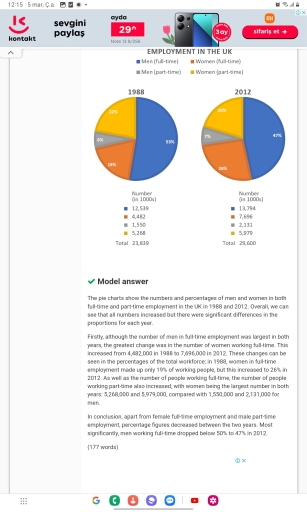
The image contains two pie charts comparing the number of men and women in full-time and part-time employment in the UK in 1988 and 2012 respectively. In 1988, there were a total of 23,180 individuals employed, with men in full-time work accounting for the majority at 12,650, followed by women in full-time work at 4,899, men in part-time work at 1,298, and women in part-time work at 4,332. In 2012, the total employed individuals increased to 25,259 with men in full-time work slightly reduced to 12,566, women in full-time work increased to 7,246, men in part-time work increased to 2,374, and women in part-time work increased to 3,073. The data demonstrates that over the 24 year period, there was a decrease in the proportion of men in full-time employment and an increase in all other categories, with a significant rise in the number of women in full-time employment.
Given the complexity of the image, the above description may not be entirely accurate.
Skyrocket your IELTS band score by 1-2 points in under a month with our premium plan!
Note: Both the topic and the answer were created by one of our users.
the pie charts illustrate the number of men and women in full-time and part-time employment in the UK in 1988 and 2012.
overall, the number of people in employment increased between the two years. full-time employment for men remaind the largest category, although it decreased in percentage. meanwhile, part-time work, especially among women, grew significantly.
in 1988, men working full-time accounted for the largest share at 52% followed by women in full-time jobs at 22%. part-time employment was less common 15% of the workforce were women working part-time, while only 7% were men in part-time roles.
by 2012, full-time male employment had decreased to 47%, while the proportion of part-time male workers rose to 9%. the number of women working full-time slightly dropped inpercantage to 21%, but part-time female employment saw a significant increase to 23%, making in the second largest category.
overall, full-time emloyment among men was the largest category in both years.
Word Count: 154
