Our system will evaluate the answer based on this AI-generated description.
The image contains two graphs related to travel. The top graph titled "Travel Over Time" displays data from 1990 to 2015, with y-axes for both Time Taken (minutes) ranging from 355 to 395 and Distance Traveled (miles) ranging from 6300 to 7300. In 1990, the time taken was 365 minutes and distance traveled was 6300 miles; in 1995 both increased to 370 minutes and 6850 miles; 2000 saw further increase to 385 minutes and 7100 miles; in 2005 time increased to 390 minutes but distance decreased to 7000 miles; 2010 had a time of 380 minutes and distance of 6900 miles; and 2015 saw the time decrease to 365 minutes and distance to 6400 miles. The bottom graph titled "Mode of Travel" shows the percentage breakdown of travel methods for the years 1995, 2000, 2005, 2010, and 2015. Walking/Cycling percentages were 28%, 27%, 24%, 24%, and 24%, respectively. Other Private Transport percentages were 62%, 64%, 65%, 66%, and 65%, respectively. Public Transport percentages were 9%, 9%, 11%, 11%, and 11%, respectively.
Given the complexity of the image, the above description may not be entirely accurate.
Skyrocket your IELTS band score by 1-2 points in under a month with our premium plan!
Note: Both the topic and the answer were created by one of our users.
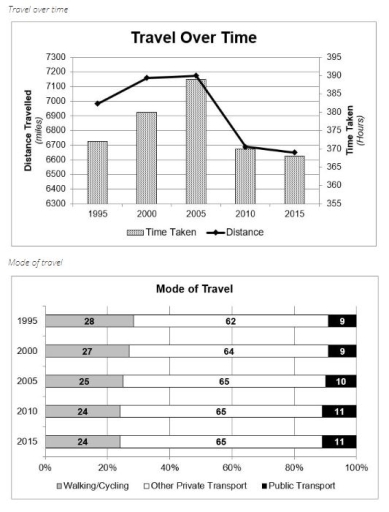
The two charts illustrate changes in travel patterns in one country between 1995 and 2015. The first chart shows the total distance travelled and the time spent travelling, while the second chart examines the popularity of different modes of transport used.
Both the distance travelled and the time spent travelling increased steadily from 1995 to 2005; however, they declined sharply by 2015. In terms of transport modes, private transport remained the dominant choice throughout the period, while walking/cycling and public transport showed only slight fluctuations.
Between 1995 and 2000, the total distance travelled increased rapidly, from about 6,000 miles to nearly 7,200 miles. This figure plateaued until 2005. By 2010, the decline was significant, to approximately 6,700 miles, followed by a modest decrease to around 6,600 miles by 2015. The time spent travelling followed a similar trend, rising steadily until 2005 and then dropping sharply by 2015.
Regarding modes of transport, private transport consistently accounted for the largest share of all journeys, fluctuating slightly between 62% and 65% over the 20-year period. Walking and cycling experienced a gradual decline, decreasing from 28% in 1995 to 24% in 2015. Furthermore, public transport usage increased marginally from 9% to 11% during the same period.
Word Count: 202
