Our system will evaluate the answer based on this AI-generated description.
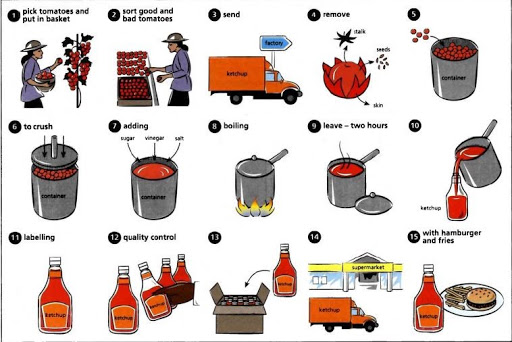
The image shows a 15-step process diagram of making ketchup, with each step represented by a numbered illustration. Step 1 involves picking tomatoes and placing them in a basket, while step 2 involves sorting the good and bad tomatoes. Step 3 shows the tomatoes being sent to a factory via a truck, and step 4 involves removing the stalk and skin of the tomatoes. Step 5 shows the tomatoes being placed in a container, and step 6 involves crushing the tomatoes, also in a container. Step 7 adds sugar, vinegar, and salt to the mix in a container, while step 8 involves boiling the mixture. Step 9 shows the mixture being left for two hours, and step 10 involves pouring the ketchup into a bottle. Step 11 involves labeling the bottles, and step 12 is quality control. Step 13 shows the ketchup bottles being packaged, while step 14 shows the bottles on sale at a supermarket. The final step, 15, shows the ketchup being used with a hamburger and fries.
Given the complexity of the image, the above description may not be entirely accurate.
Skyrocket your IELTS band score by 1-2 points in under a month with our premium plan!
Note: Both the topic and the answer were created by one of our users.
The diagram illustrates the process of making tomato ketchup, which involves 15 distinct stages—beginning with harvesting tomatoes and ending with consumers enjoying the final product with a hamburger and fries.
The process starts with farmers picking ripe tomatoes and placing them into baskets. These tomatoes are then sorted to separate the good ones from the bad ones before being transported to a factory. Upon arrival, their stalks, seeds, and skins are removed, after which they are placed into a container and crushed into a smooth paste.
Next, sugar, vinegar, and salt are added to enhance the flavor, and the mixture is left to simmer for two hours. Once the ketchup reaches the desired consistency, it is transferred into bottles, labeled, and subjected to quality control.
In the final stages, the bottles are packed into boxes and distributed to supermarkets. Finally, customers purchase the ketchup and enjoy it as a condiment with meals such as hamburgers and fries.
Word Count: 157
