Our system will evaluate the answer based on this AI-generated description.
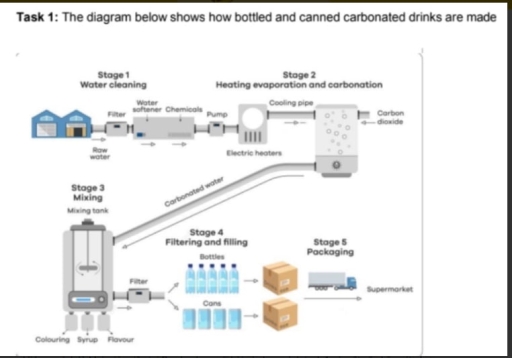
The image displays a five-stage process diagram of how bottled and canned carbonated drinks are made. Stage 1, titled "Water cleaning," includes a flow depicting raw water undergoing filtration, water softening through chemicals, and pumping. Stage 2, "Heating evaporation and carbonation," shows cooling pipes and electric heaters connected to a carbon dioxide source, indicating carbonation. Stage 3, labeled "Mixing," features a mixing tank where coloring, syrup, and flavor are added to the carbonated water. Stage 4, named "Filtering and Filling," illustrates filtered liquid being filled into bottles and cans. The final Stage 5, "Packaging," portrays the bottled and canned drinks being boxed and subsequently transported to a supermarket. Each stage is interlinked with arrows, emphasizing the progression of the production process.
Given the complexity of the image, the above description may not be entirely accurate.
Skyrocket your IELTS band score by 1-2 points in under a month with our premium plan!
Note: Both the topic and the answer were created by one of our users.
The diagram illustrates how bottled and canned drinks that are carbonated are produced. Overall, multi-stage process involves water cleaning, heating, evaporation and carbonation, mixing, filtering, and filling of the product, before finally proceeding to packaging. While manual labor is required, much of the process relies on certain machines.
The first stage focuses on the purification of water. Firstly, raw water is piped into the filter, after which it is softened and chemicals are added to the water. Secondly, pump is used to push the water into electric heaters, where it gets evaporated. These water vapors are condensed in the cooling pipe, after which carbon dioxide dissolves and reacts to form carbonic acid.
The next is the mixing phase, where carbonated water is combined with flavor, syrup, and coloring in the mixing tank. After that the final product is filtered and poured into bottles and cans. As the last manufacturing stage, it is packaged to make it ready for distributions.
Word Count: 159
