Our system will evaluate the answer based on this AI-generated description.
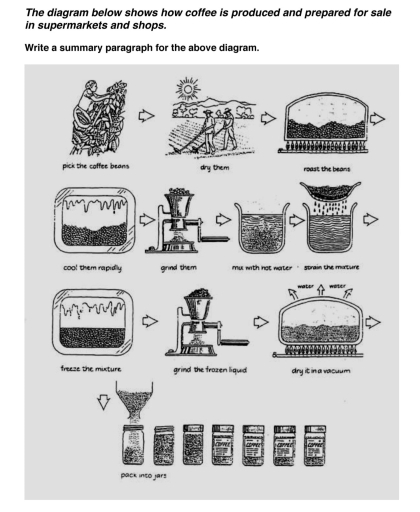
The image features an eleven-stage process flow diagram interconnected sequentially by directional arrows across four rows. The labeled stages are: Row 1: "pick the coffee beans" (a person harvesting beans from a plant), "dry them" (two people raking under the sun), and "roast the beans" (beans placed in an enclosed chamber over burner flames). Row 2: "cool them rapidly" (beans inside a cooling unit), "grind them" (beans processed in a mechanical crank grinder), "mix with hot water" (ground coffee steeped in a liquid container), and "strain the mixture" (liquid filtered through a sieve into a pot). Row 3: "freeze the mixture" (liquid frozen in a cooling unit), "grind the frozen liquid" (grinder processing the frozen block), and "dry it in a vacuum" (chamber over heat with upward arrows labeled "water"). Row 4: "pack into jars" (a funnel dispensing granules into a jar, followed by a lineup of six jars, the last four bearing "COFFEE" labels).
Given the complexity of the image, the above description may not be entirely accurate.
Skyrocket your IELTS band score by 1-2 points in under a month with our premium plan!
Note: Both the topic and the answer were created by one of our users.
The diagram details the process by which coffee is made for retail in supermarkets and shops.
Overall, this process for making coffee beans includes three main stages, beginning with collecting the coffee beans for drying and roasting them, followed by cooling them and processing, and finally packaging them into jars and labeling.
To begin, the coffee beans are collected and dried in the sun. These dried beans are then roasted before colling them quickly.
After being cooled, the beans are ground and mixed with hot water. The next stage is to strain them before freezing the mixture again.
In the subsequent steps, this frozen liquid goes through a further grinding process, followed by drying it in a vacuum to remove the water. Finally, the resulting beans are packed into jars and labelled.
Word Count: 132
