Our system will evaluate the answer based on this AI-generated description.
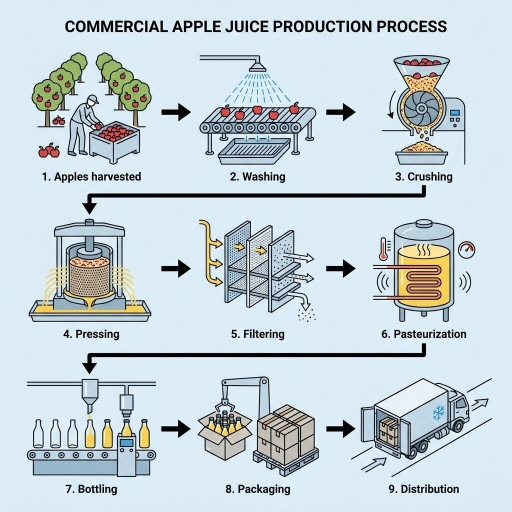
The image features a process diagram titled "COMMERCIAL APPLE JUICE PRODUCTION PROCESS" comprising 9 sequential numbered steps linked by directional arrows across three rows. Row 1 details: "1. Apples harvested" (orchard trees, worker, crate), "2. Washing" (apples on a roller conveyor under a spray nozzle with a drain tray), and "3. Crushing" (apples entering a hopper, a rotating grinding mechanism, and crushed mash in a bin). Row 2 details: "4. Pressing" (a hydraulic/mechanical press extracting liquid into a bottom tray), "5. Filtering" (liquid flowing through a multi-screen filtration unit with a solid residue discharge), and "6. Pasteurization" (a heated vat with internal coils, temperature gauge, thermometer icon, and heat waves). Row 3 details: "7. Bottling" (bottles on a conveyor belt undergoing filling and capping), "8. Packaging" (a mechanical crane packing bottled juice into cardboard boxes positioned on a pallet), and "9. Distribution" (a refrigerated delivery truck loaded with boxed cargo driving along a roadway).
Given the complexity of the image, the above description may not be entirely accurate.
Skyrocket your IELTS band score by 1-2 points in under a month with our premium plan!
Note: Both the topic and the answer were created by one of our users.
The provided diagram illustrates the multi-step process involved in the commercial production of apple juice.
Overall, the process consists of four main stages, beginning with the manual harvesting of fresh apples and culminating in the packaging and distribution of the finished product.
In the initial stage of the process, ripe apples are picked manually from trees in the orchard. After being collected, the fruit is transported directly to the processing factory. Upon arrival, the apples are washed thoroughly to remove any dirt or impurities. Following this cleaning step, the fruit is moved to a crushing machine, where it is broken down into a coarse pulp. This pulp is then subjected to heavy pressing in order to extract the liquid juice.
In the subsequent phase, the extracted juice undergoes a filtration process using various techniques to remove solid particles and ensure clarity. To extend its shelf life and eliminate harmful bacteria, the liquid is heated during the pasteurization stage. Finally, the processed juice is poured into sterile glass bottles or cartons, which are then sealed, packaged, and readied for distribution to retail stores.
Word Count: 182
