Our system will evaluate the answer based on this AI-generated description.
The image contains two diagrams, the left diagram, titled "A wind turbine," features a wind turbine with labeled parts including rotor diameter (40-90m), hub height (50-80m), and generator (1.5-5MW). Below the turbine, there is a small building labeled electrical systems. The turbine is set on flat terrain with a single tree and vehicle close by. An arrow indicating wind goes through the rotor. The right diagram, title "Wind turbines: optimum locations," presents the same wind turbine with labeled rotor diameter (40-90m), hub height (50-80m), and generator (1.5-5MW). This turbine is placed on a hilly terrain with variable heights indicated (20-80m), a coastline depicted on the right, and a house and tree on the lower left side. An arrow indicating wind is pointing towards the rotor, originating from the higher elevations of the hill.
Given the complexity of the image, the above description may not be entirely accurate.
Skyrocket your IELTS band score by 1-2 points in under a month with our premium plan!
Note: Both the topic and the answer were created by one of our users.
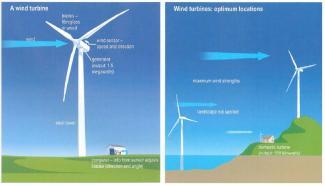
The diagrams illustrate the design of a turbine that can be rotated by the wind and its ideal locations.
Generally speaking, the diagrams effectively illustrate the turbine’s components and factors determining its ideal location. The primary objective is to maximize energy production while minimizing environmental impact.
A powerful steel tower forms the base, supporting a powerful generator capable of producing 1.5 megawatts of electricity. Extending upwards from the generator are stretched fiberglass or wooden blades designed to utilize the wind’s kinetic energy. A wind sensor, strategically positioned at the tower’s apex, continuously monitors wind speed and direction.
Data collected by the wind sensor is transmitted to a computer system, which later adjusts blade angle and direction to optimize energy generation. Ideally, turbines are positioned in areas described by consistent high wind speeds and minimal visual impact. Coastal regions, renowned for their vulnerability to strong winds, are frequently selected. Domestic turbines, with a capacity of 100 kilowatts, are commonly situated in coastal areas to capitalize on sufficient wind resources.
Word Count: 168
