🔥 Today Only: Save 30% on Premium — Offer Ends Soon! - Upgrade Now!
Process Diagram

Band 8+: The diagram below shows the process by which bricks are manufactured for the building industry. Summarise the information by selecting and reporting the main features, and make comparisons where relevant. Write at least 150 words.

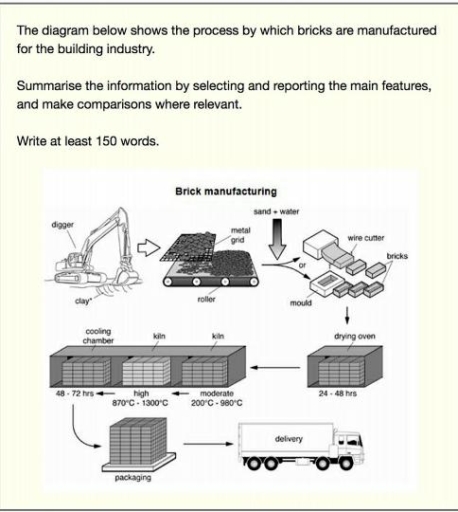
Image for topic: The diagram below shows the process by which bricks are manufactured for the building industry. Summarise the information by selecting and reporting the main features, and make comparisons where relevant. Write at least 150 words.
Our system will evaluate the answer based on this AI-generated description.
The image illustrates the brick manufacturing process in a sequential diagram form, featuring various equipment and steps involved. It starts with the extraction of clay using a digger, followed by clay processing through a roller. The processed clay is then mixed with sand and water, and passed through a metal grid to achieve a consistent blend. This mixture can be shaped into bricks using either a wire cutter or a mould, resulting in the formation of wire cut bricks or moulded bricks respectively. Subsequently, bricks are transferred to a drying oven where they stay for 24-48 hours. This step is followed by placing the bricks in a kiln for further hardening; depending on the kiln type, bricks are heated at temperatures ranging from 200°C in a moderate kiln to 980°C, or from 870°C to 1300°C in a high kiln over a period of 48-72 hours. Post kiln processing, bricks are moved to the packaging stage and then loaded onto a delivery truck for distribution.
Given the complexity of the image, the above description may not be entirely accurate.
Note: Both the topic and the answer were created by one of our users.

The diagram illustrates how bricks are manufactured for construction purposes.

Overall, the process includes 7 subsequent stages that are completely operated using special equipment.

The process starts when clay, the main raw material in brick manufacturing, is dug by a large digger. This clay in the following stage goes through a metal grid, where it is filtered, and the resulting sand continues on a roller for the next step. Turning to the third stage, sand is mixed with water so that the mixture can be used to form bricks in moulds or using a wire cutter. The next step takes place in a drying oven where bricks are kept for 24 to 48 hours before being sent into kilns. In the kiln, bricks are first heated moderately at 200°C to 980°C, then later in the second furnace, a high temperature of 870°C to 1300°C is applied to them. Having been heated at the necessary temperatures, bricks are kept in a cooling chamber for another 48 to 72 hours until they are ready for packaging. Eventually, the final procedure includes delivering the ready brick packages to construction sites with trucks so that the bricks can be used for buildings later.

Word Count: 199

Answers On The Same Topic:

The diagram below shows the process by which bricks are manufactured for the building industry. Summarise the information by selecting and reporting the main features, and make comparisons where relevant. Write at least 150 words.

The diagram illustrates the process of manufacturing bricks for the building industry. Overall, it is a linear process consisting of several stages, beginning with the extraction of clay and ending with the packaging and delivery of the finished bricks. The main stages include preparing the raw materials, shaping and drying the bricks, heating them at […]

The diagram below shows the process by which bricks are manufactured for the building industry. Summarise the information by selecting and reporting the main features, and make comparisons where relevant. Write at least 150 words.

provided process diagram details information about the process how brick are made in the building industry. Looking at the overall picture, the production of bricks is a multi-step linear process that starts with the excavation of raw clay and culminates in the transport of finished products to the building sector. This is accomplished by preparing […]

The diagram below shows the process by which bricks are manufactured for the building industry. Summarise the information by selecting and reporting the main features, and make comparisons where relevant. Write at least 150 words.

The diagram illustrates the sequential stages involved in the manufacturing of bricks for the construction industry. Overall, the production of bricks is a multi-step linear process that starts with the excavation of raw clay and culminates in the transport of finished products to the building sector. This is accomplished by preparing the raw material, shaping […]

The diagram below shows the process by which bricks are manufactured for the building industry. Summarise the information by selecting and reporting the main features, and make comparisons where relevant. Write at least 150 words.

The provided diagram illustrates the multi-stage process of producing clay bricks for the construction industry. Overall, the manufacturing of bricks is a linear, eight-stage process that commences with the extraction of raw clay and culminates in the delivery of the final packaged product. It heavily relies on automated machinery and precise temperature control. The process […]

The diagram below shows the process by which bricks are manufactured for the building industry. Summarise the information by selecting and reporting the main features, and make comparisons where relevant. Write at least 150 words.

The diagram illustrates the multi-stage process of manufacturing bricks for the construction industry. Overall, the production consists of several sequential phases, beginning with the extraction of raw materials and concluding with the packaging and delivery of the final product. To begin with, clay is excavated from the ground using a large digger. This raw clay […]

See All

Other Topics:

The diagram below shows the stages and equipment used in cement making process, and how cement is used to produce concrete for building puropses

The diagram illustrates the stages and equipment involved in cement production, as well as the process of making concrete from cement. Overall, limestone and clay undergo four stages of processing before they are ready for use as cement. Subsequently, the cement is combined with other materials to produce concrete. Concrete production is simpler; unlike cement […]

The diagram below shows the life cycle of the salmon. Summarise the information by selecting and reporting the main features, and make comparisons where relevant.

The picture illustrates the stages involved in the life cycle of a salmon. From an overall perspective, it is evident that the cyclical process comprises seven consecutive steps in total, commencing with the laying of eggs and culminating in the formation of a fully-grown salmon fish. In detail, the life cycle of a salmon begins […]

Task 1 The diagrams below show the stages and equipment used in the cement-making process, and how cement is used to produce concrete for building purposes. Summarise the information by selecting and reporting the main features, and make comparisons where relevant. Write at least 150 words.

The diagrams illustrate the process of cement making, like how much equipments and stages it need. Additionally, for bulding purposes, how much cement is nedded to making concrete? Overall the diagrams show the cement production and concrete production. In there for those production making, there are some machines and eliments nedded. For cement meking,we need […]

The diagram below shows the operation of a combine harvester on a farm. Summarise the information by selecting and reporting the main features, and make comparisons where relevant.

The supplied diagram illustrates the sequential stages about the operation of combine harvester. Showing how raw crop develops into harvested one. Overall, it is evident that the diagram follows a technical process dividing into several distinct stages including crop cutting, conveyor, crop feeding, grain and straw separation, straw discharge, grain cleaning, collection, auger, and finally […]

The diagram below shows two different processes for manufacturing black tea. Summarise the information by selecting and reporting the main features.

THAT TABLE ILLUSTRATE TWO VARIOUS TYPE FOR MANUFACTURING BLACK TEA. OVERALL THE TEA IS MOISTURE OUT 60% AND THERE ARE TWO WAYS FOR USEING TEA TRADITIONAL WAY AND MODERN WAY.BOTH OF THEM BENEFICIAL FOR USING TEA HOWEVER WE CAN SAVE TIME WITH CONTEMPORARY WAY. FIRST OFF ALL THE BEST TEA LEAVES CHOOSEN FROM GARDEN,MOISTURE OUT […]

The flow-chart shows how sweaters are manufactured in garment factory in Bangladesh

The presented flow-chart delineates the process of how sweaters are manufactured in garment factory in bangladesh. Overall, it is a sixteen step procedure for making sweaters starting from stage 1 then step by step ending on a stage 16. In this whole procedure, After six steps there is a stage in which they check and […]

See All
We have detected unusual activity on your device.
Please verify your identity to continue.
Note: This verification step won't sign you in. If you have a premium account, please log in to access the service as usual.
Google/Gmail Verification
Or verify using Email/Code
We've sent a verification code to:
youremail@gmail.com (Not your email?)
Enter it below to complete the verification process.
Ensure your email address is correct, your inbox is not full, and you check your spam folder. If no email arrives, consider using an alternative email.
You will need a Premium plan to perform your action!
Note: If you already have a premium account, please log in to access our services as usual.

Plans & Pricing

Our mission is to make quality education accessible for everyone.
However, to keep our hardworking team running and this service alive, we genuinely need your support!
By opting for a premium plan, not only do you sustain us in achieving the mission, but you also unlock advanced features to enrich your learning experience.

Free

For learners who aren't pressed for time

What's included on Free
100+ Cambridge IELTS Tests
Instant IELTS Writing Task 1 & 2 Evaluation (2 times/month)
Instant IELTS Speaking Part 1, 2, & 3 Evaluation (2 times/month)
Instant IELTS Writing Task 1 & 2 Essay Generator (2 times/month)
500+ Dictation & Shadowing Exercises
100+ Pronunciation Exercises
Flashcards
Other Advanced Tools

Premium

For those serious about advancing their English proficiency, and for IELTS candidates aspiring to boost their band score by 1-2 points (especially in writing & speaking) in just 30 days or less

What's included on Premium
Save Your IELTS Test Progress & Analyze Mistakes By Question Type
Save Your Own Flashcard Sets & Use Them On Any Device
Unlock All Courses, IELTS Tests, Section & Part Practice
Unlimited AI Conversations
Unlimited AI Writing Enhancement Exercises
Unlimited IELTS Writing Task 1 & 2 Evaluation
Unlimited IELTS Speaking Part 1, 2, & 3 Evaluation
Checked Answers Will Not Be Published
Unlimited IELTS Writing Task 1 & 2 Essay Generator
Unlimited IELTS Speaking Part 1, 2, & 3 Sample Generator
Unlimited Usage Of Advanced Tools & AI Features
Priority Support within 24h (12-month plan only)

Due to the nature of our service and the provided free trials, payments are non-refundable.