Our system will evaluate the answer based on this AI-generated description.
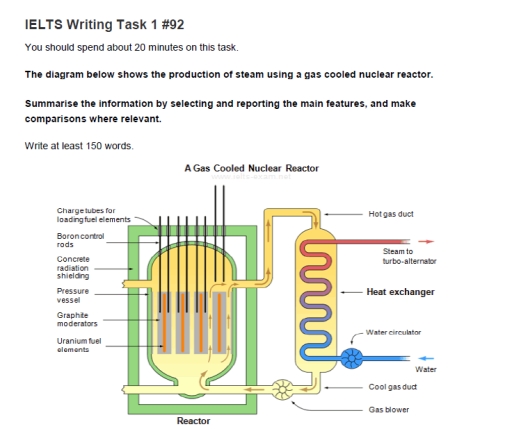
The image illustrates a gas cooled nuclear reactor system comprising a reactor and heat exchanger. The reactor contains graphite moderators encasing uranium fuel elements; boron control rods intersect the center. Surrounding these components are charge tubes for loading fuel elements and concrete radiation shielding. A gas blower moves a gas coolant from the cool gas duct through the reactor, where it is heated and exits via the hot gas duct heading to the heat exchanger. Within the heat exchanger, the hot gas transfers thermal energy to water, generating steam directed to a turbo-alternator. The now cool gas cycles back through the gas blower, thus completing the coolant loop. Water circulated by a water circulator enters the lower section of the heat exchanger to absorb heat, exits as steam, and circulates back once it loses heat and condenses.
Given the complexity of the image, the above description may not be entirely accurate.
Skyrocket your IELTS band score by 1-2 points in under a month with our premium plan!
Note: Both the topic and the answer were created by one of our users.
The diagram explains the way in which steam is produced using a gas cooled nuclear reactor. Overall, it can be seen that this is a continuous and relatively sophisticated procedure which prevents the reactor from overheating.
A gas cooled nuclear reactor consists of the reactor itself and a heat exchanger. The reactor contains uranium fuel elements which is surrounded by graphite moderators and topped by boron control rods and charge tubes for loading fuel elements. The reactor is covered by a pressure vessel which is contained in concrete radiation shielding.
The process commences when hot gas passes through a duct into a heat exchanger, which is outside the concrete radiation shielding. Then, it sinks to the bottom of the heat exchanger and gets cooled. Following this, a blower pushes cool gas into the reactor. Simultaneously, a pipe brings in water which flows through a circulator, and then it is heated to steam in order to be delivered to a turbo-alternator.
Word Count: 160
