Our system will evaluate the answer based on this AI-generated description.
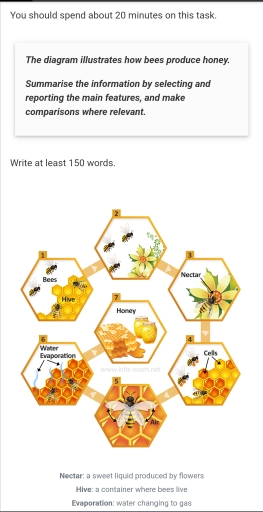
The image shows a process diagram with six steps demonstrating how bees produce honey. The first step shows bees flying around flowers. The second step involves the bees collecting nectar from the flowers. In the third step, the bees store the nectar in a hive. The fourth step shows the bees producing honey within the hive. The fifth step illustrates water evaporation from the honey. The final step shows the honey being stored in cells within the hive. No numerical data points, percentages, or specific years are provided in the diagram. Each step is visually represented with an illustration and labeled with a brief description: "Bees," "Nectar," "Hive," "Honey," "Water Evaporation," and "Cells." The bottom of the image includes a brief definition of three terms: "Nectar: a sweet liquid produced by flowers," "Hive: a container where bees live," and "Evaporation: water changing to gas."
Given the complexity of the image, the above description may not be entirely accurate.
Skyrocket your IELTS band score by 1-2 points in under a month with our premium plan!
Note: Both the topic and the answer were created by one of our users.
The diagram illustrates the process by which bees produce honey in their hives. It consists of seven distinct stages, beginning with bees collecting nectar from flowers and ending with the production of honey.
At the start of the process, bees leave the hive to gather nectar from flowers. Once collected, the nectar is stored inside small hexagonal cells within the hive. In the next stage, the bees use their wings to create airflow, which helps speed up water evaporation. As the moisture content decreases, the nectar thickens and eventually turns into honey.
In the final stage, the honey is fully formed and can be collected for consumption. This natural process ensures a continuous supply of honey in the hive.
Word Count: 119
