Our system will evaluate the answer based on this AI-generated description.
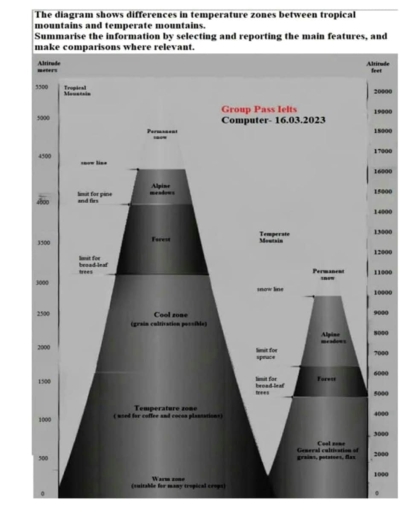
The image displays two cone-shaped diagrams depicting temperature zones correlated with altitude for tropical and temperate mountains, with labels in meters and feet. For tropical mountains, the altitude starts at 0 meters (0 feet) in the warm zone (suitable for many tropical crops) and moves up, covering the temperature zone (1,500 meters or 5,000 feet; used for coffee and coca plantations), the cool zone (1,500 to 3,100 meters or 5,000 to 10,000 feet; grains cultivation possible), forest (3,100 to 4,000 meters or 10,000 to 13,000 feet), suitable for spruce and fir (3,500 to 4,000 meters or 11,500 to 13,000 feet), and alpine meadows (4,000 to 4,800 meters or 13,000 to 16,000 feet), followed by snow line above 4,800 meters or 16,000 feet indicating permanent snow. For temperate mountains, the diagram begins at sea level (0 meters or 0 feet) with a warm zone extending to 500 meters or 1,600 feet, followed by a temperature zone (500 to 1,000 meters or 1,600 to 3,300 feet), forest extends from 1,000 to 2,000 meters or 3,300 to 6,600 feet, areas suitable for spruce and fir (2,500 to 3,500 meters or 8,300 to 11,500 feet), alpine meadows reach up to 3,500 meters or 11,500 feet, and permanent snow appears above 3,500 meters or 11,500 feet.
Given the complexity of the image, the above description may not be entirely accurate.
Skyrocket your IELTS band score by 1-2 points in under a month with our premium plan!
Note: Both the topic and the answer were created by one of our users.
The illustration depicts the structural differences between the typical tropical mountains and the temperate ones.
Overall, mountains in temperate areas usually meet their permanent snow at a much lower height compared to tropical ones. It is also clear that tropical mountains are generally more suitable for agriculture.
Compared to tropical mountains, temperate ones are more likely to have their peak covered by snow permanently. Due to warmer climates, tropical mountains have their permanently snow-covered zone by the height of 16000 feet, which is 60% higher than that of the temperate, at only 10000 feet. Additionally, both types have about 5000 feet below the snow line which is suitable for alpine and forest. The difference is that while the ratio of alpine meadows and forests is one-fourth in tropical mountains, that of the temperate is contrastingly four-to-one.
Mountains in tropical regions are generally more suitable for agriculture, as reflected in their ability to grow a wider variety of crops and the larger area of arable land. While temperate mountains have only about 5000 feet from their base for crops, that of the tropical is more than two times higher, stopping at 11000 feet. Moreover, while the temperate climate allows only grain cultivation, which is planted in cool zones, warmer conditions of tropical regions allow a more diverse plantation, including coffee, cocoa, and a variety of tropical crops in the mountain bases, which are called temperature and warm zones.
Word Count: 237
