Our system will evaluate the answer based on this AI-generated description.
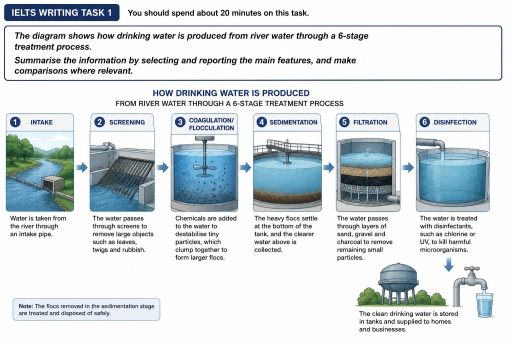
The image details a 6-stage treatment process for producing drinking water from river water. Stage 1, INTAKE, involves taking water from a river through an intake pipe. Stage 2, SCREENING, passes the water through screens to remove large objects such as leaves, twigs, and rubbish. In Stage 3, COAGULATION/FLOCCULATION, chemicals are added to the water to destabilise tiny particles, which clump together to form larger flocs. Stage 4, SEDIMENTATION, is where heavy flocs settle at the bottom of a tank, and the clearer water above is collected; a note states that removed flocs are treated and disposed of safely. Stage 5, FILTRATION, passes the water through layers of sand, gravel, and charcoal to remove remaining small particles. Stage 6, DISINFECTION, treats the water with disinfectants like chlorine or UV to kill harmful microorganisms. Finally, the clean drinking water is stored in tanks and supplied to homes and businesses.
Given the complexity of the image, the above description may not be entirely accurate.
Skyrocket your IELTS band score by 1-2 points in under a month with our premium plan!
Note: Both the topic and the answer were created by one of our users.
The flow chart illustrates how drinking water is produced from river water. Overall, the process consist of 6 main treatment stages, beginning with intaking, culminating in killing harful microorganisms.
The process begins with taking water from the river through imtake pipes. At the second stage, the water is passed through screens in order to remove large objects such as leaves, twigs, or rubbish. In the third phas, the water is subject to adding og chemical to destabilise tiny particles, which climb together to form larger flocs. As a result, a sedimentation accurs, when the heavy flocs settle at the bottom of the tank, and the ceaner water is collected above.
The next phase of the production takes place in a designed facility. There, there are three layers of sand, gravel and activated charcoal which the wtaer passes through to remove small particles. In the final step, disinfection takes place with help of chlorine and UV light which effectively kills all microorganisms in the water. After that, water is stored in takes, and supplied to homes or different buildings.
Word Count: 178
