Our system will evaluate the answer based on this AI-generated description.
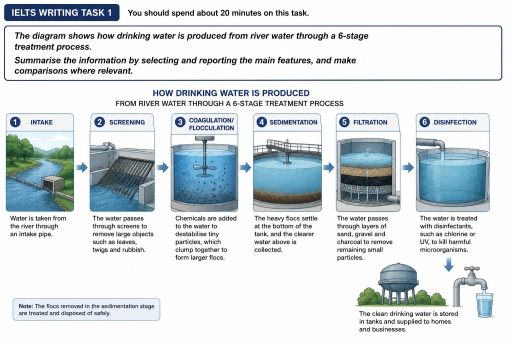
The image details a 6-stage treatment process for producing drinking water from river water. Stage 1, INTAKE, involves taking water from a river through an intake pipe. Stage 2, SCREENING, passes the water through screens to remove large objects such as leaves, twigs, and rubbish. In Stage 3, COAGULATION/FLOCCULATION, chemicals are added to the water to destabilise tiny particles, which clump together to form larger flocs. Stage 4, SEDIMENTATION, is where heavy flocs settle at the bottom of a tank, and the clearer water above is collected; a note states that removed flocs are treated and disposed of safely. Stage 5, FILTRATION, passes the water through layers of sand, gravel, and charcoal to remove remaining small particles. Stage 6, DISINFECTION, treats the water with disinfectants like chlorine or UV to kill harmful microorganisms. Finally, the clean drinking water is stored in tanks and supplied to homes and businesses.
Given the complexity of the image, the above description may not be entirely accurate.
Skyrocket your IELTS band score by 1-2 points in under a month with our premium plan!
Note: Both the topic and the answer were created by one of our users.
The diagram illustrates the process by which river water is transformed into safe drinking water through six sequential stages.
Overall, the process involves progressively removing contaminants from the raw water through a combination of physical and chemical treatments before it is delivered to consumers.
Initially, water is drawn from the river through an intake pipe. It then passes through a screening stage where large debris such as leaves and stones are filtred out. Subsequently, chemicals are added during the coagulation and flocculation phase, causing small particles to clump together into larger masses called floc.
The floc then settles to the bottom of sedimentation tanks, separating the solid waste from the clearer water above. Next, the water is passed through the layers of sand , coal , stones and gravel filters to remove any remaining fine particles. Finally, chlorine or ultraviolet light is applied for disinfection before the treated water is distributed to household.
Word Count: 153
