Our system will evaluate the answer based on this AI-generated description.
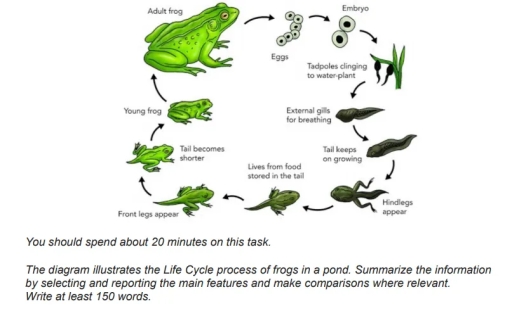
The image displays the life cycle of a frog in a sequential format, starting from eggs to an adult frog. The stages depicted include: eggs, which develop into embryos that cling to water plants; tadpoles with external gills for breathing as they grow; tadpoles whose tails begin to shrink, illustrating the absorption of the tail as they progress; tadpoles living off of the food stored in their tail for energy; appearance of hind legs; emergence of front legs while the tail continues to shorten; and finally, transformation into a young frog and then an adult frog. There are no numerical data points, percentages, or specific measurements provided in the diagram. The focus of each stage emphasizes growth and anatomical changes such as the transition from aquatic gills to air-breathing lungs, the gradual disappearance of the tail, and the development of limbs which denote the frog's transition from an aquatic to a terrestrial life.
Given the complexity of the image, the above description may not be entirely accurate.
Skyrocket your IELTS band score by 1-2 points in under a month with our premium plan!
Note: Both the topic and the answer were created by one of our users.
The diagram illustrates the different stages in the natural life cycle of a frog.
Overall, there are ten distinct stages in the development of a frog, starting with the mating of male and female frogs and culminating in the transformation from a young frog to a fully adult one.
The process commences when an adult female frog lays its eggs in the pond where they go through all further growth steps. After that, the embryos slowly develop inside the eggs until new tadpoles come to life. In early life, they cling to the leaves of aquatic plants. As tadpoles develop, external gills are formed to breathe more easily underwater, and their tails keep on lengthening to help them swim smoothly. In the subsequent stage, hindlegs start appearing but the baby frog now depends on the nutrients stored in their tails to survive. Thanks to the front legs continuously developing, the tail shrinks gradually until they vanish completely. Once the tail is lost, the frogs can stand on all four legs. The process culminates when they become fully grown, ready to give birth to a new generation.
Word Count: 186
