Our system will evaluate the answer based on this AI-generated description.
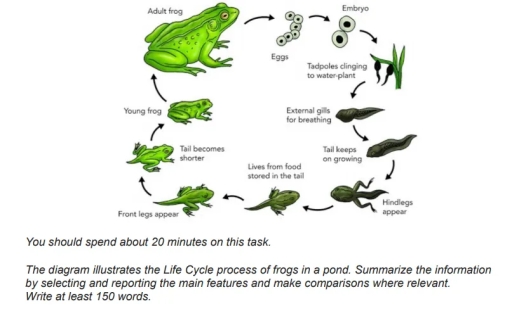
The image displays the life cycle of a frog in a sequential format, starting from eggs to an adult frog. The stages depicted include: eggs, which develop into embryos that cling to water plants; tadpoles with external gills for breathing as they grow; tadpoles whose tails begin to shrink, illustrating the absorption of the tail as they progress; tadpoles living off of the food stored in their tail for energy; appearance of hind legs; emergence of front legs while the tail continues to shorten; and finally, transformation into a young frog and then an adult frog. There are no numerical data points, percentages, or specific measurements provided in the diagram. The focus of each stage emphasizes growth and anatomical changes such as the transition from aquatic gills to air-breathing lungs, the gradual disappearance of the tail, and the development of limbs which denote the frog's transition from an aquatic to a terrestrial life.
Given the complexity of the image, the above description may not be entirely accurate.
Skyrocket your IELTS band score by 1-2 points in under a month with our premium plan!
Note: Both the topic and the answer were created by one of our users.
The diagram illustrates the stages in the development of the frog, the life cycle begins with eggs and ends with maturity. Overall, it is clear that there are eleven steps in the life cycle of the frog
At the first stage of the life cycle, the adult frogs are looking for mates to lay their eggs, and then the egg gradually develops into an embryo. At this point, they are jet black with long tails, grow bigger and their limbs begin to form.
In the following stage, the small tadpoles grow remarkably with the appearance of two legs and an extended tail, and now they live from food stored in the tail. Then, they continue to develop into young frogs with additional legs, but the tail is shorter. Finally ,the young tadpole flourishes in size and becomes an adult, and they reproduce and lay their eggs, and the life cycle begins anew
Word Count: 152
