Our system will evaluate the answer based on this AI-generated description.
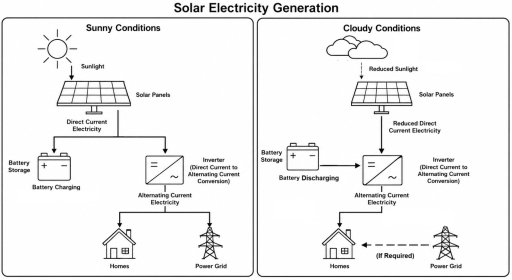
The image displays two side-by-side diagrams titled "Solar Electricity Generation", illustrating system operation under "Sunny Conditions" and "Cloudy Conditions". In the left panel, "Sunny Conditions", a sun icon directs "Sunlight" to "Solar Panels", which supply "Direct Current Electricity" that splits into two paths: one to "Battery Storage" labeled "Battery Charging", and one to an "Inverter (Direct Current to Alternating Current Conversion)". The inverter outputs "Alternating Current Electricity", which divides to supply "Homes" and the "Power Grid". In the right panel, "Cloudy Conditions", clouds direct "Reduced Sunlight" to "Solar Panels", sending "Reduced Direct Current Electricity" to the "Inverter (Direct Current to Alternating Current Conversion)". Concurrently, "Battery Storage" supplies energy via "Battery Discharging" to the inverter. The inverter delivers "Alternating Current Electricity" to "Homes", while a dashed arrow shows potential input from the "Power Grid" to "Homes" marked "(If Required)".
Given the complexity of the image, the above description may not be entirely accurate.
Skyrocket your IELTS band score by 1-2 points in under a month with our premium plan!
Note: Both the topic and the answer were created by one of our users.
The provided diagrams illustrate how solar pannels generate electricity under two distinct weather conditions: sunny and cloudy.
Overall, the process of solar electricity generation varies significantly depending on the weather. While sunny conditions allow for countinuous direct current generatio to power homes, charge batteries, and supply surplus energy to the power grid, cloudy condtions reduce solar efficency, requiring supplementary power from both a discharging battery and the external power grid.
Under sunny conditions, direct sunlight strikes the solar panels producing a stable and high volume of direct current. This current flows into an inverter, which converts the DC into and alternating current AC suitable for household use. During peak generation, electricity is simulteneously directed to power homes and feed excess energy into the power grid. Additonally, surplus DC electricity is routed to a battery storage system for later use, resulting in active battery charging.
In contrast, under cloudy conditions, reduced sunlight striking the solar panels yields a much lower volume of reduced direct current. Because the solar output is insufficient on its own, the system’s operational dynamics shift.
Word Count: 178
