Our system will evaluate the answer based on this AI-generated description.
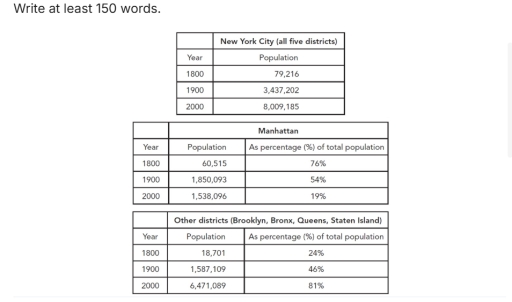
The image consists of three tables detailing population statistics for New York City and its districts across three selective years: 1800, 1900, and 2000. The first table displays New York City's total population, with figures: 79,216 in 1800, 3,437,202 in 1900, and 8,009,185 in 2000. The second table outlines Manhattan's population and its percentage relative to New York City's total population. Manhattan's population was 60,515 in 1800, accounting for 76% of New York City's population; in 1900 it recorded 1,850,093, comprising 54% of the total population; and in 2000 the population was 1,538,096, representing 19% of the total city population. The third table covers populations for other districts, namely Brooklyn, Bronx, Queens, and Staten Island, with respective populations: 18,701 in 1800 (24%), 1,587,109 in 1900 (46%), and 6,471,089 in 2000 (81%).
Given the complexity of the image, the above description may not be entirely accurate.
Skyrocket your IELTS band score by 1-2 points in under a month with our premium plan!
Note: Both the topic and the answer were created by one of our users.
The first table chart demonstrates the population of New York City (all five districts) between 1800 and 2000.Likewise,the other tables illusrate the population of Manhattan and other districts such as:Brooklyn,Bronx,Queens,Staten Island,but with percentage.
Overall,the number of citizen in New York City increased,as the percentage of total population of other districts,not including Manhattan.Compare to other dictricts the persentage of population in Manhattan was 76%,while they had only 24% of total population in New York City in 1800.However by the time passed,other districts had 81% of total population in New York City in 2000 that is 6,471,089,when Manhattan was only a 19% of total inhabitants that is 1,538,096.
To sum,it means that in 2000s the percentage of total population in New York City from other districts had grown,otherwise the percentage of Manhattan decreased from 76% to 19%.It also means that the percentage of migration to other districts had rosen.
Word Count: 147
