Our system will evaluate the answer based on this AI-generated description.
The image displays a bar graph showing the percentage contribution of three sectors (Agriculture, Manufacturing, and Business and Financial) to the UK economy in the 20th century, with data points at 1900, 1950, 1975, and 2000. Agriculture is represented in blue, Manufacturing in green, and Business and Financial in purple. In 1900, Agriculture contributed approximately 10%, Manufacturing 55%, and Business and Financial 5%. In 1950, Agriculture decreased to just below 5%, Manufacturing also decreased to around 45%, and Business and Financial increased to approximately 32%. In 1975, all three sectors show a substantial decline, with Agriculture around 3%, Manufacturing just below 30%, and Business and Financial around 27%. In 2000, Agriculture is minimal at around 1%, Manufacturing further decreased to approximately 22%, and Business and Financial rose significantly to around 38%.
Given the complexity of the image, the above description may not be entirely accurate.
Skyrocket your IELTS band score by 1-2 points in under a month with our premium plan!
Note: Both the topic and the answer were created by one of our users.
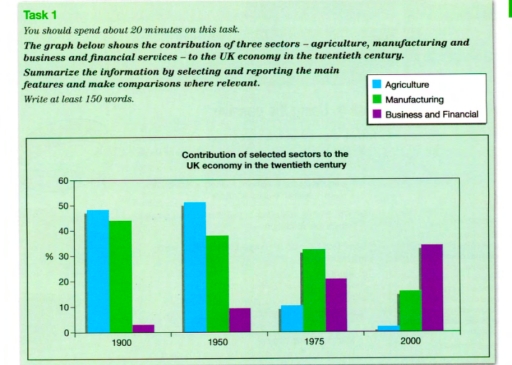
The graph illustrates the proportion of three sectors – agriculture, manufacturing and business and financial servies – to the UK economy from 1900 to 2000.
At first glance, it is apparent that the agriculture and manufacturing made up the majority in the first half of twentieth century, but then saw a steady decrease during the entire period, while the business and financial showed a noticeable increase.
Looking at the chart in more detail, one can see that the data for agriculture started at approximately 47% then climbed to around 51% gradually. However, after 1950 it descent dramatically from 51% to around 10% and finally it stopped at only 2% in 2000. We can see the difference in the figure for business and financial when it began at 4% approximately then burgeoned to 10%. Futhermore, after 1950 it proliferated from that to 20% rapidly and finally it stopped at 30% with a steady increase.
The opposite trend was true for the data for manufacturing when it started at roughly 45% and then decreased to 40% gradually in the first hallf of twentieth century. Moreover, after 1950 it experienced a moderate decline from around 40% to 35% in 1975 and finally it ended at 25% in 2000.
Word Count: 205
