Our system will evaluate the answer based on this AI-generated description.
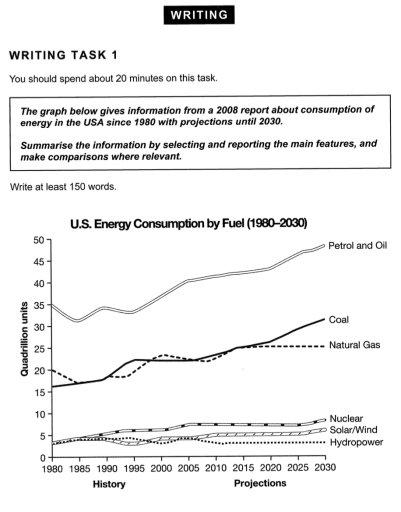
The image portrays a line graph detailing U.S. Energy Consumption by Fuel from 1980 to 2030, including both historical data and future projections. Data lines represent consumption values of Petrol and Oil, Coal, Natural Gas, and a combined category for Nuclear, Solar/Wind, and Hydropower. From 1980 to the early 2000s, Petrol and Oil demonstrate a steady increase, starting close to 35 quadrillion units and rising to just over 40. Coal consumption also increases during this period, beginning near 15 and peaking around 25 before a gradual decline. Natural Gas shows a more variable trend, initially at 15, rising to nearly 25, dipping and then recovering to just under 25 by 2005. The combined category remains consistently below 10 quadrillion units. Projection lines suggest Petrol and Oil will plateau around 45, Coal will decline to below 20, Natural Gas will surpass Coal, reaching close to 30, and the combined category will see a slight increase, remaining under 15 quadrillion units.
Given the complexity of the image, the above description may not be entirely accurate.
Skyrocket your IELTS band score by 1-2 points in under a month with our premium plan!
Note: Both the topic and the answer were created by one of our users.
The given line graph depicts data from a 2008 survey about expenditures in the USA since 1980 and provides projections until 2030.
From an overall perspective, petrol and oil had the highest usage in the USA, while hydropower had the least from 1980 to 2030 in the USA.
In 1980, petrol and oil were at 35 units, while in 2030, they are projected to rise dramatically to 45 units. Coal and natural gas were at 20 units and 16 units, respectively, in 1980. Although the usage of natural gas fluctuated, it remained the same from 2015 to 2030, and in 2030, the consumption of natural gas will be about 20 units. On the other hand, the expenditure on coal increased significantly, and it will increase to just over 25 units.
In 1980, the expenditure on hydropower was approximately 0.6 units; it will decline by nearly 0.5 units. Solar, wind, and new nuclear were about 0.4 units and 0.5 units, respectively, in 1980. However, in 2030, they will climb to just under five units and just over five units, respectively.
Word Count: 179
