Our system will evaluate the answer based on this AI-generated description.
The image shows top priorities by company size: For 0 to 25 employees, 71% converting contacts/leads to customers, 43% increasing number of contacts/leads, 33% increasing revenue derived from existing customers, 20% providing ROI of marketing activities, 20% reducing cost of contact/lead/customer acquisition; for 26 to 200 employees, 79% converting contacts/leads to customers, 73% increasing number of contacts/leads, 47% increasing revenue derived from existing customers, 47% providing ROI of marketing activities, 26% reducing cost of contact/lead/customer acquisition; for 201 or more employees, 66% converting contacts/leads to customers, 62% increasing number of contacts/leads, 55% increasing revenue derived from existing customers, 58% providing ROI of marketing activities, 30% reducing cost of contact/lead/customer acquisition.
Given the complexity of the image, the above description may not be entirely accurate.
Skyrocket your IELTS band score by 1-2 points in under a month with our premium plan!
Note: Both the topic and the answer were created by one of our users.
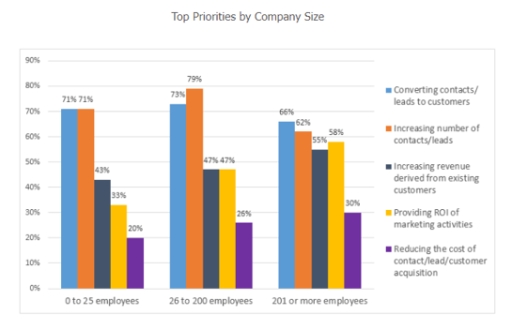
The bar chart illustrates the most significant categories for firms in the USA in the year 2016. Overall it can be seen that increasing contacts and converting those into customers have the largest share of priority, followed by the financial aspects. The lowest attention gets the cost reduction of new customer acquisition. This is the case for all three company sizes, but with more workforce, the shares get more balanced.
Firstly, the aspect of growth of the customer base, splittet in converting contacts to customers and increasing the number of contacts have the same level of priority in small firms with 0 to 25 employees at 71%. These two sections increases to 73% and 79% for medium organizations with 26 to 200 employees. The largest conglomerates with 201 or more people working for them reduces the importance to 66% and 62%.
The other three sections all increases over the size, with revenue of existing customers increaing from 43% to 47% to end at 55%. The same positive trend is seen at the aspects of ROI of marketing activities and reducing the cost of customer acquisition
Word Count: 185
