Our system will evaluate the answer based on this AI-generated description.
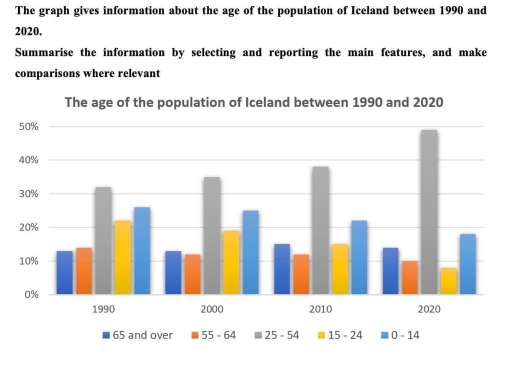
The image shows a bar chart of the age of the population of Iceland from 1990 to 2020 in five categories, with the y-axis representing percentage from 0% to 50% in 10% increments and the x-axis denoting the years 1990, 2000, 2010, and 2020. In 1990, the 65 and over category is slightly above 10%, 55-64 is just under 10%, 25-54 is about 35%, 15-24 is just above 20%, and 0-14 is close to 30%. In 2000, 65 and over rose to just under 15%, 55-64 increased to nearly 15%, 25-54 declined to around 30%, 15-24 dipped to around 15%, and 0-14 went down to nearly 25%. In 2010, 65 and over approached 20%, 55-64 jumped to about 20%, 25-54 saw a slight increase above 30%, 15-24 decreased to nearly 10%, and 0-14 dropped to just above 20%. In 2020, 65 and over continues to rise to almost 25%, 55-64 stabilizes near 20%, 25-54 decreases to below 30%, 15-24 remains around 10%, and 0-14 continues its downward trend to just below 20%.
Given the complexity of the image, the above description may not be entirely accurate.
Skyrocket your IELTS band score by 1-2 points in under a month with our premium plan!
Note: Both the topic and the answer were created by one of our users.
The bar chart compares the ages of people living in Iceland from 1990 to 2020.
Overall, it can be seen that the majority of the population of Iceland consisted 25-54 age people. Additionally, 0-14 age people were the second major group during the period.
According to the bar graph, in 1990, 25-54 age group was the major part of population, it was 32% of the population. The following 5 years, the proportional of this group grew gradually and reached a peak in 2020, it was almost half of the population of Iceland. In contrast, although 15-24 age people stood at 22%, it decreased significantly and dropped less than 10%, which was the lowest point, at the end of the period. Similarly, while 0-14 group was 26% of the population in 1990, it plunged 18% in 2020. Additionally, 65 or over age people remained almost constant and changed between 10% and 15% given the period. Likewise, 55-64 group experienced same trend with 65 and over age people and it was 10% at the end of the period.
Word Count: 176
