Our system will evaluate the answer based on this AI-generated description.
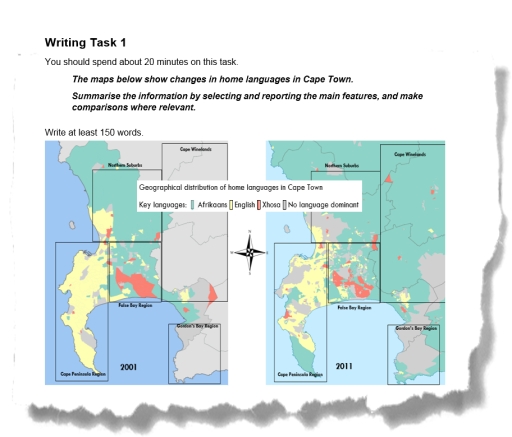
The image presents two maps detailing home language distributions in Cape Town for 2001 and 2011, divided into four language categories: Afrikaans, English, Xhosa, and regions with no dominant language. In 2001, Afrikaans predominates in the Cape Flats Region, with scattered presence elsewhere. English is primarily seen in the northwestern area and around the City Bowl, with limited spots in the northeastern fringes. Xhosa is strongly centered in the southeastern suburbs and isolated pockets in the city periphery. Regions with no dominant language are sparse, mostly occurring adjacent to Xhosa and English regions. By 2011, Afrikaans remains widespread in similar areas but with increased presence in the southwest. English regions expand slightly towards the east of the original spots and northwest edges, while Xhosa areas are condensed but retain concentration in southeastern Cape Town and increase in central areas. Regions with no language dominance marginally expand, appearing more prominently in central and southern locations.
Given the complexity of the image, the above description may not be entirely accurate.
Skyrocket your IELTS band score by 1-2 points in under a month with our premium plan!
Note: Both the topic and the answer were created by one of our users.
The diagrams illustrate changes in native languages in Cape Town over the course of 10 years.
Overall, over time, people in Cape Town started speaking more Afrikaans. This resulted in a dramatic rise in the Afrikaans language, while the frequency of people speaking English dropped significantly. Similarly, Xhosa was spoken less in 2011 compared to 2001.
Looking at each region, it is evident that the most substantial change was seen in Cape Winelands, where there was no majority language spoken in 2001. However, by 2011, Afrikaans became the dominant language. In contrast, inhabitants of the Cape Peninsula Region mostly spoke English in 2001, but, over the 10 years, no language was dominant in some parts of the Peninsula, while in other parts, languages such as Xhosa and Afrikaans started spreading. Moving on to the False Bay Region, the area was diverse in terms of language, with English, Xhosa, and Afrikaans all being spoken. Although, throughout the ten years, languages disappeared as no particular language was dominant in many places within the Bay region.
Word Count: 173
