🔥 Today Only: Save 30% on Premium — Offer Ends Soon! - Upgrade Now!
Line Graph

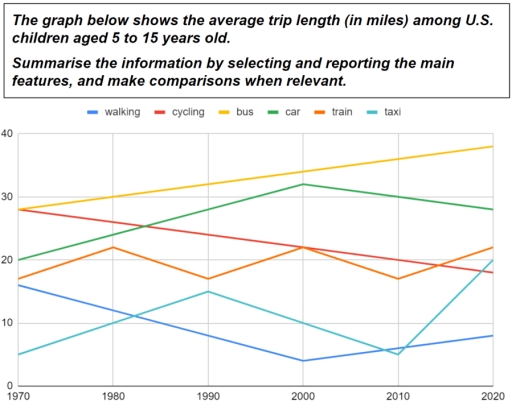
Band 4+: the graph shows the average trip length(in miles) in US children aged 5 to 15 years old.

Image for topic: the graph shows the average trip length(in miles) in US children aged 5 to 15 years old.
Our system will evaluate the answer based on this AI-generated description.
The image displays a line graph illustrating the average trip length in miles for U.S. children aged 5 to 15 over a period from 1970 to 2020, with measurements every decade. Data points for walking start from about 0.5 miles in 1970, peaking near 1 mile in 2010, and slightly decreasing to around 0.8 miles by 2020. Cycling begins at approximately 1.5 miles in 1970, rises to just below 2 miles in 1990, and maintains that length through 2020. The bus line starts around 10 miles in 1970, increases to roughly 15 miles by 1990, peaking at 20 miles in 2000, before it ends near 17 miles in 2020. Car travel starts near 3 miles in 1970, steadily climbs to just above 15 miles in 2000, and maintains this distance through 2020. The train line shows a starting point around 25 miles in 1970, falls to 20 miles in 1980, recovers to about 25 miles in 2000, decreases to slightly below 20 miles in 2010, before reaching almost 30 miles by 2020. Lastly, taxi usage begins around 3 miles in 1970, demonstrating a peak at approximately 10 miles in 2000 before slightly decreasing to 8 miles in 2020.
Given the complexity of the image, the above description may not be entirely accurate.
Note: Both the topic and the answer were created by one of our users.

The provided chart illustrates the average length of trip (in miles) among teenagers in the United States for twenty years old).

Overall, It can be seen that there is a difference between the standard of long travels in the United States in which the bus becomes the highest trend and walking is the lowest one.

It is clear that walking experienced an increasing trend in 1970 at about 16, But in the thirty years later, it decreased significantly at 3 in 2000. Moreover, in the same time, Car became the second highest trend after walking at 20, then inclined rapidly to in 2000. Twenty years later, walking and also car were heterogenous enough particularly in 2020. Car went up at 28 while walking was at 8.

On the contrary, bus and cycling had the same starting point at 28 in 1970. Over fifty years, cycling reduced gradually at 19 and became one of the third-high trends meanwhile bus experienced a significant boom climbing to 30, becoming the highest trend.

Word Count: 169

Answers On The Same Topic:

the graph shows the average trip length(in miles) in US children aged 5 to 15 years old.

The line graph compares the average amount of miles passed by American children aged from 5 to 15 over a trip by 5 different means of transport between 1970 and 2020. Overall, buses maintained their position as the transport used for the longest trips, whereas the length of trips on a bicycle continuously shrank. The […]

the graph shows the average trip length(in miles) in US children aged 5 to 15 years old.

The provided line graph represents the the average distance traveled during several types of trips for kids between 5 and 15, from 1970 till 2020. The x-axis represents period, whereas the y-axis represents miles traveled. Generally speaking, throughout the period thelongest distance was covered by bus trip, while the shortest one by walking adventure. Furthermore, […]

the graph shows the average trip length(in miles) in US children aged 5 to 15 years old.

The line graph demonstrates the average travel length in lilws in US children aged 5 to 15 years old. Overall, bus and car rose over the period while, cycling walking dropped. Taxi and train had fluctuated throughout the time. In 1970 bus and cycling had the same miles at around 30 miles and were the […]

the graph shows the average trip length(in miles) in US children aged 5 to 15 years old.

The data outlines the average trip length among American children of different ages, particularly from 5 to 15 years old. Overall, every kind of trip had declines and increases except journeys by bus and bike. Firstly, travelling by bus dramatically started to increase from more than 30 miles to approximately 47 miles. In addition, this […]

See All

Other Topics:

The line graph gives information about the number of Iranian, Greek and Turkish students who enrolled at Sheffield University between 2005 and 2009. Summarize the information by selecting and reporting the main features, and make comparision where relevant.

The line graph illustrates the number of international students from three countries, Iran, Greece and Turkey, who registered at Sheffield University between 2005 and 2009. Overall, it is clear that the number of Greek students decreased significantly throughout the period, while the figures for Iranian and Turkish students increased substantially. In 2005, Greece had the […]

The line graph gives information about the number of Iranian, Greek and Turkish students who enrolled at Sheffield University between 2005 and 2009. Summarize the information by selecting and reporting the main features, and make comparision where relevant.

The line graph illustrates the number of international students from three countries, Iran, Greece and Turkey, who registered at Sheffield University between 2005 and 2009. Overall, it is clear that the number of Greek students decreased significantly throughout the period, while the figures for Iranian and Turkish students increased substantially. In 2005, Greece had the […]

The graph below shows the percentage of people in a European country, by age group, who believed that wearing traditional attire was an important part of their cultural identity between 1990 and 2020.

The line graph illustrates the percentage of people lived in Europe, by five age groups who had a belief that wearing traditional attire had a significant meaning of their cultural identification between 1990 and 2020. Overall, age grops that are older showed higher percentage but gradually declined decade by decade. As for the younger generation […]

The chart below shows the changes in car ownership in Great Britain between 1961 and 2001.

The line graph illustrates the changes in the proportion of households owning cars in Great Britain over a 40-year period from 1961 to 2001. Overall, it is clear that car ownership in Great Britain increased significantly over the period. The percentage of households without a car experienced a sharp decline, while the figures for families […]

The diagram below gives information about the number of parcels delivered by two major mail services companies from 1920 to 2000. Summarise the information by selecting and reporting the main features, and make comparisons where relevant.

The diagram illustrates data about the number of parcels delivered by two major mail service companies between 1920 and 2000. Overall, while Federal Express (FedEx) underwent a period of volatility, TNT mail services experienced an upward trend throughout the period. In addition, the highest number of parcels delivered by both FedEx and TNT was observed […]

The line graph below gives information on cinema attendance in the UK. Summarize the information by selecting and reporting the main features, and make comparisons where relevant. Write at least 150 words.

The provided line chart illustrates the great Britain reports for percentage of people are attending cinema age-by- age Between 1984 to 2003 . Following all Data are increasingly significant over the time . From 1984 to 1988 age fifteen to twenty – four are 18% grown at that time and after that Between 2000 to […]

See All
We have detected unusual activity on your device.
Please verify your identity to continue.
Note: This verification step won't sign you in. If you have a premium account, please log in to access the service as usual.
Google/Gmail Verification
Or verify using Email/Code
We've sent a verification code to:
youremail@gmail.com (Not your email?)
Enter it below to complete the verification process.
Ensure your email address is correct, your inbox is not full, and you check your spam folder. If no email arrives, consider using an alternative email.
You will need a Premium plan to perform your action!
Note: If you already have a premium account, please log in to access our services as usual.

Plans & Pricing

Our mission is to make quality education accessible for everyone.
However, to keep our hardworking team running and this service alive, we genuinely need your support!
By opting for a premium plan, not only do you sustain us in achieving the mission, but you also unlock advanced features to enrich your learning experience.

Free

For learners who aren't pressed for time

What's included on Free
100+ Cambridge IELTS Tests
Instant IELTS Writing Task 1 & 2 Evaluation (2 times/month)
Instant IELTS Speaking Part 1, 2, & 3 Evaluation (2 times/month)
Instant IELTS Writing Task 1 & 2 Essay Generator (2 times/month)
500+ Dictation & Shadowing Exercises
100+ Pronunciation Exercises
Flashcards
Other Advanced Tools

Premium

For those serious about advancing their English proficiency, and for IELTS candidates aspiring to boost their band score by 1-2 points (especially in writing & speaking) in just 30 days or less

What's included on Premium
Save Your IELTS Test Progress & Analyze Mistakes By Question Type
Save Your Own Flashcard Sets & Use Them On Any Device
Unlock All Courses, IELTS Tests, Section & Part Practice
Unlimited AI Conversations
Unlimited AI Writing Enhancement Exercises
Unlimited IELTS Writing Task 1 & 2 Evaluation
Unlimited IELTS Speaking Part 1, 2, & 3 Evaluation
Checked Answers Will Not Be Published
Unlimited IELTS Writing Task 1 & 2 Essay Generator
Unlimited IELTS Speaking Part 1, 2, & 3 Sample Generator
Unlimited Usage Of Advanced Tools & AI Features
Priority Support within 24h (12-month plan only)

Due to the nature of our service and the provided free trials, payments are non-refundable.