Our system will evaluate the answer based on this AI-generated description.
The image is a line graph representing percentages over time, from 2001 to 2051, of three categories: Education, Medical care, and Pension. In 2001, Education starts at approximately 10%, Medical care at 14%, and Pension at 6%; by 2011, Education decreases to below 6%, Medical care increases to nearly 16%, and Pension to over 8%; in 2021, Education is at 4%, Medical care at 18%, and Pension at 10%; by 2031, Education remains at 4%, Medical care approaches 20%, and Pension increases to 12%; in 2041, Education slightly increases to 6%, Medical care exceeds 20%, and Pension reaches approximately 14%; finally, in 2051, Education continues at 6%, Medical care is above 22%, and Pension is at 16%. The lines for Education and Medical care intersect between 2001 and 2011, while the Pension line gradually increases without intersection.
Given the complexity of the image, the above description may not be entirely accurate.
Skyrocket your IELTS band score by 1-2 points in under a month with our premium plan!
Note: Both the topic and the answer were created by one of our users.
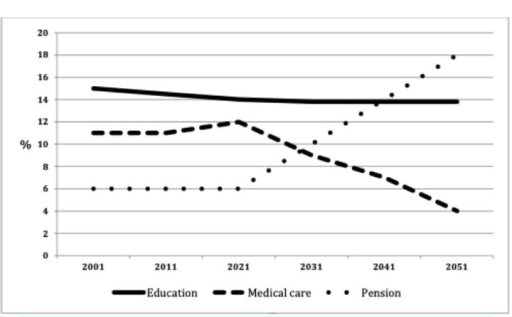
The line graph illustrates the percentage of money spent on three categories in a particular country over a 50-year span, with future predictions up to the year 2051.
Overall, the expenditure for pensions will significantly rise, while the opposite is true for that made on medical care. The expense on education will rather remain the same.
For the first 20 years, only a mere 6% of money was spent on pensions. Since then, there has been a steep increase and it is expected to reach 10% in 2031. The predictions reveal that the upward trend will continue and the figure will reach 18% by 2051. The expense made on education is estimated to slightly decrease by 1% towards the end of the period.
From 2001 to 2011, the expenditure on medical care remained static at roughly 11%. Although for the next ten years it showed a minimal upward trend, estimates show that it will drop dramatically to reach 4% in 2051.
Word Count: 161
