Our system will evaluate the answer based on this AI-generated description.
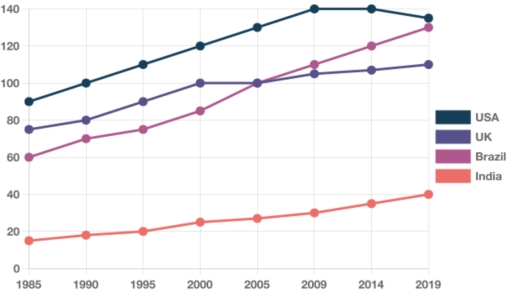
The image shows a line graph with four lines, each representing a different country. The x-axis shows years from 1985 to 2019 at five-year intervals, and the y-axis shows numerical values from 0 to 140 at 20-unit intervals. The line for the USA starts at approximately 40 in 1985 and ends at approximately 120 in 2019, showing a steady increase over time. The UK line starts at approximately 35 in 1985, reaching a value of just over 100 in 2019, also showing a steady increase. Brazil's line begins at approximately 15 in 1985 and ends at roughly 30 in 2019, indicating a slower and less significant growth. India's line starts at approximately 10 in 1985 and ends at just under 40 in 2019, showing a steady but modest increase. The lines do not display any sharp peaks or drops and maintain consistent trajectories throughout the years. The data points on each line are marked by dots.
Given the complexity of the image, the above description may not be entirely accurate.
Skyrocket your IELTS band score by 1-2 points in under a month with our premium plan!
Note: Both the topic and the answer were created by one of our users.
The line graph illustrates the daily consumption of water in four different countries, mainly the USA, India, Germany, and Australia, over a 20-year period.
Overall, it can be seen that water consumption in Australia and Germany fell over the presented period, while people from the USA and India increased their consumption of this resource. In the beginning of the given period, Australia had the highest consumption, but the USA surpassed this trend by 2004.
In 1995, Australia had the highest water consumption, with about 375 litres per person. By 2015, this number dropped to 300 litres per person. In contrast, the USA had seen a steady rise in its numbers from more than 300 litres per person, reaching by 2015 the same number of litres that Australia had in 1995.
In India the amount of water consumed by the public went from 100 litres per person, the lowest value in 1995, rising by nearly 50 litres per person over the following 20 years. Germany, in contrast, had seen a decrease in its number, dropping from almost 250 litres per person in 1995 to 200 litres per person in 2015.
Word Count: 189
