Our system will evaluate the answer based on this AI-generated description.
The image features a line graph and a pie chart. The line graph depicts the number of foreign students in Japan from 1983 to 2003, with three distinct categories. "Students on MEXT scholarships" numbered 2,502 in 1983, 4,221 in 1990, 7,771 in 1995, 8,374 in 2000, 9,100 in 2001, 9,379 in 2002, and 9,612 in 2003. "Privately-financed students" started at 11,173 in 1983, rose to 36,298 in 1990, 45,236 in 1995, 62,325 in 2000, 77,101 in 2001, 88,279 in 2002, and reached 96,135 in 2003. "Students on foreign government study programs" showed 808 in 1983, increased to 1,782 in 1990, reached 2,274 in 1995, 4,350 in 2000, 4,661 in 2001, 5,204 in 2002, and stood at 5,287 in 2003. The pie chart illustrates the geographical distribution of the students: Asia accounts for 91.7%, with China at 63.5%, Korea at 13.9%, "Other" Asian countries at 14.9%. Next are Europe at 3.1%, North America at 1.8%, Latin America at 1.1%, Near and Middle East at 0.7%, Africa at 1.0%, and Oceania at 0.6%.
Given the complexity of the image, the above description may not be entirely accurate.
Skyrocket your IELTS band score by 1-2 points in under a month with our premium plan!
Note: Both the topic and the answer were created by one of our users.
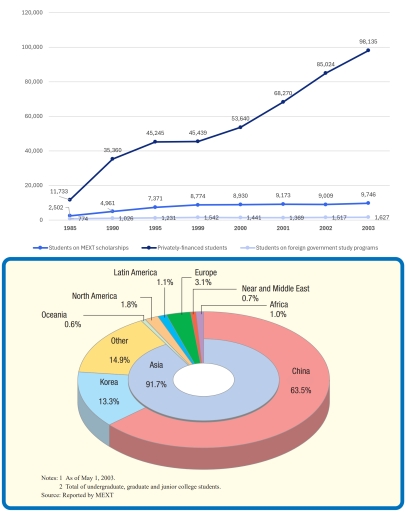
The line chart shows the changes in the number of international students in Japan between 1985 and 2003, while the pie graph provides information on the geographic origin of foreign students in Japan.
Overall, most overseas students in Japan over the given period were self-financed, and foreign students in Japan were mainly from Asian countries by the year of 2003.
During an 18-year period, the number of international students without scholarships in Japan were by far the highest with over 98,000 students by 2003. At the same period, the figure for undergraduates coming to Japan via foreign government study programs only increased slightly from around 770 to 1,627, whereas those with MEXT scholarships gradually climbed from approximately 2,500 to almost 9,750 over 18 years.
Regarding the origin of overseas undergraduates, approximately 92% were from Asia, mainly Korea and China. Students from Europe and the Americas each accounted for about 3%, while those from Africa, Oceania, and the Middle East comprised only 0.6% to 1%.
Word Count: 164
