Our system will evaluate the answer based on this AI-generated description.
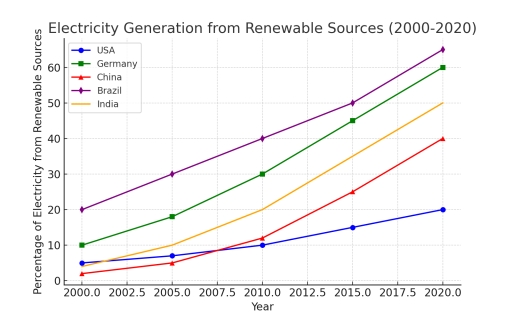
The image depicts a line graph illustrating electricity generation from renewable sources from 2000 to 2020 for USA, Germany, China, Brazil, and India. For USA, percentages are 6% (2000), approximately 6.2% (2002.5), 6.4% (2005), approximately 7% (2007.5), 7.5% (2010), 8% (2012.5), approximately 8.5% (2015), 9% (2017.5), and 9% (2020); for Germany, percentages are 5% (2000), approximately 6.5% (2002.5), 9% (2005), 11% (2007.5), 16% (2010), 21% (2012.5), 30% (2015), 33% (2017.5), and 39% (2020); for China, percentages are approximately 15% (2000), 16.5% (2002.5), 17% (2005), 18% (2007.5), 19% (2010), 20% (2012.5), 23% (2015), approximately 25.5% (2017.5), and 27% (2020); for Brazil, percentages are 80% (2000), approximately 80% (2002.5), 80% (2005), 81% (2007.5), 82% (2010), 83% (2012.5), 81% (2015), approximately 81% (2017.5), and 82% (2020); for India, percentages are 9% (2000), approximately 9.3% (2002.5), 10% (2005), 11% (2007.5), 13% (2010), approximately 14.5% (2012.5), approximately 16.5% (2015), 18% (2017.5), and 22% (2020).
Given the complexity of the image, the above description may not be entirely accurate.
Skyrocket your IELTS band score by 1-2 points in under a month with our premium plan!
Note: Both the topic and the answer were created by one of our users.
The provided line graph delineates the proportion of electricity produced from renewable resources in five specific nations over a six-year period, commencing in 2020.
Overall, a unidirectional upward trend was observed across all surveyed countries, reflecting a global shift toward sustainable energy. Germany consistently emerged as the frontrunner, while Brazil, despite starting at a lower baseline, exhibited the most pronounced acceleration in its green energy transition by the end of the period.
Regarding the leading nations, Germany began the decade with approximately 40% of its power sourced from renewables, a figure that gradually climbed to reach a peak of 55% in 2025. China followed a similar trajectory, though it started at a lower 30%. However, China’s growth was more exponential, eventually surpassing 45% by the final year, narrowing the gap with Germany.
In contrast, the United States and India showed more modest gains. Both nations hovered around the 20% mark in 2020. While the US saw a marginal increase to 28% by 2025, India’s growth was more sporadic, ending the period just shy of 25%. Brazil, meanwhile, witnessed a significant surge starting in 2023, jumping from 15% to 35% in just two years, thereby overtaking both the US and India in its renewable output.
Word Count: 204
