Our system will evaluate the answer based on this AI-generated description.
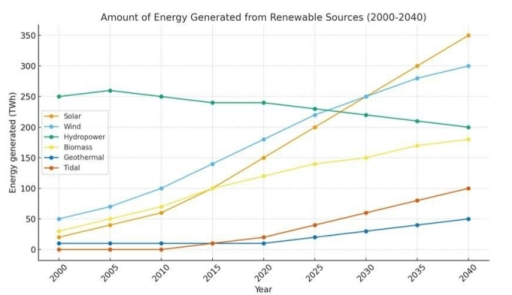
The image shows a line graph titled 'Amount of Energy Generated from Renewable Sources (2000-2040)', with the y-axis labeled 'Energy generated (TWh)' ranging from 0 to 350, and the x-axis labeled 'Year' from 2000 to 2040. Data points in TWh are approximately as follows: Solar - 2000: 20, 2005: 40, 2010: 65, 2015: 100, 2020: 155, 2025: 225, 2030: 270, 2035: 310, 2040: 350; Wind - 2000: 50, 2005: 70, 2010: 100, 2015: 140, 2020: 180, 2025: 230, 2030: 255, 2035: 280, 2040: 300; Hydropower - 2000: 250, 2005: 260, 2010: 250, 2015: 240, 2020: 240, 2025: 230, 2030: 220, 2035: 210, 2040: 200; Biomass - 2000: 30, 2005: 50, 2010: 70, 2015: 100, 2020: 120, 2025: 140, 2030: 155, 2035: 170, 2040: 180; Geothermal - 2000: 10, 2005: 10, 2010: 10, 2015: 15, 2020: 20, 2025: 25, 2030: 30, 2035: 40, 2040: 50; Tidal - 2000: 0, 2005: 0, 2010: 0, 2015: 10, 2020: 20, 2025: 40, 2030: 60, 2035: 80, 2040: 100.
Given the complexity of the image, the above description may not be entirely accurate.
Skyrocket your IELTS band score by 1-2 points in under a month with our premium plan!
Note: Both the topic and the answer were created by one of our users.
The line graph shows information about energy generated from different renewable sources between 2000 and 2040, measured in terawatt-hours (TWh).
Looking from an overall perspective, it is clear that solar, wind, biomass, and tidal energy increased significantly over the period, while hydropower declined gradually. In addition, solar recorded the fastest and most dramatic growth among all sources.
In detail, solar, wind, biomass, and tidal energy all showed a strong upward trend. Solar rose from 20 TWh in 2000 to 350 TWh in 2040, while wind increased from 50 TWh to 300 TWh over the same period. Similarly, biomass climbed steadily from 30 TWh to 180 TWh. Tidal energy, which started at zero, rose sharply after 2015 and reached 100 TWh by 2040.
On the other hand, hydropower showed a different pattern. It decreased gradually from 250 TWh in 2000 to 200 TWh in 2040. Meanwhile, geothermal energy remained relatively low throughout the period, staying at 10 TWh until 2010 before increasing slowly to 50 TWh by 2040.
Word Count: 167
