Our system will evaluate the answer based on this AI-generated description.
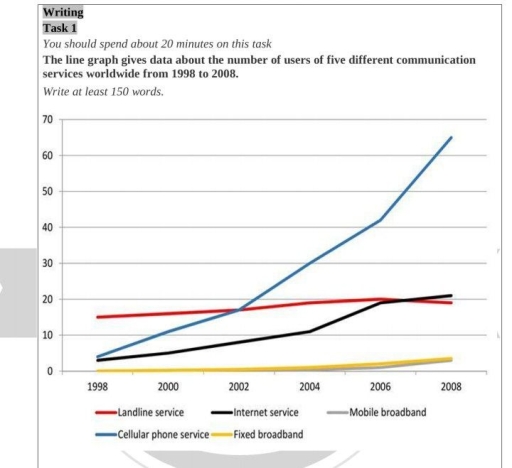
The image is a line graph depicting the number of users for five different communication services worldwide from 1998 to 2008. In 1998, landline service users were around 20 per 100 inhabitants, internet service and cellular phone service users were below 10 per 100 inhabitants, with fixed broadband and mobile broadband users being negligible or around 0 per 100 inhabitants. By 2008, mobile broadband users skyrocketed to above 60 per 100 inhabitants, with cellular phone service users also showing significant growth to around 40 per 100 inhabitants. Fixed broadband users demonstrated a steady increase over the years, reaching just above 20 per 100 inhabitants. Internet service users grew moderately to around 25 per 100 inhabitants. Landline service users showed the least growth, reaching just below 25 per 100 inhabitants. All services, except landline, show an upward trend, with mobile broadband showing the most significant exponential growth.
Given the complexity of the image, the above description may not be entirely accurate.
Skyrocket your IELTS band score by 1-2 points in under a month with our premium plan!
Note: Both the topic and the answer were created by one of our users.
The provided line graph illustrates the percentage of five different networking services used globally commencing from 1998 to 2008.
Overall, cellular phone service saw the most dramatic rise in users, while fixed and mobile broadband remained relatively unchanged during the surveyed timeframe. At the same time, communication through the internet and landline experienced considerable growth.
In 1998, landline and cellular phone services had the highest user percentages, with landline service starting at around 15% and cellular phone service at 10% lower. However, while landline service showed only a modest increase over time, only rising by 10%, cellular phone service grew rapidly, outshining all other services and reaching nearly 70% by 2008. The same upward trend can be seen with internet service whose data also started at around 5% in 1998 and barely exceeded that of landline service by a narrow margin in 2008.
Meanwhile, mobile and fixed broadband attracted close to no users at the beginning of the period as their data was roughly 0% at the time. Their figures began rising slightly in 2004 and reached a mere 4% in 2008.
Word Count: 182
