Our system will evaluate the answer based on this AI-generated description.
The image is a line graph depicting the number of users for five different communication services worldwide from 1998 to 2008. In 1998, landline service users were around 20 per 100 inhabitants, internet service and cellular phone service users were below 10 per 100 inhabitants, with fixed broadband and mobile broadband users being negligible or around 0 per 100 inhabitants. By 2008, mobile broadband users skyrocketed to above 60 per 100 inhabitants, with cellular phone service users also showing significant growth to around 40 per 100 inhabitants. Fixed broadband users demonstrated a steady increase over the years, reaching just above 20 per 100 inhabitants. Internet service users grew moderately to around 25 per 100 inhabitants. Landline service users showed the least growth, reaching just below 25 per 100 inhabitants. All services, except landline, show an upward trend, with mobile broadband showing the most significant exponential growth.
Given the complexity of the image, the above description may not be entirely accurate.
Skyrocket your IELTS band score by 1-2 points in under a month with our premium plan!
Note: Both the topic and the answer were created by one of our users.
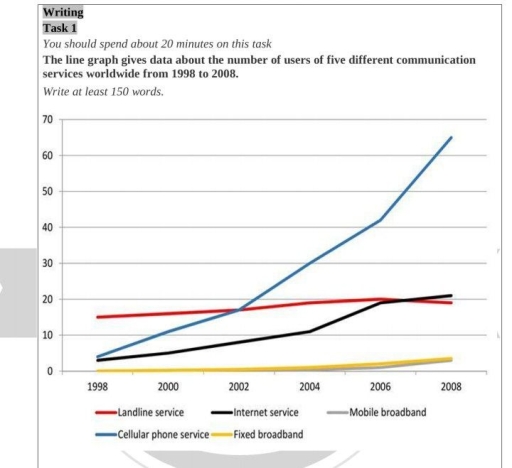
The diagram illustrates the number of individuals who used five distinct communication services worldwide between 1998 and 2008.
Overall, the proportion of cellular phone service users ranked first throughout the period, while the number of users of mobile and fixed broadbands stood last. Besides, all figures experienced some rises over the decade.
The popularity of cellular phone service was initially around 5 and dramatically boomed to around 65 in 2008.
At the beginning, the figure for landline service was almost 10 units higher than that for internet service (15 units vs 5 units). However, while the former rose significantly to around 20 units, which was followed by a slight decline from 1998 to 2008, the latter saw a notable rise to above 20 units, after reaching the same level as landline service.
Finally, the number of mobile broadband was initially as high as that for fixed broadband. However, both showed a similar trend to reach nearly 5 units over the rest of the period.
Word Count: 164
