Our system will evaluate the answer based on this AI-generated description.
The image consists of two floor plans labeled "Art Gallery, 2015" and "Art Gallery, Present day" with changes in the art gallery floor in 2015 and present day. Both floor plans have an entrance at the bottom and are symmetrically divided into two halves by a central path. In 2015, from left to right, there is a Gallery Office, a Receptionist, Exhibition Room 2, Exhibition Room 1, and a Café; only Exhibition Room 1 and the Café have icons indicating coffee and a framed picture. The right side consists of an empty area, stairs, a shop, more stairs, and Exhibition Room 3; Exhibition Room 3 and Shop have icons indicating a shopping bag and a framed picture. In the present day, from left to right, there is a Gallery Office, a Receptionist, Exhibition Room 2, Exhibition Room 1, and a Café without the coffee icon. The right side includes stairs, a shop with a vending machine icon, temporary exhibitions with the word "Children" above, stairs, and Exhibition Room 3 with an additional lift icon. There are no numerical data points, percentages, trends, or specific years other than 2015 and present day mentioned.
Given the complexity of the image, the above description may not be entirely accurate.
Skyrocket your IELTS band score by 1-2 points in under a month with our premium plan!
Note: Both the topic and the answer were created by one of our users.
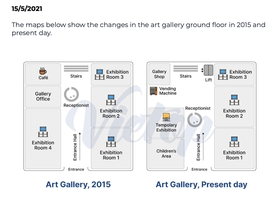
The maps give information on the first level of an art gallery as it was in 2015 and how it has changed recently. Overall, the area has been renovated to facilitate visitors’ experience. The changes involve the addition of more facilities for public use and the removal of an exhibition room.
Regarding the middle sector of the maps, the reception area was relocated to the center of the entrance hall. Similarly, the stairs were moved a little to the northwest of the floor to make room for the construction of an elevator. Unlike the mentioned modifications, the entrance to the south remained unchanged.
Concerning the sides of the layout, the size-reduced café at the northwest corner was converted into a gallery shop, while the gallery office to its north was demolished to pave the way for a vending machine. Meanwhile, exhibition room 4 in the southwest corner was divided into 2 different facilities, a temporary exhibition and a children-focused space. Notably, disabled people can now access the ground floor through a newly installed ramp to the north. In contrast to these significant changes, the rows of exhibition rooms along the east of the ground floor stayed intact.
Word Count: 197
