Our system will evaluate the answer based on this AI-generated description.
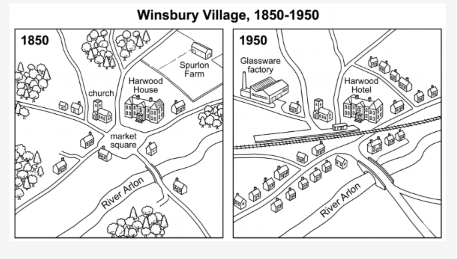
The image features two maps titled "Winsbury Village, 1850-1950", contrasting the village layout between "1850" and "1950". In the 1850 map, labeled features include "church" and "market square" at a central road junction, "Harwood House" to the east, "Spurlon Farm" to the northeast, and "River Arlon" running across the southern area, surrounded by wooded areas in the northwest, west, and south, along with a few scattered houses along the roads. In the 1950 map, labeled features include "Glassware factory" in the northwest, "Harwood Hotel" (occupying the former site of Harwood House), and "River Arlon" spanned by a bridge to the southeast. Additional developments in 1950 include an east-west railway line with a station near the central junction, new rows of residential houses replacing Spurlon Farm and line the roads to the south and northeast, while the church remains intact and the original trees and market square label are removed.
Given the complexity of the image, the above description may not be entirely accurate.
Skyrocket your IELTS band score by 1-2 points in under a month with our premium plan!
Note: Both the topic and the answer were created by one of our users.
The provided map illustrates the transformations that occurred in Winsbury Village over one century, from 1850 to 1950.
Overall, the area expanded significantly and evolved from a small village with just a couple of houses, a farm, and a market square into a larger settlement with a railroad passing through it and even a factory.
In 1850, the village was small and surrounded by a forest and a river (Arlon River on the southern side), with a small bridge connecting the south side to the village passing over the river. As can be observed, a lot of small roads start from the market square located on the center of the village. Moreover, the village consists of some small houses scattered around the square, the Harwood House, a church, and Spurlon Farm on the northwest.
On the other hand, in 1950, the village has expanded with more houses being visible. Furthermore, a Glassware Factory has been constructed on the northeast, while the farm has been replaced by houses. As can be noticed, a railroad that passes though the village has been built taking the market square’s spot. Finally, the bridge over river Arlon has been replaced with a larger one and the forest around the village has ceased to exist.
Word Count: 209
