Our system will evaluate the answer based on this AI-generated description.
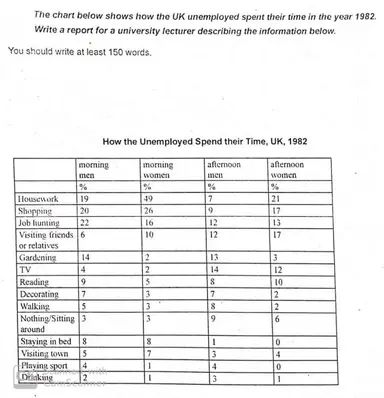
The image displays a chart titled "How the Unemployed Spend their Time, UK, 1982" with two separate columns for morning and afternoon activities, further divided by gender (men and women). Morning activities for men: Housework (19), Shopping (20), Visiting friends or relatives (6), Gardening (4), TV (14), Reading (7), Decorating (7), Walking (5), Nothing/Sitting around (3), Staying in bed (8), Playing sport (5), Visiting town (4), Drinking (2). Afternoon activities for men: Housework (7), Shopping (6), Visiting friends or relatives (12), Gardening (8), TV (13), Reading (4), Decorating (2), Walking (2), Nothing/Sitting around (14), Staying in bed (3), Playing sport (5), Visiting town (0), Drinking (3). Morning activities for women: Housework (29), Shopping (26), Visiting friends or relatives (10), Gardening (2), TV (22), Reading (3), Decorating (3), Walking (5), Nothing/Sitting around (5), Staying in bed (3), Playing sport (1), Visiting town (4), Drinking (0). Afternoon activities for women: Housework (21), Shopping (17), Visiting friends or relatives (17), Gardening (12), TV (13), Reading (2), Decorating (2), Walking (2), Nothing/Sitting around (7), Staying in bed (0), Playing sport (4), Visiting town (1), Drinking (3).
Given the complexity of the image, the above description may not be entirely accurate.
Skyrocket your IELTS band score by 1-2 points in under a month with our premium plan!
Note: Both the topic and the answer were created by one of our users.
The provided table illustrates the information on unemployment in England, who spent their leisure time on different types of activities last year. The data is given in percentages, and it can be split into two genders, boys and girls. In general, It is obvious see that both genders spend most of the time in the morning on job hunting and housework, afternoon watching TV and housework.
First of all, the data below shows the information of people who had no job spent their free time in each different activities. Starting from the male’s morning and afternoon routine. Job hunting and shopping were the most popular things for them in the morning, at 20% to 22% respectively. Whereas at noon, the trend had changed to watching TV and gardening to merely 15%.
On the other hand, the highest number of female activities in the morning were house jobs, above 50% and shopping roughly over 25%. Moreover, cleaning a house duty was still in the highest place accounting for 12%, but lower than in the morning. Lastly, the people’s routine experienced the most, which was shopping and visiting friends by 17%.
Word Count: 189
