Our system will evaluate the answer based on this AI-generated description.
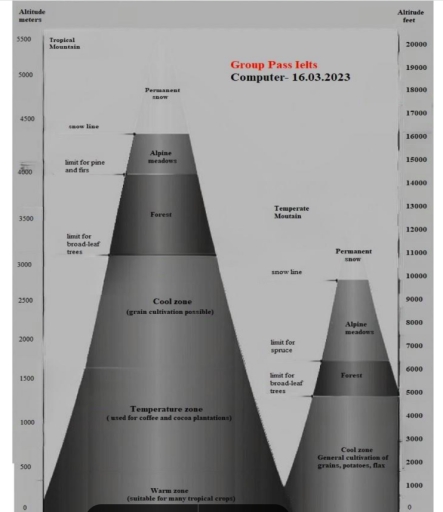
The image presents two triangular profiles depicting altitude variations in meters and feet for different ecological zones on tropical and temperate mountains; tropical mountain starts at sea level extending to 5500 meters or 18000 feet, and temperate mountain from sea level to 3500 meters or 12000 feet; tropical mountain shows "Warm zone" below 1000 meters/3000 feet, "Temperature zone" ending at 2000 meters/6500 feet, "Cool zone" suitable for grain up to 3500 meters/11500 feet, "Forest" reaching 3900 meters/12500 feet with broadleaf tree limit at 3000 meters/10000 feet and pine/fir limit at 4800 meters/15500 feet, "Alpine meadows" rising to permanent snow level capped by snow line around 5000 meters/16500 feet; temperate mountain has "Warm zone" under 500 meters/1600 feet, "Temperature zone" serving coffee/cocoa crops until 1500 meters/5000 feet, "Cool zone" usable for potatoes/grains until 2500 meters/8000 feet, "Forest" area extending to 2600 meters/8500 feet with broadleaf tree limit at 1200 meters/4000 feet and spruce limit at 2200 meters/7200 feet, "Alpine meadows" encompassing area before permanent snow line at approximately 3300 meters/11000 feet; permanent snow is marked above designated snow lines in both mountain profiles.
Given the complexity of the image, the above description may not be entirely accurate.
Skyrocket your IELTS band score by 1-2 points in under a month with our premium plan!
Note: Both the topic and the answer were created by one of our users.
The diagram compares and provides data on temperature zones of two distinct types of mountains: tropical and temperate.
Overall, the former is higher and consists of more climatic zones than the latter. Both categories, however, share similar patterns at higher altitudes, where forests give way to alpine meadows and eventually permanent snow is at the peak.
The tropical mountain is 5,500 altitude meters in height and comprises 6 zones in total. At the base, below 600 meters, lies the warm zone which supports a variety of tropical crops. Right above this is the temperature zone extending up to around 1,500 meters, where coffee and cocoa plantations are common. The cool zone comes next to roughly 3,000 meters, suitable for growing grains. Vegetation changes significantly beyond this point. Broad-leaf trees grow up to about 3,000 meters, beyond which pine and fir forests dominate until around 4,000 meters. At higher altitudes, between 4,000 and 5,000 meters, alpine meadows are found. On top of the tropical mountain stays permanent snow, covering 4,000 meters above.
By contrast, the temperate mountain does not contain warm and temperature zones and rises to 12,000 feet, starting with the cool zone at its base to approximately 5,000 feet. Next is forest with the highest point (6,000 feet) being the limit for spruce. Beyond this, alpine meadows appear, and the snow line occurs at much lower elevations than in tropical regions.
Word Count: 232
