Our system will evaluate the answer based on this AI-generated description.
The image presents a line graph displaying the percentage of women aged 15-64 in employment from 2003 to 2009 for five different countries, with data points for 2003, 2005, 2007, and 2009. Iceland shows a consistent employment percentage, starting at roughly 80% in 2003, a slight increase to just above 80% in 2005, and maintaining that level in 2007 and 2009. Canada has a small but steady increase, starting at just under 70% in 2003, about 70% in 2005, approximately 72% in 2007, and close to 75% in 2009. Germany starts at around 60% in 2003, increases to about 65% in 2005, then to just above 65% in 2007, and nears 70% in 2009. Chile shows a gradual increase, from just above 40% in 2003 to about 45% in 2005, close to 50% in 2007, and just under 55% in 2009. Turkey starts at just above 20% in 2003, reaches near 25% in 2005, about 30% in 2007, and surpasses 30% slightly in 2009.
Given the complexity of the image, the above description may not be entirely accurate.
Skyrocket your IELTS band score by 1-2 points in under a month with our premium plan!
Note: Both the topic and the answer were created by one of our users.
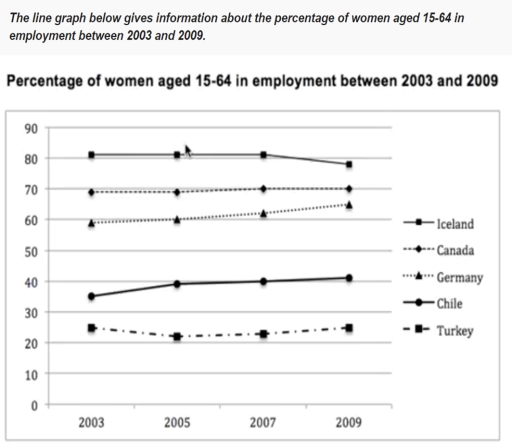
The line graph compares the proportions among female employees between 15 and 64 in five countries from 2003 to 2009. Overall, while Iceland consistently had the highest female employment rate, this employment rate of Turkey ranked last. It is apparent from this graph that all countries witnessed an overall increase or stability in this rate, except for Iceland.
With reference to the two leading countries, the percentage of 15-to 64-year-old employed women in Iceland was stable at just over 80% from 2003 to 2007 before falling by 2% by 2009. Ranking second, Canada recorded its unchanged proportion at about 69% until after 2005, when this figure slightly rose to 70%.
In terms of the remaining countries, Germany and Chile were the two out of five nations which experienced the most seeable increase in women’s employment rate, from just below 60% in 2003 to roughly 65% in 2009, and from about 35% in 2003 to around 41% in 2009, respectively. By contrast, Turkish women participating in the workforce accounted for a nearly steady proportion of about 25% in the period.
Word Count: 179
