
Brampton Museum - IELTS Listening Answers & Explanations
From IELTS Trainer 1 Academic Listening Test 4 · Part 2 · Questions 11–20
Audio
Questions
Questions 11–12 Multiple Choice (Two Answers)
Choose TWO letters, A-E.
Questions 13–14 Multiple Choice (Two Answers)
Choose TWO letters, A-E.
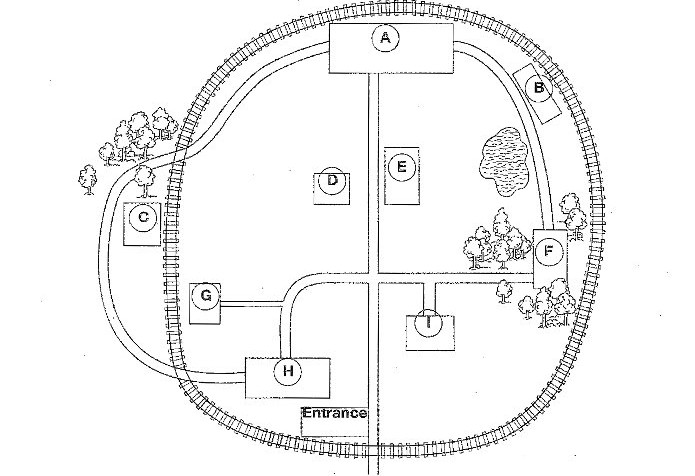
Questions 15–20 Map Labeling
Label the map below.
Write the correct letter, A-I, next to questions 15-20.
Answers & Explanations Summary
| # | Answer | Evidence | Explanation |
|---|---|---|---|
| Q11 | — | — | |
| Q12 | A / D | The site was chosen because there were already some historic 19th-century buildings here and others have been dismantled in different parts of the region, and rebuilt on the site. This hadn't been attempted before in these parts so we're very proud of what we have here What also sets Brampton apart from other museums is that the story of the exhibits is told not by labels but by costumed staff like myself |
Excerpt/Transcript Explanation: The transcript states that the museum is unusual because it moved various old buildings to one location—a new method for that area—and because it employs workers in old-fashioned clothing to talk to visitors instead of using printed signs to explain items. Answer Explanation: The answer identifies the guides and the buildings as the two features that make Brampton Museum unique compared to other museums. Reason For Correctness: The correct answer is based on the guide's description of what makes Brampton special. First, the buildings were brought from different places and put back together on one site, which the guide says is something that had not been done in that area before. Second, the guide uses the phrase 'sets Brampton apart,' which means 'makes it different or unusual,' to explain that instead of reading signs or labels, visitors learn about history from staff members wearing historical clothes. |
| Q13 | — | — | |
| Q14 | C / E | Vintage trams travel along from one end of the street to the other, carrying visitors on their journey into the past. We will also be visiting the farm and taking a ride on a steam train. Of course the main form of transport in those days was the horse and you can watch horses being exercised in the old stables. This part of Britain was famous for coal-mining and on the site we have part of a mine which opened in 1860 and was worked for over a hundred years, before closing in 1963. Visitors can put on a hard hat and take a guided tour underground to see how coal was worked and to experience the working conditions in the early 1900s | Excerpt/Transcript Explanation: The transcript explains that old-fashioned trams are used to move visitors around the museum and that people are allowed to wear hard hats and go on a tour inside a coal mine beneath the ground. Answer Explanation: The answer identifies two activities that people can enjoy as visitors at the museum: traveling on a tram (C) and exploring a coal mine below the surface (E). Reason For Correctness: The correct answer is chosen because the guide specifically describes these activities as part of the visitor experience. For option C, the guide mentions that 'vintage trams' carry visitors. For option E, the guide explains that people can go 'underground' to see a 'coal mine'. Although the museum has bread and horses, the guide says you 'watch' them rather than buy the bread or ride the horses. Similarly, posters are part of a 'demonstration' rather than something for sale. |
| Q15 | E | We'll go to the crossroads in the middle of the map and go straight on, making our way between two buildings on either side of the path. The larger one is an exhibition centre but it's not open today, unfortunately | Excerpt/Transcript Explanation: The transcript explains that the group will walk from the center crossroads and continue straight ahead. They will pass between two buildings, and the bigger building in that pair is the exhibition centre. Answer Explanation: The answer is the location marked with the letter E on the map. Reason For Correctness: The correct answer is determined by following the guide's directions. Starting from the entrance, the group walks to the crossroads in the middle of the map and proceeds straight ahead. This path goes between two buildings. The guide specifies that the larger of these two buildings is the exhibition centre, which corresponds to the location labeled E. |
| Q16 | A | We'll go to the crossroads in the middle of the map and go straight on, making our way between two buildings on either side of the path. The larger one is an exhibition centre but it's not open today, unfortunately. The other building is offices. The path leads directly to the High Street building, which is at the opposite side of the site to the entrance | Excerpt/Transcript Explanation: The transcript explains that to get to the High Street, you must pass the center area and keep walking forward. This path goes between an exhibition center and some offices, ending at a building that sits on the far side of the museum grounds, directly across from where people enter. Answer Explanation: The answer is the location marked A on the map, which represents the High Street. Reason For Correctness: The correct answer is A because the tour guide provides a specific path to find it. Starting from the entrance, you walk to the 'crossroads' in the 'middle' and then continue 'straight on'. The guide explicitly states that the High Street building is on the 'opposite side' of the museum area from the 'entrance'. On the map, location A is directly across from the entry gate. |
| Q17 | C | We'll then take the path which follows the railway line and crosses it to the farm. If you wish, you can have tea in the farmhouse and there'll be time to look at the animals and the machinery | Excerpt/Transcript Explanation: The transcript explains that the group will follow a path next to the train tracks and eventually cross over those tracks to get to the farm and the farmhouse. Answer Explanation: The answer is the letter C on the map, which marks the location of the farmhouse. Reason For Correctness: The correct answer is 'C' because the guide describes the path to the farm as following the railway line and then crossing over it. Since the farmhouse is located on the farm, and 'C' is the building found after crossing the railway line on the map, it is the correct location. Key directions to listen for are "follows the railway line" and "crosses it." |
| Q18 | H | Then, we cross the railway line again and visit our special attraction which is the coal mine. It's just in front of us here at the entrance | Excerpt/Transcript Explanation: The transcript says that after the visitors go to the farm, they will go back across the train tracks to see the coal mine. This mine is situated right in front of the people at the entrance of the park. Answer Explanation: The answer H is the location of the coal mine on the museum map. Reason For Correctness: The correct answer is H because the tour guide explains that the coal mine is a special attraction located directly in front of the tour group's starting position at the entrance. |
| Q19 | F | We'll return to the crossroads and walk through a small wooded area to the Manor House | Excerpt/Transcript Explanation: The transcript explains that to get to the Manor House, the group must go back to the main intersection of paths and walk through a small group of trees. Answer Explanation: The answer is label F on the map, representing the location of the Manor House. Reason For Correctness: The correct answer is F because the guide provides step-by-step directions around the museum site. After visiting the coal mine near the entrance, the group goes back to the 'crossroads' (the center of the map). From that central point, they walk through a 'wooded area'—which is a small group of trees—to reach the Manor House. On maps provided with this audio, letter F is located behind a cluster of tree symbols. |
| Q20 | B | We will then follow a path which goes past the pond and will take us to the Railway Station, which is situated between the path and the railway line | Excerpt/Transcript Explanation: The transcript explains that the path people walk on leads to the station, and it points out that the station is located in the middle of the path and the train tracks. Answer Explanation: The answer B is the location on the map that represents the Railway Station. Reason For Correctness: The correct answer is B because the guide describes the walking route to the station. He explains that after the group passes the pond (marked as I on the map), they will arrive at the Railway Station. He specifies its exact position as being between the walking path and the railway line (the train tracks) that circles the museum. By following the path from the pond and looking for a spot next to the train tracks, we find point B. |
Transcript
You will hear a man taking a group of tourists around a museum site. First you have some time to look at questions 11 to 14.
[Pause the recording for 30 seconds.]
Now listen carefully and answer questions 11 to 14.
Guide: Welcome to Brampton Museum. I'm going to tell you a little bit about the museum first and then show you round. As you can see, Brampton is an open-air museum. The first open-air museums were established in Scandinavia towards the end of the 19th century, and the concept soon spread throughout Europe and North America and there are several in Britain, all of which tell the history of a particular part of the country.
Brampton focuses on life during the 19th century. The site was chosen because there were already some historic 19th-century buildings here and others have been dismantled in different parts of the region, and rebuilt on the site. This hadn't been attempted before in these parts so we're very proud of what we have here. All the buildings are filled with furniture, machinery and objects. You may be able to see these in other museums but not in their original settings. What also sets Brampton apart from other museums is that the story of the exhibits is told not by labels but by costumed staff like myself. I look after sheep, cows and hens, which are much the same as those you see on modern farms, but I use traditional methods to care for them. You will also be able to see a blacksmith and a printer, as well as other craftspeople. If you talk to them, you'll be able to find out what life was really like 150 years ago. Our programme of activities during the year has guided walks, an agricultural fair and all the other events you would expect a museum to have, but remember: here you experience them in the real surroundings.
The site is divided into different areas. The main building contains our High Street which is a street of 19th-century shops, offices and some homes. There's a stationer's shop which sells a range of specially selected cards, prints and copies of Victorian stationery, all available for purchase by visitors. Upstairs in the same building, a printer demonstrates the production of posters, business cards and advertising material. Across the street from the stationer's is a clothes shop and there's a baker's where you can watch a demonstration of someone making bread, cakes and pastries. We also have a sweet shop which has old-fashioned sweets for sale.
Vintage trams travel along from one end of the street to the other, carrying visitors on their journey into the past. We will also be visiting the farm and taking a ride on a steam train. Of course the main form of transport in those days was the horse and you can watch horses being exercised in the old stables. This part of Britain was famous for coal-mining and on the site we have part of a mine which opened in 1860 and was worked for over a hundred years, before closing in 1963. Visitors can put on a hard hat and take a guided tour underground to see how coal was worked and to experience the working conditions in the early 1900s.
Before you hear the rest of the talk, you have some time to look at questions 15 to 20.
[Pause the recording for 30 seconds.]
Now listen and answer questions 15 to 20.
Now if you'd like to look at your map, we'll begin our tour. The site is a bit like a circle with the railway going round the edge. You can see where we are now by the entrance and we're going to start by walking to the High Street. We'll go to the crossroads in the middle of the map and go straight on, making our way between two buildings on either side of the path. The larger one is an exhibition centre but it's not open today, unfortunately. The other building is offices. The path leads directly to the High Street building, which is at the opposite side of the site to the entrance. Here you're free to wander around and take a ride up and down on a tram.
We'll then take the path which follows the railway line and crosses it to the farm. If you wish, you can have tea in the farmhouse and there'll be time to look at the animals and the machinery. Then, we cross the railway line again and visit our special attraction which is the coal mine. It's just in front of us here at the entrance. We'll return to the crossroads and walk through a small wooded area to the Manor House. This is one of the original buildings on the site and belonged to a wealthy farmer. You can look round the house and gardens and talk to our guides who can tell you what it was like to live there. We will then follow a path which goes past the pond and will take us to the Railway Station, which is situated between the path and the railway line. Finally we'll take the steam train back around the site, passing alongside the High Street and the Coal Mine back to the entrance. So if you'd like to follow me ...
That is the end of section 2. You now have half a minute to check your answers.
[Pause the recording for 30 seconds.]
Now turn to section 3.