
Community Garden - IELTS Listening Answers & Explanations
From IELTS Trainer 2 Academic Listening Test 4 · Part 2 · Questions 11–20
Audio
Questions
Questions 11–15 Multiple Choice (One Answer)
Choose the correct letter, A, B, or C.
Questions 16–20 Map Labeling
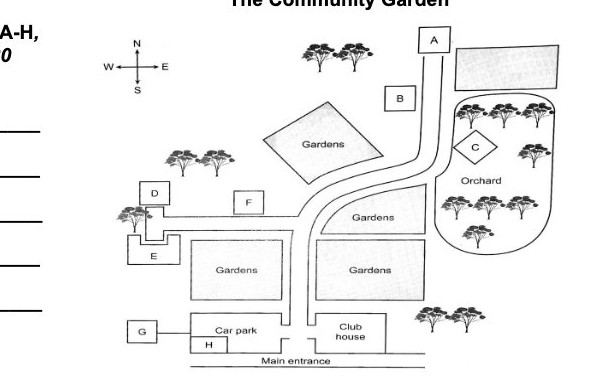
Label the map below.
Write the correct letter, A-H, next to Questions 16-20
Answers & Explanations Summary
| # | Answer | Evidence | Explanation |
|---|---|---|---|
| Q11 | B | Then we found some ancient implements, like spades and forks, for digging. They were buried in the earth. Experts say these are at least 1000 years old | Excerpt/Transcript Explanation: The transcript says they found very old tools (implements) used for farm work, such as spades and forks, buried under the ground. Answer Explanation: The answer means that people found old tools used for gardening or farm work on the land. Reason For Correctness: The correct answer is B because the speaker mentions finding 'ancient implements' like 'spades and forks' in the ground. In English, 'implements' is another word for 'tools,' and spades and forks are used for 'digging' or farming. Since these items were 'buried in the earth' and found recently, they represent the new discovery. The speaker also notes these tools are very old, which is why they are called 'ancient.' |
| Q12 | B | The great thing, though, is the stream that runs through the valley, so we can irrigate the gardens even through long, dry summers | Excerpt/Transcript Explanation: The transcript explains that the best part of the location is a small river that provides water. Because of this, the gardeners can water their vegetables and fruit even during the hot months when it does not rain. Answer Explanation: The answer means that the garden's location is helpful because it has a constant water source for the plants. Reason For Correctness: The correct answer is B because the man mentions a stream (a small river) that flows through the area. This stream allows the gardeners to irrigate (give water to) the plants, which is very important during hot summers when there is little rain. Options A and C are incorrect because the man says the weather gets very cold in winter and that strong winds from storms are actually a problem. |
| Q13 | A | Now what we do know is that in 1860, gardening stopped here. This was a time of rapid development in this area. And on that date, the City Infirmary was constructed on this site, so this is where doctors and surgeons worked to take care of the health needs of the growing population | Excerpt/Transcript Explanation: The transcript says that in 1860, a place for medical work (the City Infirmary) was built on this land so that doctors could help sick people. Answer Explanation: The answer is a place where people receive medical care. Reason For Correctness: The correct answer is A because the speaker explains that in 1860, a building called the City Infirmary was built. An 'infirmary' is another word for a hospital or a medical centre. The text also mentions that doctors and surgeons worked there to look after the health of the people living nearby. |
| Q14 | B | Each plot of land is worked by a volunteer member of the garden, and they donate what they grow to families in this neighbourhood who are struggling financially | Excerpt/Transcript Explanation: The transcript explains that the garden workers give the food they grow to people in the local area who are having a difficult time with money. Answer Explanation: The answer means that the food from the garden is given for free to people in the local area who do not have much money. Reason For Correctness: The correct answer is B because the speaker says that the volunteers who work in the garden give away (donate) the fruit and vegetables to families living nearby (neighbourhood) who are having a hard time with money (struggling financially). Although some shops or restaurants (businesses) want to buy the food, the speaker says they do not have enough to sell any to them. |
| Q15 | C | Each week, undergraduates enrolled on the college’s horticulture course have a class here, to learn about their subject first hand | Excerpt/Transcript Explanation: The transcript states that every week, college students studying plant growing have a lesson at the garden so they can see and practice what they are learning. Answer Explanation: The answer means that the neighborhood college currently holds classes in the gardens to show their students how to grow plants. Reason For Correctness: The correct answer is C because the speaker mentions that university students (referred to as 'undergraduates') who study plant cultivation (the 'horticulture course') visit the site every week for a class. This shows they are using the garden right now to learn practical skills. Answer B is incorrect because teaching the 'wider community' through workshops is something they hope to do in the 'future,' not something they are doing now. |
| Q16 | F | To get there, from the main entrance, head north. You’ll pass gardens on either side of the path. Just before the path curves round to the right, there’s a turning on the left. Go down there and the worm farms are inside the first building you come to | Excerpt/Transcript Explanation: The transcript explains that from the entrance, you should walk north past the gardens and turn left before the main path curves. The worm farms are inside the first building you reach on that side path. Answer Explanation: The answer F is the location on the map where the worm farms are found. Reason For Correctness: The correct answer is F because the speaker gives specific directions starting from the main entrance. You need to walk north (up) and pass the gardens. Before the path starts to bend to the right, you must turn left. The worm farms are located in the very first building you see on that left path. In the map, this first building is marked with the letter F. |
| Q17 | C | It’s also worth visiting our seed store. Again, head north and follow the path as it curves round to the right through the gardens. You’ll come to the orchard. Follow the path around the edge of the orchard – but don’t go too far. The seed store is actually located inside the orchard – a very pretty spot | Excerpt/Transcript Explanation: The transcript explains that to find the seed store, you must walk north, follow the path as it turns to the right, and look inside the area filled with fruit trees called the orchard. Answer Explanation: The answer C is the location of the seed store on the map. Reason For Correctness: The correct answer is determined by following the man's directions from the main entrance. He tells the group to go north (up) and follow the path as it turns (curves) to the right. This leads them to the orchard. He then explains that the seed store is located inside that orchard area. On the map, the letter C is placed within the boundaries of the orchard. |
| Q18 | G | Now the machinery shed might interest some of you. From the main entrance, just go into the car park and walk right to the end. You’ll see a little path heading out to the west – it’s down there | Excerpt/Transcript Explanation: The transcript explains that to find the machinery shed, you must start at the main entrance, enter the parking area (car park), walk to the end of it, and take a path going west. Answer Explanation: The answer is G, which is the letter on the map representing the location of the machinery shed. Reason For Correctness: The correct answer is G because the speaker gives specific directions from the main entrance. He says to walk into the car park and go to the very end. Then, you should look for a small path that goes toward the west. On a map, west is usually to the left. Following these steps leads to the area labeled G. |
| Q19 | E | Our compost heaps are also pretty impressive. So, head north from the main entrance, go past the first gardens and take the first turning on the left. Go to the end of that path. The compost heaps are built in the shape of a letter 'U' | Excerpt/Transcript Explanation: The transcript gives directions to find the compost piles: walk north from the main door, go past the first garden plots, turn left at the first available path, and walk to the very end of that path. Answer Explanation: The answer E represents the location of the compost heaps on the garden map. Reason For Correctness: The correct answer is E because the speaker provides a clear path to the compost heaps. He instructs the visitors to start at the main entrance and move north. After passing the first gardens, they should take the very first path turning to the left and follow it until it ends. This sequence of movements leads directly to the spot marked 'E'. Additionally, he mentions they are shaped like a 'U', which is a visual clue for that map position. |
| Q20 | A | The drying room is also interesting. This is where we dry fruit, to preserve it. To see how it’s done, walk up through the gardens till you come to the orchard. Keep heading north and the drying room is right at the very end of that path – as far as you can go | Excerpt/Transcript Explanation: The transcript says that to find the drying room, you must walk past the fruit trees (orchard) and continue going north (up) until you reach the very last point on that path. Answer Explanation: The answer means that the place called the drying room is marked with the letter A on the map. Reason For Correctness: The correct answer is A because the speaker gives clear directions to find the drying room. He tells the visitors to walk up through the gardens toward the north. They need to pass the orchard (a group of fruit trees) and stay on that path until they reach the very end. On a map, going 'north' usually means going to the top, and 'at the very end' means the farthest possible point on that path. Keywords to notice are 'north,' 'very end,' and 'far as you can go.' |
Transcript
You will hear a man talking to a group of people who are looking around a community garden.
Now listen carefully and answer questions 11 to 15.
Man: Well, good morning everyone and welcome to this open day at the community garden. Our garden belongs to the local community and, as you’ll see, what we grow here is mostly fruit, and different kinds of vegetables. First, I’ll tell you some background information.
Well, recently we made an interesting discovery at the garden. Before, we didn’t know much about the history of this site. We only had a few documents and records. Then we found some ancient implements, like spades and forks, for digging. They were buried in the earth. Experts say these are at least 1000 years old. So people have been using this land for growing produce for a long time. There are some photographs of these implements in the club house, as well as a diagram of what we think the garden might have looked like, if you want to look later.
So, why was this location so good for gardening? As you can see, we’re in a slight valley. And storms blow very hard up this valley, which can be a problem. But being in a valley, we get good freezing frosts here in winter, which gardeners like because it kills the bugs. The great thing, though, is the stream that runs through the valley, so we can irrigate the gardens even through long, dry summers.
Now what we do know is that in 1860, gardening stopped here. This was a time of rapid development in this area. And on that date, the City Infirmary was constructed on this site, so this is where doctors and surgeons worked to take care of the health needs of the growing population. Also, many new houses were put up for people who commuted into the city each day to work. There was even talk of a new military camp, although that never happened in the end.
Then in the 1980s, the old buildings here were removed. And this land again became a productive garden. Today, these gardens produce large quantities of fruit and vegetables. Each plot of land is worked by a volunteer member of the garden, and they donate what they grow to families in this neighbourhood who are struggling financially. Occasionally we’re approached by local businesses and restaurants wanting to buy our organic produce, but we just don’t have enough.
We also have a good relationship with the local college. In fact, several of the academics there are members of the garden. Each week, undergraduates enrolled on the college’s horticulture course have a class here, to learn about their subject first hand. And in future the college hopes to hold workshops here, to help local people establish vegetable gardens at home.
Now listen and answer questions 16 to 20.
Man: OK, now I’ll just point out a few places of interest around the gardens. So, can you all look at your maps please? OK, so we’re now standing at the main entrance to the gardens, outside the club house.
So, you might be interested in our worm farms. This is where we make fertiliser. To get there, from the main entrance, head north. You’ll pass gardens on either side of the path. Just before the path curves round to the right, there’s a turning on the left. Go down there and the worm farms are inside the first building you come to.
It’s also worth visiting our seed store. Again, head north and follow the path as it curves round to the right through the gardens. You’ll come to the orchard. Follow the path around the edge of the orchard – but don’t go too far. The seed store is actually located inside the orchard – a very pretty spot.
Now the machinery shed might interest some of you. From the main entrance, just go into the car park and walk right to the end. You’ll see a little path heading out to the west – it’s down there.
Our compost heaps are also pretty impressive. So, head north from the main entrance, go past the first gardens and take the first turning on the left. Go to the end of that path. The compost heaps are built in the shape of a letter ‘U’.
The drying room is also interesting. This is where we dry fruit, to preserve it. To see how it’s done, walk up through the gardens till you come to the orchard. Keep heading north and the drying room is right at the very end of that path – as far as you can go.
Now one other thing I’ll mention…