Our system will evaluate the answer based on this AI-generated description.
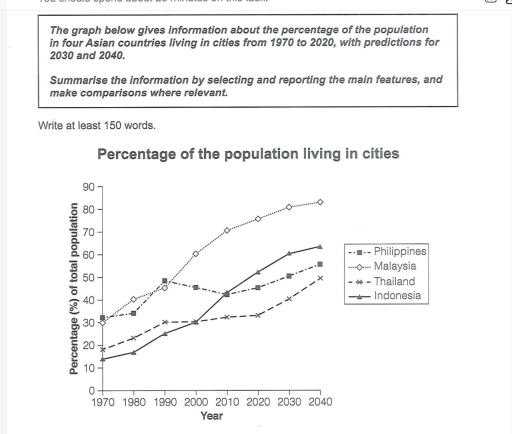
The image presents a line graph showing the percentage of population living in cities from 1970 to 2020, with predictions for 2030 and 2040, across four Asian countries. In 1970, the Philippines had 30%, Malaysia 28%, Thailand 14%, and Indonesia 15%. By 1980, these figures rose to approximately 37% for the Philippines, 32% for Malaysia, 19% for Thailand, and 22% for Indonesia. In 1990, the Philippines reached about 46%, Malaysia 40%, Thailand 23%, and Indonesia 30%. By 2000, the percentages were approximately 49% for the Philippines, 51% for Malaysia, 33% for Thailand, and 42% for Indonesia. In 2010, the Philippines had about 48%, Malaysia 59%, Thailand 44%, and Indonesia 50%. In 2020, the figures were approximately Philippines 47%, Malaysia 64%, Thailand 50%, and Indonesia 56%. Predicted values for 2030 show the Philippines at about 56%, Malaysia at 74%, Thailand at 59%, and Indonesia at 66%. For 2040, predictions show the Philippines at approximately 66%, Malaysia at 82%, Thailand at 68%, and Indonesia at 71%.
Given the complexity of the image, the above description may not be entirely accurate.
Skyrocket your IELTS band score by 1-2 points in under a month with our premium plan!
Note: Both the topic and the answer were created by one of our users.
The line graph illustrates the proportion of inhabitants living in cities across four countries from 1970 to 2020, with forecasts for 2030 and 2040. Overall, Malaysia’s urban population peaks at the end of the observed period, while Thailand has the lowest percentage compared to the other countries. The Philippines and Indonesia experience some fluctuations in their urbanization rates.
In Indonesia, the urban population in 1970 was approximately 13%. It showed significant growth by 2000, reaching about 36%, and continued to increase steadily, ultimately reaching around 56% by 2040. In contrast, Malaysia’s urban population has the highest figures among the countries studied. In 1970 and 1990, the urban populations were about 30% and 48%, respectively, but after 1990, there was a significant rise. By 2020, the urban population had increased to around 75%, and by 2040, it is projected to reach approximately 95%.
Furthermore, Thailand and the Philippines exhibit fluctuations during this timeframe. By 2020 and 2040, their urban populations are expected to peak at around 45% and 52%, respectively, compared to previous years.
Word Count: 173
