Our system will evaluate the answer based on this AI-generated description.
The image contains a circular flow diagram illustrating the concept of "Collaborative Consumption." The diagram shows various objects and activities that are shared or rented instead of owned permanently by an individual. Starting from the top and moving clockwise, the diagram includes: a car labeled "Car Sharing," a depiction of furniture and boxes labeled "Swap/Trade," two clothing items labeled "Pre-owned," and finally two forms of media, books and DVDs, labeled "Rent." Each object or activity points towards a starburst in the center with arrows indicating movement towards the center, and from it arrows lead to each subsequent item in the cycle suggesting a continuous loop. Each object or activity is represented by a stylized icon. There are no numerical data points, percentages, or specific quantitative information provided in the diagram.
Given the complexity of the image, the above description may not be entirely accurate.
Skyrocket your IELTS band score by 1-2 points in under a month with our premium plan!
Note: Both the topic and the answer were created by one of our users.
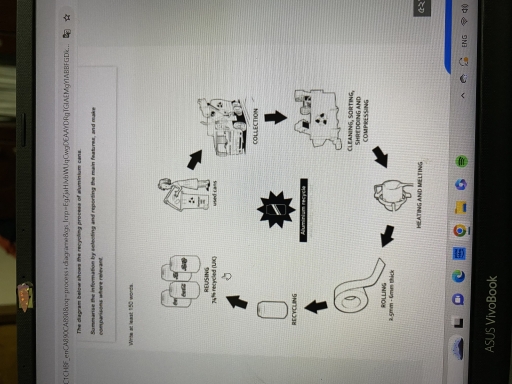
The given process below demonstrates how the aluminium cans are recycled.
From an overall perspective, the recycling process of aluminium cans consists of 7 steps, starting with throwing used cans into trash can and ending up with reusing recycled cans.
To begin with, as soon as the used cans in the trash can are collected, the aluminium cans are delivered to the recycling factories, where they are passed through four-stage process, which includes cleaning, sorting, shredding and compressing. Once the ready cans have been heated and melted, the melted aluminium is then rolled into a 2.5mm-6mm thick tape. After recycling and turning the tape into a new metal can, it can be reused by costumers.
Word Count: 115
