
City Traffic And The Motor Car - IELTS Listening Answers & Explanations
From IELTS Practice Test Plus 1 Academic Listening Test 4 · Part 3 · Questions 21–30
Audio
Questions
Questions 21–24 One Choice
Circle the correct letters A-C.
Questions 25–26 Visual Labeling
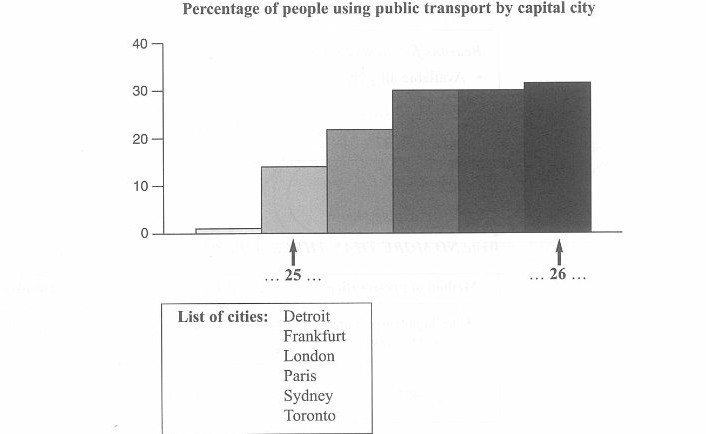
Label the two bars identified on the graph below.
Choose your answers from the box and write them next to Questions 25-26.
Detroit Frankfurt London
Paris Sydney Toronto
Questions 27–28 Two Choices
Circle TWO letters A-F.
Questions 29–30 Two Choices
Circle TWO letters A-F.
Answers & Explanations Summary
| # | Answer | Evidence | Explanation |
|---|---|---|---|
| Q21 | C | well, by continuing to encourage this dependence on the motor car, we simply create more congestion and more urban sprawl | Excerpt/Transcript Explanation: The transcript shows the professor's opinion that focusing on car travel leads to messy traffic and causes people and buildings to spread out into wider areas away from the city center. Answer Explanation: The answer means that very large roads for cars cause the city to spread out into more residential areas away from the center. Reason For Correctness: The correct answer is correct because the professor says that building more major roads encourages people to rely on cars, which leads to 'urban sprawl.' 'Urban sprawl' is a term used to describe when a city spreads out over a large area, creating more and more suburbs. He argues that instead of bringing wealth, these highways just make the city bigger and more crowded with traffic. |
| Q22 | A | The freeways mean people can enjoy the benefits of living away from the centre on larger blocks with gardens but still be able to drive back into the city centre for work or entertainment |
Excerpt/Transcript Explanation: The transcript shows the student explaining that living outside the city center is good because it gives people more space and gardens, which they find enjoyable. Answer Explanation: The answer means the student believes people enjoy the positive things about living in areas outside the main city center, which are called suburbs. Reason For Correctness: The correct answer is A because the student mentions that living outside the middle of the city (referred to as "the sprawl") allows people to "enjoy the benefits" of that lifestyle. They specifically mention "larger blocks with gardens" as positive features. In this context, "benefits" is a synonym for "advantages," and "living away from the centre" refers to living in the suburbs. |
| Q23 | A | It may be OK for you now but come back to me in five years' time! Let's take City Link, for example, the new freeway here in Melbourne If you give the automobile road space, it will fill that space and you'll soon find you'll be crawling along your City Link |
Excerpt/Transcript Explanation: The transcript shows the professor predicting the future of the City Link freeway. He explains that in five years, the road will be full because cars always fill up new space. Because there will be so many cars, drivers will be 'crawling,' which means moving at a very slow speed due to traffic congestion. Answer Explanation: The answer means that the City Link road will be very full of cars and the traffic will move very slowly. Reason For Correctness: The correct answer is A because the professor connects the 'five years' time' frame to the City Link freeway. He warns that when you build new road space for cars, they will quickly fill it up. This leads to heavy traffic where cars move slowly or are 'crawling.' In this context, 'crawling' is a synonym for the road being 'choked by traffic.' |
| Q24 | B | Well there is an argument, surely, that building good roads is actually beneficial because most new cars these days are highly efficient - they use far less petrol than in the past and emissions of dangerous gases are low. Old congested roads, on the other hand, encourage traffic to move slowly and it's the stationary cars that cause the pollution and smog whereas good roads increase traffic speeds and thus the amount of time cars are actually on the roads |
Excerpt/Transcript Explanation: The transcript shows the student arguing that when traffic moves slowly or stops on old roads, it causes pollution. However, they believe that good roads make cars go faster and spend less time on the road, which reduces the gases and smog they produce. Answer Explanation: The answer means the student thinks that building big, fast roads (highways) helps to reduce the amount of dirty air or pollution made by cars. Reason For Correctness: The correct answer is B because the student explains that cars stuck in traffic on old roads cause a lot of pollution and smog (dirty air). They argue that because modern cars are efficient (good at using fuel), and highways allow them to move quickly instead of sitting still, these better roads actually help lower the amount of pollution released. |
| Q25 | Sydney | in Detroit only 1% of passenger travel is by public transport whereas in Toronto it's 24% which is considerably better than Sydney which can only boast 16% | Excerpt/Transcript Explanation: The transcript lists the percentage of people using public transport in different cities. It clearly states that Sydney's rate is 16%. Answer Explanation: The answer is the Australian city of Sydney, which is identified as one of the cities compared in terms of its public transport usage. Reason For Correctness: The correct answer is determined by comparing the statistics mentioned by the professor. When discussing the use of public transport, the professor mentions several cities and their specific percentages of passenger travel. He explicitly states that Sydney has a 16% rate of public transport use, which is used as a data point to compare against other cities like Toronto and Detroit. Mentioning that Sydney can 'only boast 16%' indicates its specific value on a graph comparing these percentages. |
| Q26 | Frankfurt | and Frankfurt comes in higher still at 32% | Excerpt/Transcript Explanation: The transcript shows that Frankfurt has a higher usage of public transport than the other cities talked about, reaching 32%. Answer Explanation: The answer is Frankfurt, which is a city in Germany that uses a lot of public transport. Reason For Correctness: The correct answer is Frankfurt because the Professor compares different cities to show how many people use buses or trains. He says that London and Paris have 30%, but Frankfurt's number is even higher at 32%. This makes it the city with the highest percentage mentioned in that part of the conversation. |
| Q27 | — | — | |
| Q28 | A / D | For instance they paid musicians and artists to perform in the streets Then they banned cars from many parts of the city and every year 3% of the city parking is removed and by constantly reducing parking they've created public spaces and clean air |
Excerpt/Transcript Explanation: The transcript states that the city hired people to play music and create art in public to attract the community. It also explains that the city takes away 3% of car parking every year to limit cars and make more room for people and fresh air. Answer Explanation: The answer identifies two specific actions taken in Copenhagen: encouraging street performances and reducing the number of parking spaces each year. Reason For Correctness: The correct answer is A and D. The transcript explains that Copenhagen wanted to bring people back to the city, so they paid performers like musicians and artists to work in the streets. It also notes that the city removes 3% of its parking spaces every year ('annual reduction') to create more public areas and improve the air quality. While 'free bicycles' are mentioned, the text says they are hired for 'practically nothing,' which is not the same as being completely free. Additionally, the 30% figure refers to people using bicycles, not walking. |
| Q29 | — | — | |
| Q30 | B / F | Particularly in areas with low population, because if there aren't many people using the service then they don't schedule enough buses or trains for that route And secondly the whole process takes so long because usually you have to change you know, from bus to train - that sort of thing, and that can be quite difficult |
Excerpt/Transcript Explanation: The transcript shows the student giving two reasons why public transport is not preferred: companies provide fewer services (buses or trains) if there are few riders, and the time spent switching between different transport lines makes the trip very long. Answer Explanation: The answer identifies two problems with public transport: there are fewer trips scheduled when not many people use the service, and switching between different types of transport (like a bus to a train) takes a long time. Reason For Correctness: The correct answer is B and F because the student mentions these specific issues. Choice B (low use means reduced service) is correct because the student explains that if there are not many people using a bus or train line, the authorities do not plan enough trips for that path. Choice F (making connections takes time) is correct because the student points out that traveling takes a long time because you often have to switch from one vehicle to another, which is difficult. |
Transcript
Tutor: We're very pleased to welcome Professor Isaac Nebworth to our tutorial group today and he's come to share one of his pet passions with us - City traffic and our western dependence on the motor car. I believe questions are quite welcome throughout.
Professor: Thank you. Well, I know you're all very familiar with the super highway here in Melbourne. But do super highways automatically lead to super wealth, as our politicians would have us believe? I think not.
Tutor: Can you give us an example of what you mean exactly?
Professor: Sure ... well, by continuing to encourage this dependence on the motor car, we simply create more congestion and more urban sprawl. And you can see that here in Melbourne right under your nose.
Student: Excuse me. I would just like to say that I feel the sprawl is part of the city. The freeways mean people can enjoy the benefits of living away from the centre ... on larger blocks with gardens ... but still be able to drive back into the city centre for work or entertainment.
Professor: Well I'm not convinced that people want to do that. And is our money being well spent? It may be OK for you now but come back to me in five years' time! Let's take City Link, for example, the new freeway here in Melbourne.
Student: Well ... I use the freeway all the time. I think it's great.
Professor: Ah yes, but it cost $2billion to build, and you could have gotten ten times the value by putting the money into public transport. If you give the automobile road space, it will fill that space ... and you'll soon find you'll be crawling along your City Link.
Tutor: But surely, you cannot simply blame the car. Some of the blame must rest with governments and city planners?
Student: Well there is an argument, surely, that building good roads is actually beneficial because most new cars these days are highly efficient - they use far less petrol than in the past and emissions of dangerous gases are low. Old congested roads, on the other hand, encourage traffic to move slowly and it's the stationary cars that cause the pollution and smog ... whereas good roads increase traffic speeds and thus the amount of time cars are actually on the roads.
Professor: Well ... this is the old argument put forward by the road lobby but, for me it's clear cut. Roads equal cars which equal smog. Public transport is the way to go.
Tutor: Now ... on that topic of public transport, I read somewhere recently that Australia isn't doing too badly in the challenge to increase the use of public transport.
Professor: Better than America, granted, but by comparison with Canada, it's not so good. For instance, if you compare Toronto with the US metropolis of Detroit only 160 kilometres away ... in Detroit only 1% of passenger travel is by public transport whereas in Toronto it's 24% which is considerably better than Sydney which can only boast 16%.
Tutor: Well I think it's encouraging that our least car-dependent city is actually our largest city. 16% of trips being taken on public transport in Sydney, isn't too bad.
Professor: But it's a long way behind Europe. Take both London and Paris for instance ... where 30% of all trips are taken on public transport.
Tutor: Well, they do both have an excellent underground system.
Professor: ... and Frankfurt comes in higher still at 32%.
Tutor: I understand that they've been very successful in Copenhagen at ridding the city of the car. Can you tell us anything about that experiment?
Professor: Yes indeed. Copenhagen is a wonderful example of a city that has learnt to live without the motor car. Back in the 1960s they adopted a number of policies designed to draw people back into the city. For instance they paid musicians and artists to perform in the streets. They also built cycle lanes and now 30% of the inhabitants of Copenhagen use a bicycle to go to work. Sydney by comparison can only boast 1% of the population cycling to work.
Student: It could have something to do with all the hills!
Professor: Then they banned cars from many parts of the city and every year 3% of the city parking is removed and by constantly reducing parking they've created public spaces and clean air.
Student: Really!!
Professor: There are also freely available bicycles which you can hire for practically nothing. And of course, they have an excellent public transport system.
Student: Well, that's all very well for Copenhagen. But I'd just like to say that some cities are just too large for a decent public transport system to work well. Particularly in areas with low population, because if there aren't many people using the service then they don't schedule enough buses or trains for that route.
Professor: I accept that there is a vicious circle here but people do need to support the system.
Student: And secondly the whole process takes so long because usually you have to change ... you know, from bus to train - that sort of thing, and that can be quite difficult. Ultimately it's much easier to jump in your car. And often it turns out to be cheaper.
Professor: Sure ... but cheaper for whom, you or society? We have to work towards the ideal and not give in all the time because things are too difficult ... Anyway lets move on to some of the results of the survey ... [fade]