
Food Preservation - IELTS Listening Answers & Explanations
From IELTS Practice Test Plus 1 Academic Listening Test 4 · Part 4 · Questions 31–40
Audio
Questions
Questions 31–32 Note Completion
Complete the notes below.
Write NO MORE THAN THREE WORDS for each answer.
Reasons for preserving food
- Available all year
- For 31
- In case of 32
Questions 33–37 Table Completion
Complete the table below.
Write NO MORE THAN THREE WORDS for each answer.
| Method of preservation | Advantage | Disadvantage |
|---|---|---|
| Ultra-high temperature (UHT milk) | 33 | spoils the taste |
| canning | inexpensive | risk of 34 |
| refrigeration | stays fresh without processing | requires 35 |
| 36 | effective | time-consuming. |
| drying | long-lasting, light and
37 |
loses nutritional value |
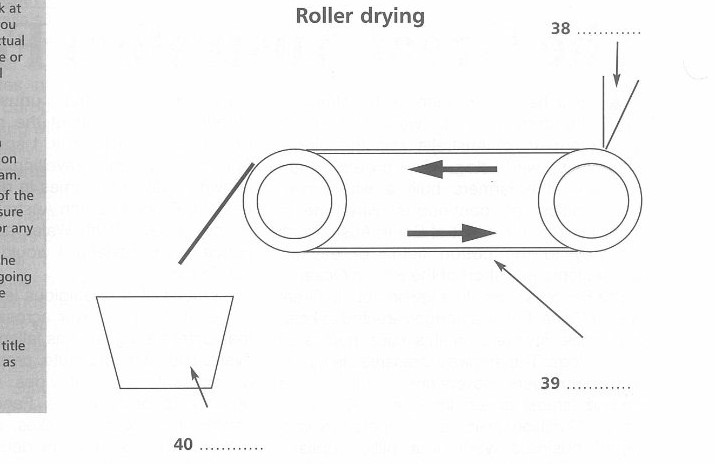
Questions 38–40 Diagram Labeling
Label the diagram.
Write NO MORE THAN THREE WORDS for each answer.
Answers & Explanations Summary
| # | Answer | Evidence | Explanation |
|---|---|---|---|
| Q31 | export overseas / export / transit overseas / transit | We also need to preserve food for export overseas to make sure that it doesn't perish in transit, and lastly we need to be able to preserve food for when there are food shortages | Excerpt/Transcript Explanation: The transcript explains that preservation is necessary to send food to different countries ('export') and to keep it from going bad while it is traveling ('transit'). Answer Explanation: The answer identifies that food is kept fresh so it can be sent to other countries or safely moved from one place to another. Reason For Correctness: The correct answer is based on the lecturer's list of why we preserve food. The lecturer mentions three reasons: to have food all year, to send it to other countries (export), and to save it for times when there is not enough food. The words 'export' and 'transit' are used specifically to describe the process of moving food long distances. |
| Q32 | food shortages | lastly we need to be able to preserve food for when there are food shortages | Excerpt/Transcript Explanation: The transcript explains that one final reason we keep food safe for a long time is so we have something to eat during times when there is very little food available. Answer Explanation: The answer "food shortages" refers to situations where there is not enough food for people to eat. Reason For Correctness: The correct answer is supported by the lecturer's opening remarks. The lecturer lists several reasons for preserving food: eating seasonal items throughout the year, shipping food to other countries (export), and having food available when there is a lack of supply. The term "food shortages" specifically points to the last reason mentioned in the list of justifications for food preservation. |
| Q33 | lasts longer / lasts much longer | The advantage of treating milk in this way is that it lasts much longer | Excerpt/Transcript Explanation: The transcript says that the benefit of using the UHT method is that the milk can be stored for a long time without spoiling. Answer Explanation: The answer means that the milk stays fresh and safe to drink for a greater amount of time. Reason For Correctness: The correct answer is found in the section about the ultra-high temperature (UHT) process. The lecturer explicitly states that the 'advantage' (a positive feature) of this method is that the milk 'lasts much longer' than regularly treated milk. This matches the 'Advantage' column in the table for UHT milk. |
| Q34 | food-poisoning / poisoning | Unfortunately, however, there were many early cases of food-poisoning because the canning process was not fully understood at that stage. We now know the exact temperature and length of time each food needs for proper preservation which has greatly reduced the risk of food-poisoning | Excerpt/Transcript Explanation: The transcript explains that in the past, many people got sick from canned food. It then mentions that while we are better at it now, we still have to be careful about the 'risk of food-poisoning' when preserving food this way. Answer Explanation: The answer is 'food-poisoning', which refers to getting sick from eating food that contains harmful bacteria or germs. Reason For Correctness: The correct answer is 'food-poisoning' because when the lecturer talks about tin cans or canning, they describe it as a cheap method but also mention a major danger. The speaker notes that because people did not understand the science of canning early on, it led to many sicknesses. Even though methods have improved, 'food-poisoning' remains the disadvantage linked to this specific process in the text. |
| Q35 | electricity / electricity supply / supply of electricity / power | However, refrigeration requires an electricity supply and unfortunately if the power goes off, so does the food | Excerpt/Transcript Explanation: The transcript states that for refrigeration to work, it needs a continuous supply of power. If the electricity is cut off, the food is ruined. Answer Explanation: The answer is the energy needed to run machines like fridges. Reason For Correctness: The correct answer is electricity because the lecturer explains that refrigerators need an energy source to work. Without this power, the food will no longer stay fresh and will spoil. Keywords like 'requires' and 'electricity supply' indicate this is the necessary component for the method of refrigeration. |
| Q36 | Chemical preservatives / Chemical | Chemical preservatives are effective but they do not suit all foods and the processes involved are time-consuming | Excerpt/Transcript Explanation: The transcript states that while using chemicals is a successful way to preserve food, it takes a long time to complete the process. Answer Explanation: The answer identifies the method of using chemicals to stop food from spoiling. Reason For Correctness: The correct answer is chemical preservation. This is because the lecturer explicitly mentions that chemical preservatives are 'effective' (which matches the advantage column) and that the processes involved are 'time-consuming' (which matches the disadvantage column). The speaker gives examples like salt, sugar, and vinegar, but the general category is chemical preservation. |
| Q37 | cheap to store | When food is dried it not only lasts a long time but it also becomes much lighter which is a big advantage as this makes it cheap to store, though some people argue that valuable nutrients are lost in the process | Excerpt/Transcript Explanation: The transcript explains that because dried food is light, it is a big advantage because it costs very little to keep the food in a storage space. Answer Explanation: The answer "cheap to store" means that it does not cost a lot of money to keep the food in a warehouse or a cupboard for a long time. Reason For Correctness: The correct answer is found in the section about drying food. The speaker lists several benefits (advantages) of this method: the food lasts for a long time, it becomes lighter, and because it is lighter, it is "cheap to store." These points match the structure of the table which lists "long-lasting" and "light" as other advantages. |
| Q38 | hot soup / soup | Well, first of all the hot soup is poured in at one end - here | Excerpt/Transcript Explanation: The transcript explains that the very first step of the process is putting the hot soup into one side of the equipment. Answer Explanation: The answer is (hot) soup. This is the liquid food used as an example to show what is put into the machine at the start of the process. Reason For Correctness: The correct answer is found in the description of the roller drying method. The lecturer uses soup as an example of a liquid and says that the process begins by pouring the hot soup into one end of the machine. |
| Q39 | heated belt / belt | The liquid spreads to form a thin layer on a heated belt | Excerpt/Transcript Explanation: The transcript explains that the liquid food covers a machine part called a "heated belt" in a thin layer so that it can dry out. Answer Explanation: The answer is the part of the machine where the liquid food is placed to dry, which is called a heated belt. Reason For Correctness: The correct answer describes a specific part of the roller drying process used for liquids like soup. According to the transcript, the soup is poured onto a moving piece of equipment that is warm, referred to as a "heated belt." On this belt, the liquid spreads out and the water leaves it, which is the main step in turning the soup into a dry powder. |
| Q40 | powdered soup / dried soup / dry soup | By the time it reaches the end of the belt, all the water has evaporated leaving only dry powder. A blade then scrapes the dried material off the roller and captures it in powder form | Excerpt/Transcript Explanation: The transcript says that at the end of the drying process, the water is gone and only a dry powder is left to be collected. Answer Explanation: The answer describes soup that has had all its water removed so it becomes a dry powder. Reason For Correctness: The correct answer is based on the description of 'roller drying' for liquids like soup. The lecturer explains that as the soup moves on a heated belt, the water goes away or 'evaporates.' This leaves 'dry powder' or 'dried material' at the end of the process. Because the liquid is gone and only a powder remains, it is called powdered or dried soup. |
Transcript
Lecturer: In today's lecture I'd like to look at the topic of food preservation and start by asking the obvious question 'Why do we need to preserve food?' Well, apart from keeping it fresh for our daily needs, many foods, such as fruit and vegetables are only available at certain times of the year so if we want to be able to eat these foods all year round, we need to preserve them. We also need to preserve food for export overseas to make sure that it doesn't perish in transit, and lastly we need to be able to preserve food for when there are food shortages. There are a number of methods of preserving food which involve both high and low temperatures, chemicals, irradiation and drying. Let's have a look at these in turn.
In the 1870s the French scientist, Louis Pasteur, showed that micro-organisms in food could be destroyed by raising the temperature of the food - a process now known as pasteurisation. This involves heating milk to just 65°C for 30 minutes. A new method, the ultra-high temperature or UHT process, involves heating milk to 150°C for three seconds. The advantage of treating milk in this way is that it lasts much longer though I tend to feel, and I'm sure many of you would agree, that taste is somewhat sacrificed in the UHT process.
Tin cans were first used in the early 1800s to store and preserve food. Just as they are now, the cans were tin-plated, steel containers and the process had the advantage of being cost effective. Unfortunately, however, there were many early cases of food-poisoning because the canning process was not fully understood at that stage. We now know the exact temperature and length of time each food needs for proper preservation which has greatly reduced the risk of food-poisoning.
People living in cold climates often preserved food by burying it in the snow and the Romans knew all about the advantages of packing food in ice but for most people this was not an option until the invention of the refrigerator in 1834. Today, however, refrigeration is the most important means of preserving food because the food stays fresh without needing to be treated. However, refrigeration requires an electricity supply and unfortunately if the power goes off, so does the food!!
A variety of chemicals can be added to food and you'll find their names listed on the labels of cans and bottles. Salt is probably the oldest of all the chemical preservatives and was used by many ancient civilisations for many years. Sugar also acts as a preservative and is used to preserve jams in much the same way that vinegar is used to pickle foods. Chemical preservatives are effective but they do not suit all foods and the processes involved are time-consuming.
Another method of preserving food is by drying it. Most foods are 75% to 90% water so if you remove the water the micro-organisms simply can't survive. When food is dried it not only lasts a long time but it also becomes much lighter which is a big advantage as this makes it cheap to store, though some people argue that valuable nutrients are lost in the process. Early methods for drying food involved cutting it into strips and hanging it in the sun or over fires. But there are now a number of more modern methods which involve the use of recent technology. One of these is known as roller drying and it's a highly effective way of making dried foods from liquids, such as soup.
Have a look at this diagram to see how it works. Well, first of all the hot soup is poured in at one end - here. The liquid spreads to form a thin layer on a heated belt. The liquid dries as it moves along. By the time it reaches the end of the belt, all the water has evaporated leaving only dry powder. A blade then scrapes the dried material off the roller and captures it in powder form. All you have to do is add boiling water and you have your hot soup back again, ready to drink! Another method is called freeze drying ...