
Hydrologic Cycle - IELTS Listening Answers & Explanations
From Expert on Cambridge IELTS 09 Academic Listening Test 2 · Part 3 · Questions 21–30
Audio
Questions
Questions 21–22 Sentence Completion
Complete the sentences below.
Write ONE WORD ONLY for each answer.
- Hydrologic cycle refers to the circulation and 21 of earth's water.
- Climatologists study the role 22 energy plays in the circle.
Questions 23–26 Diagram Labeling
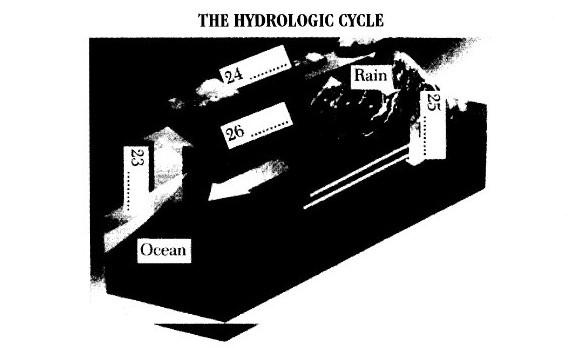
Complete the process diagram below.
Write NO MORE THAN TWO WORDS for each answer.
Questions 27–30 Sentence Completion
Complete the sentences below.
Write NO MORE THAN TWO WORDS for each answer.
- Trees and plants absorb water through their roots and evaporate water through their leaves during 27.
- When soil is saturated, water will penetrate the upper soil layers to get to 28.
- Ground water will eventually get to the surface as springs or 29.
- Water is essential for living organisms because it's the 30 for most biological reactions.
Answers & Explanations Summary
| # | Answer | Evidence | Explanation |
|---|---|---|---|
| Q21 | conservation | The circulation and conservation of earth's water is called the "hydrologic cycle" | Excerpt/Transcript Explanation: The transcript explains that the hydrologic cycle is defined as the movement and preservation of all the water on the earth. Answer Explanation: The answer "conservation" means keeping and saving the total amount of water on Earth so it does not change. Reason For Correctness: The correct answer is "conservation" because the professor clearly states that the "hydrologic cycle" is the name for the movement ("circulation") and preserving ("conservation") of the water on Earth. Key words to look for in the text are "circulation and conservation of earth's water". |
| Q22 | solar | Climatologists study the role of solar energy in the cycle | Excerpt/Transcript Explanation: The transcript directly tells us that climatologists focus on the part that sun energy (solar energy) plays in the water cycle. Answer Explanation: The answer means energy that comes from the sun. Reason For Correctness: The correct answer is "solar" because the professor clearly states that climatologists examine how solar energy functions within the water cycle. In the sentence from the task, "study the role energy plays in the circle", the word directly modifying "energy" in the lecture is "solar". |
| Q23 | Evaporation | Water is continuously absorbed into the atmosphere as vapor - evaporation | Excerpt/Transcript Explanation: The transcript states that when water turns into vapor and is taken into the air, this process is called evaporation. Answer Explanation: The answer means the natural process where liquid water turns into gas (water vapor) and enters the air. Reason For Correctness: The correct answer is confirmed because the professor explains how water moves into the air during the atmospheric phase of the water cycle. The specific stage where water is taken up into the atmosphere as gas is named evaporation. |
| Q24 | Atmospheric Circulation | Water is continuously absorbed into the atmosphere as vapor - evaporation, then water vapor is transported through the atmosphere - atmospheric circulation, and returns to the earth as rain, hail, or snow - precipitation | Excerpt/Transcript Explanation: The transcript explains that water vapor moves through the air, and this step in the process is called atmospheric circulation. Answer Explanation: The answer means the movement and travel of air and water vapor around the Earth's atmosphere. Reason For Correctness: The correct answer is confirmed by the professor's explanation of the atmospheric phase in the water cycle. The professor explains that after water turns into vapor through evaporation, it travels across the air through "atmospheric circulation" before falling back to Earth as precipitation. Keywords to notice include "transported through the atmosphere" and "atmospheric circulation." |
| Q25 | Precipitation | Water is continuously absorbed into the atmosphere as vapor - evaporation, then water vapor is transported through the atmosphere - atmospheric circulation, and returns to the earth as rain, hail, or snow - precipitation | Excerpt/Transcript Explanation: The transcript explains the stages of the atmospheric cycle: water rises into the air by evaporation, moves around with the wind, and finally drops back down to the earth as rain, hail, or snow, which is known as precipitation. Answer Explanation: The answer means water that falls from the sky down to the earth, such as rain, hail, or snow. Reason For Correctness: The correct answer is "Precipitation" because the professor describes the atmospheric phase of the water cycle, explaining that water vapor travels through the air and returns to the ground as rain, hail, or snow, which is called "precipitation". |
| Q26 | Runoff | Sarah: So, the transfer of land water to the oceans is called Runoff, right? Professor: Exactly! Runoff is the movement of land water to the oceans, chiefly in the form of rivers, lakes, and streams | Excerpt/Transcript Explanation: The transcript shows Sarah defining runoff as the process where water transfers from the land into oceans, which the professor confirms is correct. Answer Explanation: The answer refers to water moving across the land and flowing into oceans, usually through rivers and streams. Reason For Correctness: The correct answer is confirmed when Sarah asks if the transfer of land water to the oceans is called "Runoff", and the professor confirms this by stating that runoff is indeed the movement of land water back to the oceans. |
| Q27 | evapotranspiration | Trees and plants circulate and store water, they draw it up through their roots and return it to the atmosphere through their leaves during evapotranspiration | Excerpt/Transcript Explanation: The transcript states that plants take in water with their roots and release it into the air from their leaves during the process of evapotranspiration. Answer Explanation: The answer refers to the natural process called "evapotranspiration," in which water moves up through plants and is released back into the air through their leaves. Reason For Correctness: The correct answer is correct because the professor explicitly states that trees and plants take up water through their roots and send it back into the atmosphere via their leaves during "evapotranspiration." In the sentence completion task, the phrase "absorb water through their roots" matches the professor's words "draw it up through their roots," and "evaporate water through their leaves" matches "return it to the atmosphere through their leaves." |
| Q28 | water table | When it rains, if the soil is already saturated, water will seep downward through the upper soil layers, and possibly reach the water table | Excerpt/Transcript Explanation: The transcript states that if the ground is already completely wet when it rains, water goes down through the upper layers of dirt and may reach the water table. Answer Explanation: The answer "water table" refers to the level underground below which the ground and rocks are completely soaked with water. Reason For Correctness: The correct answer is "water table" because the professor explains what happens when it rains and the soil is already full of water ("saturated"). In that situation, water moves downward through the top layers of soil ("penetrate the upper soil layers" / "seep downward through the upper soil layers") and can reach the "water table". |
| Q29 | stream flow | Most of the groundwater later return to the surface, either as springs or as stream flow, supplying water to plants | Excerpt/Transcript Explanation: The transcript explains that water stored underground eventually comes back up to the surface in two ways: through springs or through running streams. Answer Explanation: The answer "stream flow" means the natural movement of water in streams or rivers. Reason For Correctness: The correct answer is "stream flow" because the sentence asks how groundwater returns to the earth's surface besides coming out as springs. In the lecture, the professor explicitly states that most groundwater later returns to the surface either as "springs" or as "stream flow". |
| Q30 | solvent | Living organisms store and use water, since water is the uh solvent for most biological reactions |
Excerpt/Transcript Explanation: The transcript states directly that living creatures need and use water because water dissolves substances to enable essential life processes. Answer Explanation: The answer "solvent" refers to a liquid that can dissolve other substances. Reason For Correctness: The correct answer is "solvent" because the professor mentions that living things store and use water because water acts as the solvent needed for biological chemical reactions to occur. The sentence in the task asks what water is for these reactions, matching the phrase "solvent for most biological reactions" in the lecture. |
Transcript
Professor: Water is essential for life, and in parts of the world, it's a precious commodity. The distribution of water, however, is quite varied; many locations have plenty of it while others have very little. Water exists on earth as a solid, liquid or gas. Oceans, rivers, clouds, and rain, all of which contain water, are in a frequent state of change - surface water evaporates, cloud water precipitates, rainfall infiltrates the ground, etc. However, the total amount of the earth's water does not change. The circulation and conservation of earth's water is called the "hydrologic cycle" - balances the amount of water in the ocean, in the atmosphere, and on the land. We get our understanding of how the cycle operates from research in climatology and hydrology. So... who can tell me what climatology is?
John: It's the study of climate...and...uh...the causes and effects of different climates.
Professor: That's right. And what is hydrology? Sarah?
Sarah: Well, "hydro" means "water", so it's something to do with water... like the study of water.
Professor: Yes, the prefix "hydro" does refer to water. The hydrologic cycle is the water cycle. And hydrology is the study of the water - the distribution and effect of the water on the earth's surface and in the soil and layers of rock. Think of climatology as the atmospheric phase, and hydrology as the land phase of the water cycle. Climatologists study the role of solar energy in the cycle. They're mainly concerned with the atmospheric phase of the cycle, how solar energy drives the cycle through the...uh...processes of evaporation, atmospheric circulation, and precipitation. Water is continuously absorbed into the atmosphere as vapor - evaporation, then water vapor is transported through the atmosphere - atmospheric circulation, and returns to the earth as rain, hail, or snow - precipitation. The amount of water evaporating from oceans exceeds precipitation over oceans, and excess water vapor is moved by wind to the land.
Sarah: What about the land phase?
Professor: The land phase of the cycle is the concern of hydrologists. Hydrologists study the vast quantities of water in the land phase of the cycle, how water moves over and through the land, and how it's stored on or within the earth. Of the over land surfaces of the precipitation that falls over land, small amounts evaporate while still in the air and...uh...re-enter the atmosphere directly. The rest of it reaches the surface of the land. The water that falls to earth is stored on the surface of lakes, or it penetrates the surface, or it runs off over the surface and flows in rivers to the ocean. Some of the water is stored temporarily in the upper soil layers and used later by trees and plants. When it rains... yes?
Sarah: So, the transfer of land water to the oceans is called Runoff, right?
Professor: Exactly! Runoff is the movement of land water to the oceans, chiefly in the form of rivers, lakes, and streams. Runoff consists of precipitation that neither evaporates, transpires nor penetrates the surface to become groundwater. Even the smallest streams are connected to larger rivers that carry billions of gallons of water into oceans worldwide.
John: I was... um... I wondered if that makes trees and plants part of the hydrologic cycle. I mean, they take in water, and the water moves through them, and then later on... um... the water evaporates from their leaves.
Professor: I'm glad you mentioned that, John. Plants do play an important role in the land phase of the cycle and are therefore part of the cycle. Trees and plants circulate and store water, they draw it up through their roots and return it to the atmosphere through their leaves during evapotranspiration. When it rains, if the soil is already saturated, water will seep downward through the upper soil layers, and possibly reach the water table. When it reaches the water table, it passes into groundwater storage. Most of the groundwater later return to the surface, either as springs or as stream flow, supplying water to plants. Eventually, all of the water falling on land makes its way back to the ocean. The movement of water from land to the ocean is called runoff. Runoff and groundwater together balance the amount of water that moves from the ocean to the land. Every molecule of water in the natural system eventually circulates through the hydrologic cycle. Tremendous quantities of water are cycled annually. And, as John pointed out, living organisms - plants and animals as well - are also part of the cycle, since water is a large part of the mass of most organisms. Living organisms store and use water, since water is the... uh... solvent for most biological reactions.