
Hydropower - IELTS Listening Answers & Explanations
From IELTS Simulation Tests Academic Listening Test 05 · Part 4 · Questions 31–40
Audio
Questions
Questions 31–35 Note Completion
Complete the notes below.
Write ONE WORD ONLY for each answer.
Hydropower
- Renewable—constant source of 31 from natural hydrologic cycle
- 32—90% of hydro energy → electricity
- Clean—no air or 33 pollution
- 34 & durable—simple to operate
- Flexible—can start & adapt quickly to meet demand → leads to 35 of power supply
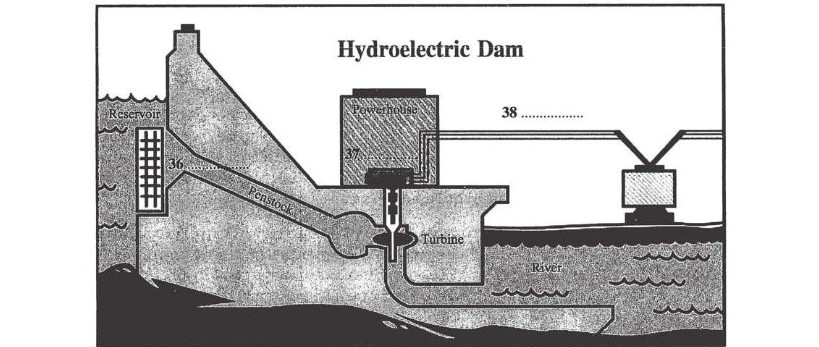
Questions 36–38 Diagram Labeling
Label the diagram below.
Write no more than TWO WORDS for each answer.
Questions 39–40 Sentence Completion
Complete the sentences below.
Write NO MORE THAN TWO WORDS for each answer.
- To be effective, hydroelectric dams should be built across rivers with both sufficient head and 39.
- There needs to be a balance between the needs of 40 living in developed environments and the preservation of natural habitat.
Answers & Explanations Summary
| # | Answer | Evidence | Explanation |
|---|---|---|---|
| Q31 | water | The earth's hydrologic cycle of constant evaporation and transpiration provides a continual supply of water from rainfall and snowmelt | Excerpt/Transcript Explanation: The transcript explains that the earth's natural water cycle continuously delivers a fresh supply of water through rain and melting snow. Answer Explanation: The answer "water" refers to the clear liquid that forms rain, rivers, and oceans, which is constantly provided by the earth's natural water cycle. Reason For Correctness: The correct answer is "water" because the speaker explains that hydropower is renewable because the natural hydrologic cycle provides a "continual supply of water". In the task notes, "constant source" means the same as "continual supply", which makes "water" the exact word needed to fill in the blank. |
| Q32 | efficient | Hydropower plants are able to convert approximately 90% of the energy from the falling water into electric energy whereas many fossil-fuelled plants lose more than half of the energy content of their fuel by way of waste heat and gases. For this reason they are very efficient | Excerpt/Transcript Explanation: The transcript explains that hydropower plants turn about 90% of falling water's energy into electricity, making them extremely efficient compared to fossil-fuel plants. Answer Explanation: The answer "efficient" means working well and producing good results without wasting energy. Reason For Correctness: The correct answer is "efficient" because the speaker discusses how hydropower turns around 90% of water energy into electricity, concluding that this makes it very efficient. Keywords in the notes like "90% of hydro energy" match the speaker's statement about converting "approximately 90% of the energy from the falling water into electric energy," which explains why hydropower is "very efficient." |
| Q33 | noise | No trucks, trains or pipelines are needed to bring fuel to the site and there's no noise pollution either | Excerpt/Transcript Explanation: The transcript explains that hydropower does not need vehicles to bring fuel and it does not create any noise pollution. Answer Explanation: The answer "noise" refers to loud, unwanted sounds. Reason For Correctness: The correct answer is "noise" because the speaker discusses why hydropower is clean. The talk mentions that it does not cause "air pollution" and adds that "there's no noise pollution either." Therefore, "noise" completes the note describing that there is no air or noise pollution. |
| Q34 | reliable | Furthermore, hydropower plant machinery is fairly simple and runs at slow speeds, which makes it reliable and durable | Excerpt/Transcript Explanation: The transcript states that the machines in hydropower plants are simple and operate at low speeds, making them dependable (reliable) and long-lasting (durable). Answer Explanation: The answer "reliable" means trustworthy, dependable, and able to work well without breaking down. Reason For Correctness: The correct answer is "reliable" because the speaker explains that hydropower equipment is simple and runs slowly, which makes it both dependable (reliable) and long-lasting (durable). In the notes, it pairs directly with "& durable". |
| Q35 | stability | And, hydropower units are flexible also—they have the ability to start quickly and adjust rapidly to changes in demand for electricity, thus enabling them to meet peak loads. But this also allows them to serve as reserve capacity and bring more stability to the power system overall | Excerpt/Transcript Explanation: The transcript explains that hydropower machines can turn on fast and change quickly when people need more or less electricity, which makes the whole electric network more stable and reliable. Answer Explanation: The answer "stability" means a steady, reliable, and balanced state where things do not easily break down or fail. Reason For Correctness: The correct answer is "stability" because the speaker explains that hydropower is flexible, starts quickly, and adjusts rapidly to changes in electricity demand. This flexibility helps bring greater balance and "stability" to the whole power supply system. |
| Q36 | intake gate / intake | Water from the reservoir flows through an intake gate into a penstock—this is kind of a narrow channel which leads to the turbine below | Excerpt/Transcript Explanation: The transcript explains that water in the storage area passes through an entrance called an intake gate into a narrow pipe or passage (penstock). Answer Explanation: The answer refers to an "intake gate" (or simply "intake"), which is the opening or door that allows water from the reservoir to enter the channel. Reason For Correctness: The correct answer is confirmed when the speaker describes how a hydropower plant works. The speaker explains that water starts in the reservoir and flows through an "intake gate" to reach the penstock. |
| Q37 | the generator / generator | The force of the water causes the turbine to rotate rapidly which, in turn, drives the generator to spin and produce electricity | Excerpt/Transcript Explanation: The transcript explains that flowing water makes the turbine rotate, which then powers the generator to spin and create electricity. Answer Explanation: The answer refers to the machine (generator) that turns movement into electrical energy. Reason For Correctness: The correct answer is "generator" because the speaker explains the process of making electricity inside the power plant: the moving water turns the turbine, which subsequently drives the generator to spin and produce electricity. Pay attention to the keywords "drives", "spin", and "produce electricity". |
| Q38 | power lines | The electricity is carried the long distances from the powerhouse to substations on the outskirts of cities via power lines | Excerpt/Transcript Explanation: The transcript states that electricity is transported across long distances through power lines. Answer Explanation: The answer "power lines" refers to the cables or wires that transport electricity over long distances. Reason For Correctness: The correct answer is supported by the speaker's explanation of how a hydropower plant works. The speaker mentions that after electricity is produced, it travels from the powerhouse to substations near cities using power lines. |
| Q39 | stream flow | A good dam site must have enough stream flow as well as enough head | Excerpt/Transcript Explanation: The transcript states that a suitable location to build a dam must have an adequate amount of flowing water (stream flow) in addition to sufficient water height difference (head). Answer Explanation: The answer means the movement and amount of water running along a river or stream. Reason For Correctness: The correct answer is "stream flow" because the speaker explains what makes a dam site suitable and effective. In the sentence, the phrase "sufficient head" corresponds to "enough head" in the talk, and the other required element mentioned alongside it is "enough stream flow". |
| Q40 | consumers / people | Certainly dams and reservoirs are built to improve the lives of people living in towns, farming communities and cities. But there must be a balance between development and preserving the natural environment | Excerpt/Transcript Explanation: The transcript explains that dams are created to make life better for humans in communities, but we must also protect nature at the same time. Answer Explanation: The answer means the humans or users who live in towns and cities and use electricity. Reason For Correctness: The correct answer is supported by the speaker's statement about finding a middle ground between human needs and environmental protection. The speaker mentions that dams are made to help the "people" living in towns and farming communities, but there must be a "balance" between this human development and protecting the natural environment. |
Transcript
Welcome to our series on renewable resources. The topic today is hydropower. As you most probably know, 'hydro' means water—so we are talking about using water to generate electricity. Of course, there are many ways to generate electricity but hydropower is important to the community, firstly and obviously, because it's renewable. The earth's hydrologic cycle of constant evaporation and transpiration provides a continual supply of water from rainfall and snowmelt. The second point to consider is its efficiency. Hydropower plants are able to convert approximately 90% of the energy from the falling water into electric energy whereas many fossil-fuelled plants lose more than half of the energy content of their fuel by way of waste heat and gases. For this reason they are very efficient.
Hydropower is also clean. It doesn't emit harmful gases that contribute to air pollution, acid rain, and global warming. No trucks, trains or pipelines are needed to bring fuel to the site and there's no noise pollution either. Furthermore, hydropower plant machinery is fairly simple and runs at slow speeds, which makes it reliable and durable. And, hydropower units are flexible also—they have the ability to start quickly and adjust rapidly to changes in demand for electricity, thus enabling them to meet peak loads. But this also allows them to serve as reserve capacity and bring more stability to the power system overall.
The dams that provide hydroelectric power also have other uses such as navigation, flood damage reduction, water supply, recreation, irrigation and low flow augmentation but it's not the purpose of this talk to go into those details.
How do the hydropower plants work? Well, a dam is built across a river which captures water to form a reservoir and raises the water level to create 'head'. Think of 'head' as the vertical distance that the water falls as it passes through the dam, in other words, the difference in water level between the reservoir behind the dam and the river below. Water from the reservoir flows through an intake gate into a penstock—this is kind of a narrow channel which leads to the turbine below. The force of the water causes the turbine to rotate rapidly which, in turn, drives the generator to spin and produce electricity. The electricity is carried the long distances from the powerhouse to substations on the outskirts of cities via power lines.
Can you build a hydropower unit on any river? Well, no, just having water in a river isn't enough. A good dam site must have enough stream flow as well as enough head. A fast flowing river on the plains is probably not suitable because a dam couldn't be built high enough to provide the head needed for efficient production of electricity. On the other hand, dams in arid high country may have plenty of head but insufficient stream flow. The perfect spot for a hydropower plant is where the right combination of stream flow and head exists.
What about the environment? Surely the construction of large dams has an environmental impact? Well, yes it does. Certainly dams and reservoirs are built to improve the lives of people living in towns, farming communities and cities. But there must be a balance between development and preserving the natural environment. Needless to say, the natural river environment is changed which leads to changes in river ecology and aquatic habitat. Sometimes, for example, dissolved oxygen levels below dams get so low in summer that there is a negative impact on aquatic life. These levels can be improved, however, by using special aerating turbines and/or injecting oxygen directly into the stream flow. In order to protect and improve the habitat for endangered and other species of birds, fish and water life, there needs to be a thorough review of operating plans to see if a better balance can be achieved.
Hydropower plant design and operation must not only meet the needs of consumers for electricity but work hand-in-hand with agencies whose concern is for the fish and wildlife, water quality and water supply.