
Landscape Architecture Project - IELTS Listening Answers & Explanations
From IELTS Trainer 1 Academic Listening Test 5 · Part 3 · Questions 21–30
Audio
Questions
Questions 21–22 Two Choices
Choose TWO letters, A-E.
Which TWO possible objections to a roof garden are discussed?
Questions 23–24 Two Choices
Choose TWO letters, A-E.
Which TWO recent developments in roof-garden building are mentioned?
Questions 25–30 Diagram Labeling
Label the diagram below.
Write the correct letter, A-H, next to questions 25-30.
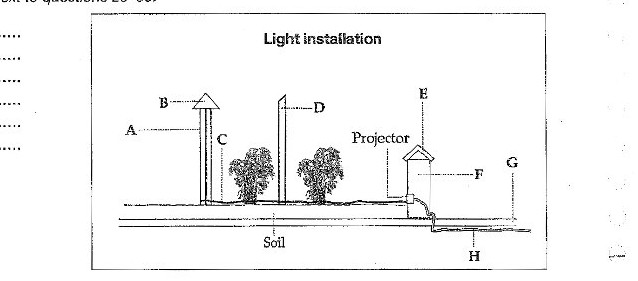
Answers & Explanations Summary
| # | Answer | Evidence | Explanation |
|---|---|---|---|
| Q21 | — | — | |
| Q22 | B / D | Why do you think a supermarket chain would be willing to meet the expense of construction? You do realise that would be the first thing they raise But they might feel the expense of maintenance would be an issue. After all, supermarkets don’t normally employ gardeners |
Excerpt/Transcript Explanation: The transcript shows the teacher asking about the high price of building the structure and pointing out that supermarkets do not have workers available to take care of plants. Answer Explanation: The answer identifies the two main problems talked about by the speakers: the price of building the garden and the question of who will do the gardening work. Reason For Correctness: The correct answer is B and D because the tutor asks about specific problems the supermarket chain might have with the plan. First, the tutor asks why a company would pay for the 'expense of construction,' which refers to the cost of building it (B). Second, the tutor says that 'maintenance' (taking care of the garden) is an 'issue' because supermarkets do not have staff who know how to 'employ gardeners' to look after it (D). |
| Q23 | — | — | |
| Q24 | A / E | Student: You mean the barrier fabric, which ensures there’s no chance of rainwater leaking down into the building? Tutor: Yes, nowadays that is very good, and quite easily sourced What I’ve been looking at are some buildings which use fairly conventional storage tanks, the kind that have been in use for decades, but have them linked to modern automatic watering systems. Tutor: Sounds complicated! Student: It’s less so in practice than it sounds, I think. I’ve been researching them and actually the latest ones definitely work very well |
Excerpt/Transcript Explanation: The transcript shows two parts where new technology is mentioned. First, the tutor says that barrier fabric (used for waterproofing) is very good at this time ("nowadays"). Second, the student mentions current ("modern") watering systems and notes that the most recent ("latest") versions work very well. Answer Explanation: The answer is waterproof barrier materials (A) and watering systems (E). Reason For Correctness: The correct answer is identified by finding items the speakers describe as new or current. The student and tutor discuss barrier fabrics (waterproof materials) that are very good "nowadays." They also talk about "modern automatic watering systems" and mention that the "latest ones" work effectively. In contrast, they describe drainage and storage tanks as things that have been around for a "long time" or for "decades," meaning they are not recent developments. |
| Q25 | F | You have this low wall on the right? Student: Yes, that’s it. This is just one element and these areas would be repeated all round the planted area. I think this will probably be a wooden wall, using reclaimed timbers, with an angled ceramic top surface | Excerpt/Transcript Explanation: The transcript shows the tutor asking about a wall located on the right side of the drawing. The student confirms its position and describes its materials, which include wood and an angled top surface. Answer Explanation: The answer is F, which is the label for the wall in the light feature diagram. Reason For Correctness: The correct answer is F because the tutor and the student identify the location of the wall during their discussion of the drawing. The tutor points out a "low wall on the right," and the student confirms this, adding that it will be made of wood (reclaimed timbers) and have a ceramic (clay) top surface. These details help locate the specific part of the diagram marked as 'F'. |
| Q26 | H | Um, and then the heavy duty electric wiring comes up through the floor just outside the planted area and into the wall | Excerpt/Transcript Explanation: The transcript explains that the thick electrical wires move from the floor area into the side of the garden's wall structure. Answer Explanation: The answer H is the label on the drawing that points to the electric wire. Reason For Correctness: The correct answer is H because the student describes the path of the electricity in his lighting design. He explicitly mentions that the 'heavy duty electric wiring' (which means thick or strong power cables) comes from under the 'floor' and goes 'into the wall.' In the diagram, 'H' represents this specific part of the system. |
| Q27 | C | Tutor: So there’s no electricity in the actual lights. The fibre optic goes across the surface of the soil in the planting area. Student: Yes, that’s the beauty of it. The shrubs will soon grow to cover it up, of course, and then the cable goes past a wooden post which is between the shrubs, and can be a support for them as they grow bigger, and then runs up into each element of the installation | Excerpt/Transcript Explanation: The transcript explains that the cable (the technology used to carry the light) is placed on top of the dirt (the soil) and passes by a wooden pole (a post). This matches position C in the diagram. Answer Explanation: The answer is label C, which marks the position of the fibre optic cable in the diagram. Reason For Correctness: The correct answer is C because the text describes the fibre optic cable's path. It mentioned that the cable travels across the top of the soil and goes past a wooden post. In the diagram, label C points to the line that represents this cable as it moves across the ground from the wall towards the plants. |
| Q28 | D | The shrubs will soon grow to cover it up, of course, and then the cable goes past a wooden post which is between the shrubs, and can be a support for them as they grow bigger, and then runs up into each element of the installation | Excerpt/Transcript Explanation: The transcript explains that the cable moves past a wooden post that is placed inside the bushes. This post is intended to help hold the plants up as they get taller. Answer Explanation: The answer D is the letter that correctly identifies the wooden post shown in the student's diagram. Reason For Correctness: The correct answer is D because the student describes a specific sequence in his drawing. After the fibre optic cable moves across the soil where the plants are, it passes by a wooden post. He mentions that this post is located among the shrubs (small bushes) and helps support them as they grow. In his drawing, the label D points to this specific wooden piece used for support. |
| Q29 | B | Tutor: So the light beam is carried up to the top of each element and illuminates a kind of conical glass cap? I see! Is that the bit which would glow in the dark? Student: Yes | Excerpt/Transcript Explanation: The transcript shows the teacher asking if the light moves to the top of the object to shine on a glass cap that glows, and the student agrees. Answer Explanation: The answer B signifies the part of the light fixture known as the glass cap. Reason For Correctness: The correct answer is B because the student and tutor discuss how light travels through the structure to the very top. The tutor describes this top part as a 'glass cap' that is shaped like a cone ('conical') and 'glows in the dark.' The student confirms that this description is correct. |
| Q30 | A | No, it’s a slender acrylic rod, er, like the stem of a flower or mushroom, which the cable runs up inside of | Excerpt/Transcript Explanation: The transcript explains that the rod is a thin, long piece (like the tall part of a flower) made from a material called acrylic, and it has a cable going through the middle. Answer Explanation: The answer is 'A' because this part of the diagram represents the thin piece of plastic (the acrylic rod) that holds up the top light. Reason For Correctness: The correct answer is identified using the student's description of a light fixture. The tutor asks what holds up the glass cap (the top part), and the student explains that it is supported by a 'slender acrylic rod'. He uses the word 'slender' to show it is very thin and compares it to a 'stem,' which is the long part of a plant that holds up a flower. This helps identify label 'A' as the rod on the diagram. |
Transcript
Now turn to section 3.
You will hear a student of landscape architecture discussing a project with his tutor. First you have some time to look at questions 21 to 24.
[Pause the recording for 30 seconds.]
Now listen carefully and answer questions 21 to 24.
Tutor: So, let’s hear what you’re doing for your next project.
Student: I’ve decided to design a roof garden for a supermarket. I’ve been looking at some on the web and I think that a garden on top of a building is the up-and-coming thing.
Tutor: OK. So you’ve done a bit of reading already? What benefits would there be for the client? Why do you think a supermarket chain would be willing to meet the expense of construction? You do realise that would be the first thing they raise.
Student: Yes, I know. But I’d explain that in spite of the initially high expense, they would save that much in approximately five years. Well, I’d have to do sums, I mean calculate specifically ...
Tutor: Yes, how would the saving come about?
Student: Mainly through lower heating and aircon bills. The extra insulation offered by having a layer of living plants in the soil would make a huge difference.
Tutor: OK. But they might feel the expense of maintenance would be an issue. After all, supermarkets don’t normally employ gardeners.
Student: What I thought was, if they made it a community garden, rather than a simple low-maintenance green roof ...
Tutor: So there’d be public access?
Student: Oh, yes! Then there’d be a sense of ownership in the local community and people could take responsibility for it, instead of the supermarket paying a commercial company, and it’d really boost their public relations.
Tutor: That’s a good point. And have you been looking into how roof gardens are built nowadays?
Student: I’m still exploring that, but if I take advantage of the latest technologies for roof gardens, it shouldn’t be too difficult. But in any case, you have to use lightweight materials.
Tutor: But that’s a matter of making the right choices. You can even use quite traditional ones such as wood for the planting areas.
Student: Yes, that’s what I thought. It’ll look good and it isn’t too heavy.
Tutor: But for the basic construction, the issue you have to address first is the material used between the building and the garden.
Student: You mean the barrier fabric, which ensures there’s no chance of rainwater leaking down into the building?
Tutor: Yes, nowadays that is very good, and quite easily sourced.
Student: Then on the other hand, there’s the business of water within the roof garden itself.
Tutor: You mean drainage? That’s an important feature of the construction in any roof design.
Student: Yes, but I think most drainage issues have been well understood for quite a long time.
Tutor: OK, but another thing is with plants in an exposed situation, you usually need to find ways to optimise rainfall.
Student: Yes, because rainwater is best for the garden, if you can store it for when it’s needed. What I’ve been looking at are some buildings which use fairly conventional storage tanks, the kind that have been in use for decades, but have them linked to modern automatic watering systems.
Tutor: Sounds complicated!
Student: It’s less so in practice than it sounds, I think. I’ve been researching them and actually the latest ones definitely work very well and they can be electronically regulated to suit the local microclimate.
Before you hear the rest of the conversation, you have some time to look at questions 25 to 30.
[Pause the recording for 30 seconds.]
Now listen and answer questions 25 to 30.
Tutor: Mmm, that sounds interesting. You seem to have been doing some thorough research! Make sure you reference all your sources when you write it up.
Student: Yes, sure. Um, there’s one more aspect I’d just like to run past you, if there’s time? I want to include a light feature in the design.
Tutor: Of course.
Student: I’ve got a sketch here.
Tutor: Let’s have a look then.
Student: Well, I was really impressed by something I saw on a roof in Cornwall and I’d like to design something similar. Um, you have an area of planting, and I’m thinking of installing this lighting in an area filled with low-growing evergreen shrubs.
Tutor: Mmm. You’d have to have lights and things well away from anywhere children might be. But I can see this could be very effective, if a bit complicated. How would it work? On this drawing, this is a section view? You have this low wall on the right?
Student: Yes, that’s it. This is just one element and these areas would be repeated all round the planted area. I think this will probably be a wooden wall, using reclaimed timbers, with an angled ceramic top surface.
Tutor: Perhaps even ridge tiles like they use on roofs?
Student: Oh, yes, that’d be just the sort of thing. And that’d make it weatherproof. Um, and then the heavy duty electric wiring comes up through the floor just outside the planted area and into the wall. Then it’s brought through to a projector low in the side of the wall, and that sends a beam of light along the fibre optic cable.
Tutor: So there’s no electricity in the actual lights. The fibre optic goes across the surface of the soil in the planting area.
Student: Yes, that’s the beauty of it. The shrubs will soon grow to cover it up, of course, and then the cable goes past a wooden post which is between the shrubs, and can be a support for them as they grow bigger, and then runs up into each element of the installation.
Tutor: So the light beam is carried up to the top of each element and illuminates a kind of conical glass cap? I see! Is that the bit which would glow in the dark?
Student: Yes.
Tutor: And what’s the cap supported on? Is it a wall?
Student: No, it’s a slender acrylic rod, er, like the stem of a flower or mushroom, which the cable runs up inside of.
Tutor: Well, I’ll be interested to see the final drawings.
Student: Thank you! I’m looking forward to putting it all together.
That is the end of section 3. You now have half a minute to check your answers.
[Pause the recording for 30 seconds.]