
Meteorology and Cloud Formation - IELTS Listening Answers & Explanations
From IELTS Simulation Tests Academic Listening Test 10 · Part 4 · Questions 31–40
Audio
Questions
Questions 31–32 Short Answers
Write ONE WORD ONLY for each answer.
Name TWO elements which produce weather:
Questions 33–37 Diagram Labeling
Label the diagram below.
Choose your answers from the box and write the letters A-E next to questions 33-37.
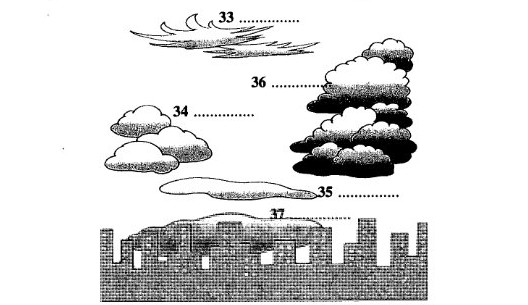
A. Cirrus | B. Cumulonimbus | C. Stratus
D. Fog | E. Cumulus
Questions 38–40 Flow Chart Completion
Complete the flow chart below.
Write NO MORE THAN TWO WORDS for each answer.
Old assumption:
Large dust particles ⇒ 38 ⇒ more rain
New research:
More dust ⇒ less rain (because water too dispersed to form 39 )
Conclusion:
Loss of topsoil in nearby areas ⇒ progressive 40 of deserts
Answers & Explanations Summary
| # | Answer | Evidence | Explanation |
|---|---|---|---|
| Q31 | sun / atmosphere / troposphere / vapour / wind / vapor | The four main ingredients are the sun, the atmosphere, water vapour and the wind |
Excerpt/Transcript Explanation: The transcript explicitly lists the four main elements that work together to create weather: the sun, the atmosphere, water vapour, and the wind. Answer Explanation: The answer refers to one of the basic components that make weather, which includes the sun, the atmosphere, the troposphere, water vapour, or the wind. Reason For Correctness: The correct answer is verified by the speaker's explanation of what creates weather. The speaker clearly mentions that the main parts or 'ingredients' needed to produce weather are the sun, the atmosphere, water vapour, and the wind. |
| Q32 | sun / atmosphere / troposphere / vapour / wind / vapor | The four main ingredients are the sun, the atmosphere, water vapour and the wind |
Excerpt/Transcript Explanation: The transcript clearly states that the four primary components that make weather are the sun, the atmosphere, water vapour, and the wind. Answer Explanation: The answer refers to any one of the key parts that create weather, such as the "sun", "atmosphere", "troposphere", "vapour", or "wind". Reason For Correctness: The correct answer is supported by the speaker's statement about what makes up the weather. The speaker explicitly lists the four main "ingredients" (which means elements or parts) as the sun, the atmosphere, water vapour, and the wind. Therefore, providing any of these single words correctly names an element that produces weather. |
| Q33 | A | The high altitude Cirrus cloud, on the other hand is mostly made of ice crystals and appears wispy and thin—almost hair-like—in fact, that's where they get their name from the word 'cirro' meaning 'wisp of hair' |
Excerpt/Transcript Explanation: The transcript explains that Cirrus clouds are high in the sky, look like thin wisps of hair, and are composed of ice crystals. Answer Explanation: The answer is option A, which corresponds to "Cirrus". Reason For Correctness: The correct answer is A because the speaker introduces "Cirrus" as a cloud located at a high altitude that looks thin, wispy, and hair-like, and is primarily made of ice crystals. Keywords to listen for include "high altitude", "Cirrus", "wispy and thin", and "hair-like". |
| Q34 | E | We'll start with Cumulus which is a low cloud with a white, puffy appearance and most often composed of water droplets. It gets its name from 'cumulo' meaning 'heap' for its typical 'piled-up' appearance | Excerpt/Transcript Explanation: The transcript explains that Cumulus is a low-altitude cloud that looks white, puffy, and piled up like a heap. Answer Explanation: The answer is option E, which refers to Cumulus clouds. Reason For Correctness: The correct answer is E because the speaker introduces Cumulus clouds as low clouds that look white and puffy, resembling a heap or piled-up structure. |
| Q35 | C | Now, let's move on to Stratus (from 'strato' meaning 'layer')—these are the grey, horizontal ones (often with a flat base) that you see on an overcast day and they too are mostly made up of water droplets | Excerpt/Transcript Explanation: The transcript explains that Stratus clouds get their name from a word meaning "layer," and they appear as horizontal, grey clouds with a flat bottom on cloudy days. Answer Explanation: The answer choice C refers to "Stratus", which is a type of flat, layered, grey cloud. Reason For Correctness: The correct answer is C because the speaker describes "Stratus" as flat-based, horizontal, layered grey clouds commonly seen on overcast days. |
| Q36 | B | Not so the Cumulonimbus—the tallest of all clouds—they extend way up into the troposphere and these are the ones that produce lightning, thunder, heavy rain, strong winds and tornadoes | Excerpt/Transcript Explanation: The transcript states that Cumulonimbus is the tallest cloud, reaching very high into the sky and bringing severe storms with thunder, lightning, and heavy rain. Answer Explanation: The answer B corresponds to the cloud type "Cumulonimbus". Reason For Correctness: The correct answer is B because the speaker describes "Cumulonimbus" as the tallest of all clouds, extending high up into the troposphere, and producing extreme weather like lightning, thunder, heavy rain, strong winds, and tornadoes. In cloud classification diagrams, the massive, vertically towering storm cloud represents Cumulonimbus. |
| Q37 | D | At this point, I should mention Fog, which you probably don't even think of as clouds, but fog consists of very low stratus—ground-hugging clouds | Excerpt/Transcript Explanation: The transcript explains that fog is made of very low clouds that stay right along the ground. Answer Explanation: The answer is option D, which refers to "Fog". Reason For Correctness: The correct answer is D because the speaker describes fog as a type of cloud that is extremely low and touches or hugs the ground ("ground-hugging clouds"). In diagram labeling questions about cloud altitudes and types, the cloud at ground level corresponds to Fog. |
| Q38 | larger droplets / large droplets | So, it was assumed, large dust particles would produce larger droplets and enhance the formation of rain | Excerpt/Transcript Explanation: The transcript explains that in the past, people believed big pieces of dust would create bigger water drops and cause more rain to fall. Answer Explanation: The answer "large(r) droplets" means bigger drops of water that form inside clouds. Reason For Correctness: The correct answer is confirmed by the speaker's explanation of the old belief (assumption). The speaker states that people used to assume large dust particles create larger water droplets, which in turn would lead to more rain (enhance rain formation). Therefore, "larger droplets" fits the step between large dust particles and more rain. |
| Q39 | raindrops / rain | Scientists have shown that as more and more dust enters a rain cloud, the same amount of water becomes spread out. The resulting smaller water droplets scatter instead of combining and growing large enough to make up raindrops | Excerpt/Transcript Explanation: The transcript explains that when extra dust enters a cloud, the water spreads out thinly into tiny droplets. Because these droplets are scattered, they cannot join together to grow big enough to become raindrops. Answer Explanation: The answer "rain(drops)" refers to the drops of water that fall from clouds as rain. Reason For Correctness: The correct answer is confirmed by the speaker when explaining new research about dust and clouds. When too much dust gets into a rain cloud, the water spreads out into smaller droplets that scatter rather than joining together to become large enough to create "raindrops" (rain). In the flow chart, "water too dispersed" corresponds directly to "the same amount of water becomes spread out" and "scatter instead of combining". |
| Q40 | expansion | Therefore, loss of topsoil from over-grazing, over-cultivation or bad livestock management in areas neighbouring desert will contribute to the continuing expansion of those arid regions | Excerpt/Transcript Explanation: The transcript explains that when dry areas lose their top layer of soil, it causes deserts (arid regions) to keep expanding and growing bigger. Answer Explanation: The answer "expansion" means the act of growing larger or spreading into new areas. Reason For Correctness: The correct answer is "expansion" because the speaker discusses what happens when topsoil is lost in areas next to deserts. In the lecture, "areas neighbouring desert" corresponds to "nearby areas", and "continuing" matches the idea of "progressive". The speaker states that losing topsoil will lead to the "continuing expansion" of dry, desert areas. |
Transcript
Good morning. It's good to see so many of you taking an interest in meteorology. As you are all newcomers to the topic, let's keep it simple to start with. In fact, let's begin with a very simple definition of what meteorology is—the suffix '-ology' gives you a clue—at least you can all guess that it is 'the study of '...something. Meteorology is in fact the scientific study of all changes in the atmosphere—essential for forecasting the weather, of course. And you all know what weather is, right? The four main ingredients are...the sun, the atmosphere, water vapour and the wind. They all come together, disseminating heat from the sun around the globe and making clouds in the layer of the atmosphere directly above the ground which is called the troposphere. Look up into the sky and on almost any day of the year you'll see clouds.
Clouds form when water that has evaporated from the surface of the Earth condenses onto microscopic dust particles (or other particles) floating in the air. Cloud formation takes different shapes and they mostly get their names from Latin roots. Now, let's look at the five most basic. We'll start with Cumulus which is a low cloud with a white, puffy appearance and most often composed of water droplets. It gets its name from 'cumulo' meaning 'heap' for its typical 'piled-up' appearance.
Now, let's move on to Stratus (from 'strato' meaning 'layer')—these are the grey, horizontal ones (often with a flat base) that you see on an overcast day and they too are mostly made up of water droplets. At this point, I should mention Fog, which you probably don't even think of as clouds, but fog consists of very low stratus—ground-hugging clouds.
The high altitude Cirrus cloud, on the other hand is mostly made of ice crystals and appears wispy and thin—almost hair-like—in fact, that's where they get their name...from the word 'cirro' meaning 'wisp of hair'. They are generally fair-weather clouds.
Not so the Cumulonimbus—the tallest of all clouds—they extend way up into the troposphere and these are the ones that produce lightning, thunder, heavy rain, strong winds and tornadoes. Beware the Cumulonimbus! You already know what cumulo means and it won't surprise you to find out that 'nimbus' means 'rain' and, added as a suffix, is an indication of the cloud's ability to produce precipitation which could be rain, snow or hailstones.
As this course progresses, you'll learn a lot more about cloud types but before I finish today, I want to go back to something I mentioned before—dust. It is generally accepted that when water vapour ascends in the process of cloud formation it condenses onto dust particles. So, it was assumed, large dust particles would produce larger droplets and enhance the formation of rain. However, recent research has shown the opposite to be true. Droplet size increases the farther the clouds are from dust-filled air. More dust reaching rain clouds produces less rainfall. Scientists have shown that as more and more dust enters a rain cloud, the same amount of water becomes spread out. The resulting smaller water droplets scatter instead of combining and growing large enough to make up raindrops.
This study shows that higher dust frequency is not inevitably the result of diminished rainfall but rather its cause! Therefore, loss of topsoil from over-grazing, over-cultivation or bad livestock management in areas neighbouring desert will contribute to the continuing expansion of those arid regions.
Your assignment for this week will be to read up on this research and write a report on how dust from damaged land may exacerbate drought conditions and lead to further desertification of arid areas. In other words, how land use has an impact on climate change.