
Wetlands - IELTS Listening Answers & Explanations
From IELTS Simulation Tests Academic Listening Test 10 · Part 3 · Questions 21–30
Audio
Questions
Questions 21–26 Summary Completion
Complete the summary below.
Choose your answers from the box and write the letters A-N next to questions 21-26.
A. water quality | B. seasonal change | C. saturated soil
D. safe places | E. quite low | F. quite high
G. nutrients | H. nurseries | I. international recognition
J. farming activity | K. extinct | L. continued existence
M. commercial development | N. at risk
A wetland is an area where the soil is typically water-logged. Plants and animals living there depend on the wetness for their 21. Draining swamps is a widespread occurrence which kills off wildlife and, consequently, wetlands are 22 worldwide. It is a feature of wetlands that conditions vary according to 23. Water-tolerant plants grow both in and out of the water and water levels are usually 24. Wetlands naturally occur between land and water and become 25 for various wildlife during very dry periods. They also act as nurseries for different kinds of animal life. Wetlands are known to upgrade 26 by removing pollutants.
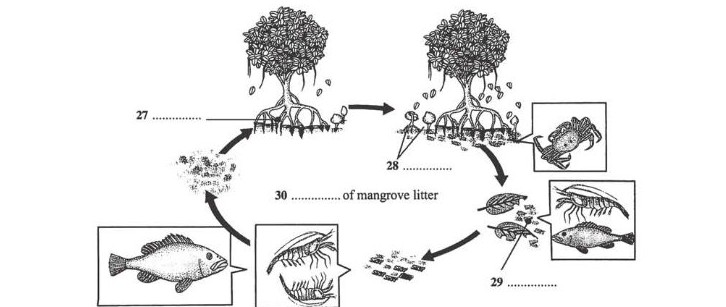
Questions 27–30 Diagram Labeling
Complete the diagram below.
Write NO MORE THAN TWO WORDS for each answer.
Answers & Explanations Summary
| # | Answer | Evidence | Explanation |
|---|---|---|---|
| Q21 | L | PERRY: And we could add: 'the flora and fauna of the area are reliant on the water-logged soil for their survival' | Excerpt/Transcript Explanation: The transcript states that the plants and animals in a wetland need the wet, water-filled soil in order to survive (continue living). Answer Explanation: The answer "L" means "continued existence", which refers to living things staying alive or surviving. Reason For Correctness: The correct answer is L because the summary states that plants and animals depend on the wet soil for something essential. In the conversation, Perry explains that "the flora and fauna of the area are reliant on the water-logged soil for their survival". Here, "flora and fauna" means "plants and animals", "reliant on" means "depend on", and "survival" directly corresponds to "continued existence". |
| Q22 | N | Did you know that, as a result, wetlands are recognised internationally as one of the most threatened types of habitat | Excerpt/Transcript Explanation: The transcript states that people around the world know wetlands are among the most threatened and endangered habitats. Answer Explanation: The answer "N" means "at risk" or in danger of being damaged or destroyed. Reason For Correctness: The correct answer is N because Opal mentions that wetlands are recognized all over the world as one of the most threatened types of habitat. In the summary text, "worldwide" matches "internationally", and "at risk" is a direct synonym for "threatened". |
| Q23 | B | wetlands are limited areas of open water, which vary depending on seasonal fluctuations | Excerpt/Transcript Explanation: The transcript states that wetlands change based on the shifts and changes that happen with each season of the year. Answer Explanation: The answer "B" stands for "seasonal change", which means the different conditions that happen during different times of the year. Reason For Correctness: The correct answer is B because the summary states that conditions in wetlands "vary according to" something. In the transcript, Perry mentions that wetlands are areas of open water that "vary depending on seasonal fluctuations". The phrase "seasonal fluctuations" has the exact same meaning as "seasonal change". |
| Q24 | E | Of course, depending on the time of year, there may be more or less water but levels generally remain quite shallow | Excerpt/Transcript Explanation: The transcript states that the water in wetlands is usually not deep, meaning the water level stays quite low. Answer Explanation: The answer "E" means "quite low". Reason For Correctness: The correct answer is E because Perry explains that although the amount of water can change during the year, water levels generally stay "quite shallow." The word "shallow" means having little depth, which directly corresponds to the phrase "quite low." Therefore, option E accurately describes the typical water levels in wetlands. |
| Q25 | D | They turn into refuge areas or sanctuaries in times of drought and they often support rare and threatened plants and animals found nowhere else | Excerpt/Transcript Explanation: The transcript explains that when there is very little rain (drought), wetlands become safe shelters (refuges or sanctuaries) for living things. Answer Explanation: The answer "D" means safe locations or shelters where animals and plants are protected from harm. Reason For Correctness: The correct answer is D because the summary discusses how wetlands serve animals when the weather is very dry ("during very dry periods"). In the conversation, Opal mentions that wetlands "turn into refuge areas or sanctuaries in times of drought". The terms "refuge areas" and "sanctuaries" directly correspond to the phrase "safe places" (Option D), and "in times of drought" corresponds to "during very dry periods". |
| Q26 | A | OPAL: Wetlands are important for improving the purity of the water, too. PERRY: Yes, that's because the flow of water through the wetlands is slowed by bank and in-stream plants, and so it allows sediment to settle. Nutrients, such as nitrogen and phosphorous and other pollutants are removed as the water passes through | Excerpt/Transcript Explanation: The transcript explains that wetlands make water cleaner (improve its purity) because the plants slow the water down and filter out dirt and harmful pollutants. Answer Explanation: The answer "A" means "water quality", which refers to how clean and pure the water is. Reason For Correctness: The correct answer is A because Opal mentions that wetlands help by "improving the purity of the water," and Perry adds that pollutants and nutrients are filtered out as water moves through. In the summary text, "upgrade" matches "improving," and "the purity of the water" directly corresponds to "water quality". |
| Q27 | aerial roots / aaerial roots / aërial roots | They're very special because of their aerial roots that allow them to breathe even when the tide is high and their roots are under water | Excerpt/Transcript Explanation: The transcript explains that mangrove trees have special roots above the water called aerial roots, which let the trees breathe when water levels rise. Answer Explanation: The answer refers to roots that grow above the ground or water in the air to help a plant take in air. Reason For Correctness: The correct answer is confirmed by Perry's explanation of mangrove trees. He states that mangrove trees are unique and special because they have "aerial roots" which enable them to breathe even when water covers them at high tide. |
| Q28 | the seedlings / seedlings | A unique feature of mangroves is their ability to develop leaves on their seeds while they're still on the tree and the seedlings drop down planting themselves directly into the mud underneath | Excerpt/Transcript Explanation: The transcript states that young mangrove plants (seedlings) begin growing leaves while still on the tree before dropping into the mud below to grow. Answer Explanation: The answer "seedlings" refers to very young, newly sprouted plants. Reason For Correctness: The correct answer is "seedlings" because Perry explains that mangrove seeds develop leaves while still attached to the tree, and then these "seedlings" fall down and plant themselves straight into the mud below. |
| Q29 | the leaves / leaves / fallen leaves / decomposed leaves / litter | PERRY: The fallen leaves, or litter, decay in the water and form a rich mud that feeds bacteria, worms and small crustaceans. OPAL: You mean things like prawns and crabs feed on the decomposed leaves | Excerpt/Transcript Explanation: The transcript states that leaves falling from mangrove trees are called litter, and when they rot or decay, creatures like bacteria, worms, and crabs eat them as food. Answer Explanation: The answer "decomposed leaves/litter" means old plant leaves that have fallen into the water and broken down or rotted naturally. Reason For Correctness: The correct answer is supported by the discussion about the mangrove nutrient cycle. Perry explains that the fallen leaves are called "litter" and that they "decay" (break down) in the water to feed small organisms. Opal then confirms that small sea creatures feed on these "decomposed leaves". Therefore, both "decomposed leaves" and "litter" correctly describe this stage of the cycle. |
| Q30 | nutrient cycle | PERRY: Yes, that's exactly it, that's what we'll call it—the nutrient cycle of mangrove litter | Excerpt/Transcript Explanation: The transcript shows Perry confirming the name for this repeated natural process as the "nutrient cycle". Answer Explanation: The answer "nutrient cycle" refers to the continuous natural process in which food and energy substances move through living things, soil, and plants in an ecosystem. Reason For Correctness: The correct answer is "nutrient cycle" because when Perry and Opal finish describing how fallen mangrove leaves break down, feed small organisms and fish, and return food back to the tree roots, Perry summarizes and titles the whole process as "the nutrient cycle of mangrove litter". |
Transcript
PERRY: Hi, Opal. Any ideas about what we should do for our geography project?
OPAL: Hi, Perry. Yes, I'd like to do something on Wetlands.
PERRY: I think that's a great idea—where do we start?
OPAL: With a definition of course—something like: 'a marshy area of land where the soil near the surface is saturated or covered with water, forming a special habitat for wildlife'.
PERRY: And we could add: 'the flora and fauna of the area are reliant on the water-logged soil for their survival'.
OPAL: Yes, that's a major problem actually—when commercial developers or farmers come along and decide to drain the swamps—everything dies. The practice is all too common unfortunately. Did you know that, as a result, wetlands are recognised internationally as one of the most threatened types of habitat?
PERRY: That's right. We'll have to be sure to discuss their importance in our assignment.
OPAL: But, first; I think we should state some of the particular characteristics of wetlands.
PERRY: Well, there are three that I can think of. To start with: wetlands are limited areas of open water, which vary depending on seasonal fluctuations.
OPAL: Yes...and the second could be that there's usually a variety of water-tolerant flora on the banks and throughout the water.
PERRY: Of course, depending on the time of year, there may be more or less water but levels generally remain quite shallow.
OPAL: Okay...now let's move on to the importance of wetlands.
PERRY: Shall we start with plant and wildlife habitat?
OPAL: Yes, I think we should point out that wetlands are homes for countless species of water birds, frogs, invertebrates and fish...
PERRY: ...and they support many varieties of water-loving plants...
OPAL: which brings us naturally to the topic of biodiversity—even small wetlands act as borders between land and permanent water. They turn into refuge areas or sanctuaries in times of drought and they often support rare and threatened plants and animals found nowhere else.
PERRY: Exactly. And they're especially important as nurseries and breeding grounds for all kinds of fish, birds and invertebrates.
OPAL: Wetlands are important for improving the purity of the water, too.
PERRY: Yes, that's because the flow of water through the wetlands is slowed by bank and in-stream plants, and so it allows sediment to settle. Nutrients, such as nitrogen and phosphorous and other pollutants are removed as the water passes through.
OPAL: Okay, at this point I think we should look at mangroves...they're important for nutrient removal...
PERRY: I think 'nutrient recycling' is more accurate...and biological productivity...because wetlands are really very productive ecosystems.
OPAL: Should we do a food web, then?
PERRY: We should do a diagram of some sort showing the importance of mangrove trees but maybe not a food chain...
OPAL: How about you explain it while I try and sketch it?
PERRY: Right. Well, let's start with the mangrove trees. They're very special because of their aerial roots that allow them to breathe even when the tide is high and their roots are under water. They can live in salt water and the salt enters through the roots, travels up to the older leaves and then these die and drop back into the water. A unique feature of mangroves is their ability to develop leaves on their seeds while they're still on the tree and the seedlings drop down planting themselves directly into the mud underneath.
OPAL: Mmm, got that. What happens to those older leaves that fall?
PERRY: The fallen leaves, or litter, decay in the water and form a rich mud that feeds bacteria, worms and small crustaceans.
OPAL: You mean things like prawns and crabs feed on the decomposed leaves?
PERRY: Yes, and even little fish do as well.
OPAL: And bigger fish feed on them.
PERRY: Eventually the remaining organic matter—which is now just very tiny particles—is taken up through the root system providing nourishment for the mangrove trees.
OPAL: And the cycle begins all over again.
PERRY: Yes, that's exactly it, that's what we'll call it—the nutrient cycle of mangrove litter.
OPAL: Great. I'll go home and work on this and we'll meet again tomorrow.
PERRY: Okay, see you then.