
Neutrinos - IELTS Listening Answers & Explanations
From IELTS Recent Actual Test 6 Academic Listening Test 4 · Part 4 · Questions 31–40
Audio
Questions
Questions 31–35 Note Completion
Complete the notes.
Write NO MORE THAN TWO WORDS for each answer.
| Neutrinos | |
|---|---|
| • are everywhere | 100 to 200 31 pass through our bodies every second. |
| • are difficult to detect because of | 1. the presence of other particles → usually need a 32 |
| 2. the surrounding 33 → detection location usually 34 | |
| 3. challenge of installing equipment → engineering is very 35 | |
Questions 36–40 Diagram Labeling
Complete the diagram.
Write NO MORE THAN TWO WORDS AND/OR NUMBERS for each answer.
Answers & Explanations Summary
| # | Answer | Evidence | Explanation |
|---|---|---|---|
| Q31 | billion | most people know of electrons, protons, and neutrons, but almost none know of another particle, even though they are constantly emitted from the sun in the trillions, with 100 to 200 billion of them regularly passing through your body every second | Excerpt/Transcript Explanation: The transcript says that even though we don't feel them, 100 to 200 billion of these tiny particles called neutrinos go through our bodies every second. Answer Explanation: The answer means that every single second, between 100 and 200 billion neutrinos travel through a human body. Reason For Correctness: The correct answer is supported by the lecturer's statement about how many neutrinos enter our bodies. The speaker explicitly mentions the specific number '100 to 200 billion' and emphasizes that it is a very large amount, repeating that we are talking about billions rather than just thousands or millions. |
| Q32 | clean room | To do this, you need what is called a clean room, one that has an extremely low level of dust, microbes, floating particles, or chemical vapours | Excerpt/Transcript Explanation: The transcript states that to find neutrinos, you must get rid of other particles. This is done by using a specific type of environment known as a clean room. Answer Explanation: The answer "clean room" refers to a special space where the air is filtered to keep out almost all tiny bits of dust or other particles. Reason For Correctness: The correct answer is "clean room" because the lecturer explains that neutrinos are so tiny that other particles around them must be removed to see them. To achieve this, scientists use a "clean room," which contains very few floating particles compared to normal air. |
| Q33 | radiation | The second problem is that you also need an environment with absolutely no background radiation | Excerpt/Transcript Explanation: The transcript states that the second difficulty is finding a place that has no background radiation flowing through it. Answer Explanation: The answer "radiation" refers to invisible energy that is all around us, coming from the sun, the sky, and electronic devices like TVs. Reason For Correctness: The correct answer is "radiation" because the lecturer explains that this is the second major difficulty in detecting neutrinos. This energy exists everywhere on the surface of the Earth, so to avoid it, scientists must build detectors in very deep locations. In this context, "surrounding" refers to the "background radiation" that exists in the environment where we live. |
| Q34 | deep underground / underground | The only way to screen out all that is to go underground, and I mean deep underground | Excerpt/Transcript Explanation: The transcript explains that the only method to block unwanted radiation is to place the detection facility far below the Earth's surface. Answer Explanation: The answer means that the equipment used to find neutrinos is placed far below the surface of the Earth. Reason For Correctness: The correct answer is derived from the lecturer's explanation that background radiation on the Earth's surface interferes with neutrino detection. To block or 'screen out' this radiation, the detection equipment must be placed in a location far 'underground,' such as in deep mines. The lecturer emphasizes this by saying 'deep underground' to show how far down it must go. |
| Q35 | complex | Holding such a weighty construction safe and secure requires complex engineering work, such as rock-bolting and support structuring | Excerpt/Transcript Explanation: The transcript explains that to keep the heavy equipment safe and in place, engineers must perform very detailed and difficult work, specifically using the word "complex" to describe it. Answer Explanation: The answer "complex" means that something is not simple and has many different parts or steps that make it difficult to do. Reason For Correctness: The correct answer is "complex" because the lecturer describes the difficulty of installing the large equipment deep underground. They mention that keeping the heavy structure safe and steady needs "complex engineering work." This matches the notes which ask about the nature of the engineering involved in the installation. |
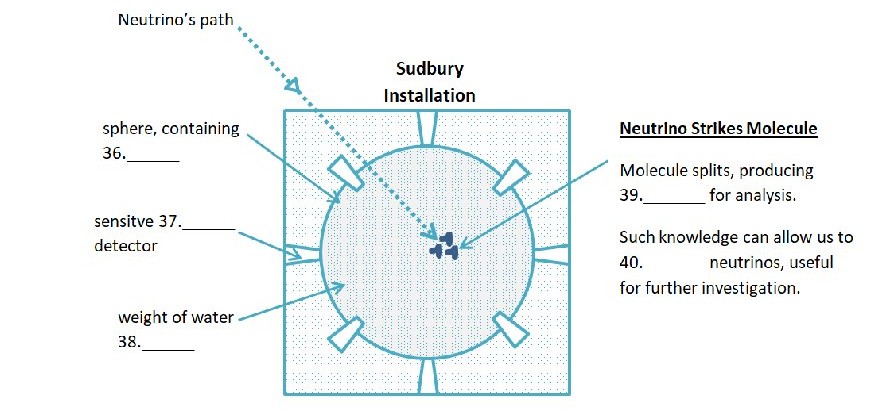
| Q36 | heavy water | The detector there consists of a spherical container filled with heavy water | Excerpt/Transcript Explanation: The transcript explains that the main part of the detection machine is a round tank that is filled with 'heavy water' to help catch the tiny particles. Answer Explanation: The answer identifies a special type of liquid used inside the neutrino detector. Reason For Correctness: The correct answer is 'heavy water' because the transcript describes the construction of the Sudbury neutrino detector, noting that it contains a spherical ball filled with this specific substance. This material is chosen because its heavier molecules increase the rare chance that a neutrino will hit a water molecule and be detected. |
| Q37 | electronic | At the edge of this inner sphere are about 10,000 electronic detectors | Excerpt/Transcript Explanation: The transcript states that there are approximately 10,000 electronic devices used to sense particles located on the boundary of the inner container. Answer Explanation: The answer "electronic" describes the specific type of technology used for the detectors that find neutrinos. Reason For Correctness: The correct answer is determined by the lecturer's description of the Sudbury installation's structure. He explains that there is an inner sphere (a round container), and on the edge (the outside part) of this sphere, there are 10,000 sensors. He specifically uses the word "electronic" to describe these detectors, which are very sensitive to electricity. |
| Q38 | 1000 tons / 1 000 tons / 1,000 tons | One, the larger the sphere of water, the better, and the Sudbury tank holds not 10 tons, not 100 tons, but 1000 tons | Excerpt/Transcript Explanation: The transcript explains that using a large amount of water makes it easier to find neutrinos. It then states that the specific tank at Sudbury contains 1000 tons of this water. Answer Explanation: The answer is the total weight of the water inside the large tank used at the Sudbury facility. Reason For Correctness: The correct answer is based on the lecturer's description of the Sudbury installation. To increase the chance of a neutrino hitting a water molecule, they use a massive amount of water. The speaker specifies the exact capacity of the tank, noting it holds 1000 tons, which is significantly more than smaller amounts like 10 or 100 tons. |
| Q39 | electric current | If the neutrino hits the water molecule, the neutrino is absorbed, but the molecule itself splits apart, producing a tiny electric current | Excerpt/Transcript Explanation: The transcript says that when a neutrino hits the water, the water molecule breaks. This action creates a very small amount of electricity. Answer Explanation: The answer is a small flow of electricity. Reason For Correctness: The correct answer is the result of a neutrino hitting a water molecule. The transcript explains that when this collision happens, the water molecule breaks into pieces. This process creates or 'produces' a small amount of electricity. Scientists use machines to find this electricity to learn about the particles. Keywords to notice are 'splits apart' and 'producing'. |
| Q40 | control | No other form of radiation can do that, meaning that the knowledge we get about neutrinos can help us to control them | Excerpt/Transcript Explanation: The transcript explains that since neutrinos can travel through difficult areas without losing their strength, the information researchers collect will give us the ability to manage or handle the particles. Answer Explanation: The answer "control" means that by gathering more information about neutrinos, scientists hope to eventually be able to manage or use these particles for research purposes. Reason For Correctness: The correct answer is "control" because the lecturer explains the goal of studying these elusive particles. He points out that neutrinos are unique because they aren't affected by traveling through things like the sun's core. Because of this special quality, he explains that gaining knowledge about them is a way to help us "control" them, which then allows scientists to explore the earth and solar system in new ways. |
Transcript
SECTION 4
You will hear a lecturer talking about an unusual atomic particle, called the neutrino.
When considering the smallest unit of matter—the atom — most people know of electrons, protons, and neutrons, but almost none know of another particle, even though they are constantly emitted from the sun in the trillions, with 100 to 200 billion of them regularly passing through your body every second. To repeat, that’s not thousands, not millions, but billions, every second. You don’t feel them because they are small, in fact, so tiny that we can barely detect their presence at all. These mysterious particles are called neutrinos.
Despite such an abundance, detecting them is a huge undertaking, and there are many reasons for this. Firstly, the neutrino itself is so small that you need to eliminate absolutely all other particles around. To do this, you need what is called a clean room, one that has an extremely low level of dust, microbes, floating particles, or chemical vapours. You probably don’t know it, but the air around you right now has almost 40 million particles per cubic meter. In contrast, the cleanest of clean rooms has less than 10.
The second problem is that you also need an environment with absolutely no background radiation. At the surface of the Earth, such radiation is all around, from the sun and sky, and from TVs and communication devices. The only way to screen out all that is to go underground, and I mean deep underground. For example, the Sudbury Neutrino Observatory in Canada uses an old nickel mine, one of the deepest in the world, and puts the Observatory in its lowest tunnel, more than two kilometers below the surface. At such depths, stray radiation is sufficiently screened out to allow neutrinos only to pass by.
The final problem is that you need an elaborate detection system, and this apparatus is huge, and its installation in this deep underground cavity presents quite a headache. Holding such a weighty construction safe and secure requires complex engineering work, such as rock-bolting and support structuring. This obviously requires great care, and takes a lot of effort.
So, I've told you about the difficulty in detecting neutrinos. They are tiny, virtually weightless, have no electric charge, and hardly interact with anything at all. Yet we can detect them, and to see how, let’s consider the Sudbury installation once again. The detector there consists of a spherical container filled with heavy water. This rests inside another vessel filled with normal water, which helps support the weight of the inner sphere, as well as providing further shielding from any stray radiation. At the edge of this inner sphere are about 10,000 electronic detectors. These are extremely sensitive, able to multiply a hundred million times any electric current which occurs.
So, as the neutrinos pass through this sphere of water, there is a very very very small chance that one of them may hit a water molecule. To increase the likelihood of this, two strategies are used. One, the larger the sphere of water, the better, and the Sudbury tank holds not 10 tons, not 100 tons, but 1000 tons. Two, the water is special, consisting as it does of heavier molecules. So, what happens is this. If the neutrino hits the water molecule, the neutrino is absorbed, but the molecule itself splits apart, producing a tiny electric current. It is this which is detected, and analysed, giving key information about the neutrino.
The final question is why do we care about these elusive particles? Well, just think -- they can pass right through the core of our sun at the speed of light without being affected or losing strength. No other form of radiation can do that, meaning that the knowledge we get about neutrinos can help us to control them. With this ability, we can probe the centre of our Earth, the inner layers of our sun, and the outer limits of our solar system, and that makes it all worth the effort.