
Language Centre Library - IELTS Listening Answers & Explanations
From IELTS Recent Actual Test 6 Academic Listening Test 4 · Part 2 · Questions 11–20
Audio
Questions
Questions 11–16 Plan Labeling
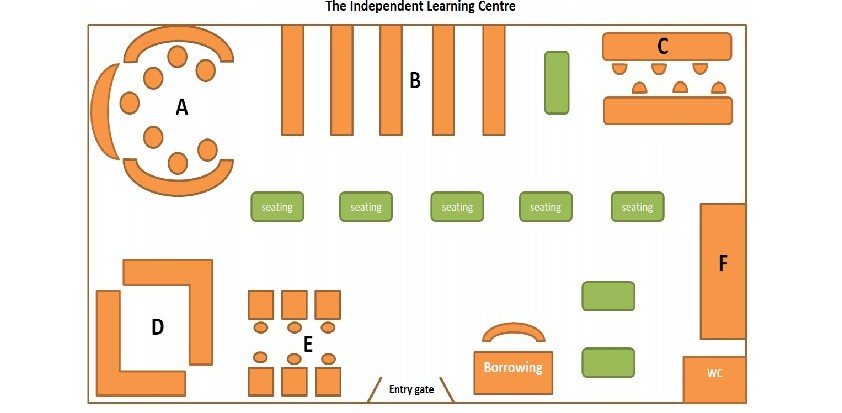
Label the floor plan.
Write the correct letter, A—F, for each answer.
Questions 17–20 Visual Labeling
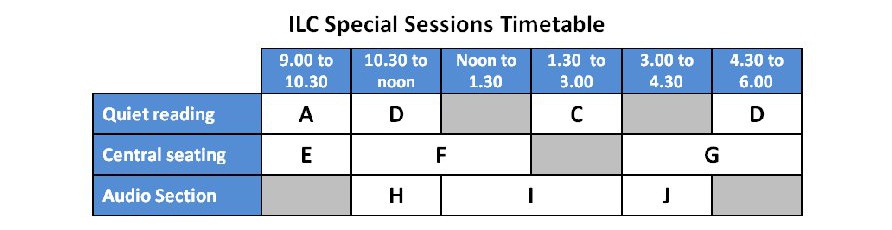
Complete the timetable.
Write the correct letter, A-J, for each answer.
Answers & Explanations Summary
| # | Answer | Evidence | Explanation |
|---|---|---|---|
| Q11 | A | in that far corner in front of us. on the left, we have the Quiet Reading Section, for some serious reading activity | Excerpt/Transcript Explanation: The transcript describes where the quiet reading area is located: in the corner at the back of the room on the left side. Answer Explanation: The answer is the letter A on the diagram of the library. Reason For Correctness: The correct answer is A because the library director gives directions to its location. He says that the area for quiet reading is in the corner that is far away and on the left side. By following these directions from the entry gates, you find area A. Key words to listen for are 'far corner' and 'on the left'. |
| Q12 | E | The computers were instead shifted to a more central location, right beside us here, on the left | Excerpt/Transcript Explanation: The transcript says the computers were moved to a middle area that is right next to the entrance area on the left side. Answer Explanation: The answer is the location marked E on the floor plan, which represents where the computers are kept. Reason For Correctness: The correct answer is E because the director explains that the computers are no longer in the back corner. Instead, they moved them to a central spot. This new spot is directly next to where the group is currently standing (the entrance) on the left-hand side. In English, 'shifted' means moved, and 'right beside us' means very close to the speaker. |
| Q13 | D | this area once housed the Newspaper and Magazine Section, but the people in the Quiet Reading Area had to walk too far to collect this literature, so it was moved to right beside them, in the adjacent corner | Excerpt/Transcript Explanation: The transcript explains that the magazines were relocated to the corner right next to the Quiet Reading Area so that readers would not have to walk a long distance to get them. Answer Explanation: The answer D is the location on the map for newspapers and magazines. Reason For Correctness: The correct answer is D because the director explains that the newspaper and magazine area was moved to be closer to the students. It used to be near the entrance, but now it is in the corner 'adjacent' (next) to the Quiet Reading Section. Since the Quiet Reading Section is in the far left corner, the spot for newspapers and magazines is the corner next to it on the right side of the back wall. |
| Q14 | F | But the reference books, those huge weighty dictionaries, atlases, and encyclopedias, were all situated at the opposite end of the building, against the wall | Excerpt/Transcript Explanation: The transcript says that heavy books like big dictionaries are located on the far side of the library, right next to the wall. Answer Explanation: The answer F is the label for the area where reference books, such as big dictionaries, are kept. Reason For Correctness: The correct answer is F because the speaker describes the location of the reference books as being at the 'opposite end of the building' and 'against the wall.' Since the group is standing at the entry gates at one end, the opposite end is the far side of the room. On the floor plan, F is the area located against the far wall. The speaker also uses words like 'weighty' for big books and lists examples like 'dictionaries' to identify this section. |
| Q15 | C | Again, such an activity needs a quiet area, so we put this in the last remaining corner, up there on your right, as you can see | Excerpt/Transcript Explanation: The transcript explains that the Audio Section is placed in the final corner on the right side because it is a quiet spot for listening. Answer Explanation: The answer C is the specific spot on the map where the Audio Section is located. Reason For Correctness: The correct answer is C because the library director gives directions from the entrance. He says the Audio Section needs to be in a quiet place, so it is in the last empty corner on the right-hand side of the building. |
| Q16 | B | For the main library, just follow your nose, past the central settling there, and it’s there among all that shelving, upon which you’ll find an abundance of interesting books and listening packs to use | Excerpt/Transcript Explanation: The transcript explains that to get to the main library, you should walk straight forward, pass through the middle seating area, and you will find it in the place where there are many bookshelves. Answer Explanation: The answer is choice B, which represents the location and area of the main library on the floor plan. Reason For Correctness: The correct answer is B because the director tells the students to 'follow your nose'—which is an idiom meaning to walk straight ahead—passed the middle of the room ('central settling') to reach the main library. He mentions that this area contains many bookshelves ('shelving') where the books are kept. |
| Q17 | E | For a start, many of you need practice in speaking English. and for that we hold a special Discussion Session, led by a teacher. That can be noisy, in fact, we hope that it is noisy, since that would mean many people are talking. It's in the Central Seating area, and it used to be from 10.30 to 1.30. but we found that the noise was disturbing the regular I.L.C patrons, so we shortened and moved this discussion to the morning, 9.00 am time slot, when fewer people tire in the centre. It goes for one and a half hours | Excerpt/Transcript Explanation: The transcript explains that the speaking practice session with a teacher happens in the middle of the library (Central Seating) at 9:00 in the morning. Answer Explanation: The answer E is the label on the timetable for the session where a teacher leads a conversation group for students. Reason For Correctness: The correct answer is E because the speaker mentions a 'Discussion Session' that is 'led by a teacher.' He explains that because this session is noisy, they changed its time to the early morning at '9.00 am' when fewer people are around. He specifically notes that this activity occurs in the 'Central Seating area.' Key terms to listen for include 'Discussion Session,' 'led by a teacher,' '9.00 am,' and 'Central Seating area.' |
| Q18 | C | Alright, what about Writing Skills? Well, we can help you there with another teacher. Now, writing is a fairly quiet activity, so that teacher stations him or herself in the Quiet Reading area from 1.30 until three | Excerpt/Transcript Explanation: The transcript tells us that help for writing skills is available in the Quiet Reading area between 1:30 and 3:00. Answer Explanation: The answer identifies the correct time and place on the timetable for students to get help with their writing. Reason For Correctness: The correct answer is chosen because the library director mentions that help for 'Writing Skills' involves a teacher. Since writing is a 'quiet activity', the teacher works in the 'Quiet Reading area'. This specific session happens from '1.30 until three' in the afternoon. |
| Q19 | I | These students all have to wait until midday onwards, when, for three hours, a teacher will be stationed in the Audio Section, ready to deal with all those questions | Excerpt/Transcript Explanation: The transcript says that students must wait until 12:00 PM (midday). At that time, a teacher will be in the Audio Section for three hours to answer their questions. Answer Explanation: The answer is 'I', which represents the time and place on the schedule for the teacher who is available to help students with questions. Reason For Correctness: The correct answer is I because the speaker mentions that a teacher is ready to help starting at 'midday' (12:00 PM). This teacher stays in the 'Audio Section' for 'three hours' to answer questions. In the timetable, the letter I corresponds to the teacher being in the Audio Section from 12:00 PM to 3:00 PM. |
| Q20 | F | Also noisy can be the Language Exchange, where local students who want to learn your language will help you practise English. This is generally done in pairs, so the noise level is low enough not to need this exchange to run at 9 am, but at a more congenial time of 10.30, among the Central Seating. That must finish by 1.30 though, after which quieter and more individual activities take place | Excerpt/Transcript Explanation: The transcript explains that the Language Exchange program happens in the middle part of the library called 'Central Seating'. It begins at 10:30 in the morning and ends at 1:30 in the afternoon. Answer Explanation: The answer F is the correct label for the 'Language exchange' session on the library schedule. Reason For Correctness: The correct answer is found by identifying where and when the 'Language Exchange' happens. The speaker says this event takes place in the 'Central Seating' area. He also gives the specific times: it starts at '10.30' and must 'finish by 1.30'. By matching these two details—the location and the time block—you find the correct spot on the timetable. |
Transcript
SECTION 2
You will hear the director of a language-centre library explaining about its facilities to some new students.
Welcome to the library, or the I.L.C.. which means Independent Learning Centre, and let me explain about some of its facilities. We're standing here at the entry gates, next to the borrowing desk. That's where you check out any books, but you are also advised to study in the library here, since most of our material cannot be borrowed. Thus, we have Seating along the middle of the library, and in that far corner in front of us. on the left, we have the Quiet Reading Section, for some serious reading activity.
We used to have the computers there but then realised that that corner was very quiet, and thus better suited for the purpose it now has. The computers were instead shifted to a more central location, right beside us here, on the left. Again, somewhat confusingly, this area once housed the Newspaper and Magazine Section, but the people in the Quiet Reading Area had to walk too far to collect this literature, so it was moved to right beside them, in the adjacent corner. So, feel free to read the newspapers there. But the reference books, those huge weighty dictionaries, atlases, and encyclopedias, were all situated at the opposite end of the building, against the wall. This was because they weren't generally that popular, and we wanted more space for the magazine racks, always a favourite with readers.
Okay, as well as reading, you need to work on your listening skills, and for that you need the Audio Section. Again, such an activity needs a quiet area, so we put this in the last remaining corner, up there on your right, as you can see. There are CD players and headphones, so just borrow the listening packs, sit down there, and listen away.
Right, that just leaves the main library. In other libraries, that's often right beside the Newspaper and Magazine Section, allowing freedom to choose from all genres of literature, but here, we've got them further apart. For the main library, just follow your nose, past the central settling there, and it’s there among all that shelving, upon which you’ll find an abundance of interesting books and listening packs to use.
Now, I’d like to tell you a bit more about an excellent service offered in the I.L.C. here that we call the 'Special Sessions'. What can you do in them? For a start, many of you need practice in speaking English. and for that we hold a special Discussion Session, led by a teacher. That can be noisy, in fact, we hope that it is noisy, since that would mean many people are talking. It's in the Central Seating area, and it used to be from 10.30 to 1.30. but we found that the noise was disturbing the regular I.L.C patrons, so we shortened and moved this discussion to the morning, 9.00 am time slot, when fewer people tire in the centre. It goes for one and a half hours.
Alright, what about Writing Skills? Well, we can help you there with another teacher. Now, writing is a fairly quiet activity, so that teacher stations him or herself in the Quiet Reading area from 1.30 until three. The 10.30-to-midday time slot cannot have a teacher for such writing skills, as they are all teaching in the morning. For this reason, of course, there cannot be an on-call teacher in the morning either, although many people would like one, particularly the 10.30-to-noon crowd, having just finished their early morning class. These students all have to wait until midday onwards, when, for three hours, a teacher will be stationed in the Audio Section, ready to deal with all those questions.
Until recently, we had another teacher doing the 3-pm-to-6-pm time slot, in the Central Settling, but all the noise interfered with the late users of the I.L.C., so we had to cancel that. Also noisy can be the Language Exchange, where local students who want to learn your language will help you practise English. This is generally done in pairs, so the noise level is low enough not to need this exchange to run at 9 am, but at a more congenial time of 10.30, among the Central Seating. That must finish by 1.30 though, after which quieter and more individual activities take place.