
OCEAN RESEARCH - IELTS Listening Answers & Explanations
From Cambridge IELTS 07 Academic Listening Test 3 · Part 3 · Questions 21–30
Audio
Questions
Questions 21–22 Note Completion
Complete the notes below.
Write ONE WORD AND/OR A NUMBER for each answer.
OCEAN RESEARCH
The Robotic Float Project
• Float is shaped like a 21
• Scientists from 22 have worked on the project so far
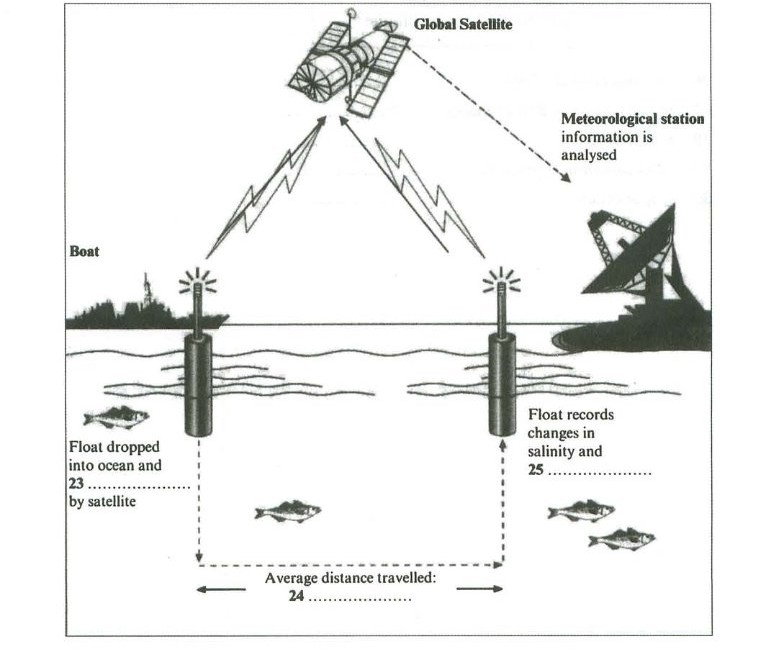
Questions 23–25 Diagram Labeling
Complete the diagram below.
Write ONE WORD AND/OR A NUMBER for each answer.
Questions 26–30 Matching
In what time period can data from the float projects help with the following things?
Write the correct letter, A, B or C, next to questions 26-30.
A. At present
B. In the near future
C. In the long-term future
Answers & Explanations Summary
| # | Answer | Evidence | Explanation |
|---|---|---|---|
| Q21 | cigar | It looks a bit like a cigar and it's about one and a half metres long | Excerpt/Transcript Explanation: The transcript states that the device has a shape similar to a cigar and is 1.5 meters in length. Answer Explanation: The answer is a 'cigar,' which is a long, thin, tube-shaped object. Reason For Correctness: The correct answer is 'cigar' because the speaker, Simon, uses this word to describe what the robotic float looks like. In English, when we describe the shape of something, we often compare it to a familiar object using the phrase 'looks like.' |
| Q22 | 13 countries | Over the last five years scientists from thirteen countries have been taking part in the project and launching floats in their area of ocean control | Excerpt/Transcript Explanation: The transcript says that for five years, scientists from thirteen different countries have been involved in the project by putting floats in the parts of the ocean they manage. Answer Explanation: The answer is 13 nations. Reason For Correctness: The correct answer is 13 because Simon mentions that over the past five years, scientists from thirteen countries have participated in the project. The question asks about the work done 'so far,' and since Indonesia is not joining until next year (making it 14), the current total is 13. |
| Q23 | activated | Each of the floats is dropped in the ocean from a boat at a set point and activated from a satellite | Excerpt/Transcript Explanation: The transcript explains that when the float is in the water, it is turned on (activated) by a signal from a satellite. Answer Explanation: The answer "activated" means the machine is turned on or starts working. Reason For Correctness: The correct answer is "activated" because it describes the first step of the machine's cycle in the ocean. After the float is put into the water, it is turned on using a signal sent from a satellite. To "activate" something means to make it start functioning. |
| Q24 | 50 km / 50 kilometers / 50 kilometres | During this time it's possible for it to cover quite large distances but the average is fifty kilometres | Excerpt/Transcript Explanation: The transcript says that the device can move a lot, but usually, it moves about 50 kilometers when it is deep in the water. Answer Explanation: The answer is 50 kilometers. This is the usual distance the machine moves while it is deep under the ocean. Reason For Correctness: The correct answer is 50 kilometers because the speaker, Simon, describes how the float stays under the water for 10 days. While it is down there, ocean currents move it. He says that the 'average' distance it covers is 'fifty kilometres'. Keywords here include 'average', which means the typical or usual amount, and 'distance', which relates to the 'kilometres' mentioned. |
| Q25 | temperature | Well at this stage nothing, but as it rises to the surface it collects all sorts of data, most importantly variations in salinity, that's salt levels, and the changes in temperature, a bit like underwater weather balloons | Excerpt/Transcript Explanation: The transcript explains that when the robot floats up to the top of the ocean, it gathers different information. The most important things it checks are the amount of salt in the water and the changes in how warm or cold the water is. Answer Explanation: The answer is temperature, which measures how hot or cold something is. Reason For Correctness: The correct answer is temperature because the transcript mentions it as one of the two main types of data the float records while it moves back up to the ocean's surface. Besides salt levels (salinity), the float tracks 'changes in temperature.' |
| Q26 | A | Some of the data has already helped in completing projects. For example, our understanding of the underlying causes of El Niño events is being confirmed by float data | Excerpt/Transcript Explanation: The transcript tells us that researchers are using the information from the floats right now. It specifically says that they are using this data to check if their ideas about the causes of El Niño are correct. Answer Explanation: The answer 'A' means that the float data is being used to understand El Niño right now, at the current time. Reason For Correctness: The correct answer is A because Simon explains that some projects are already finished or currently happening. He mentions that float data 'is being confirmed,' which means the process is taking place now. Keywords like 'already' and 'is being confirmed' show that this information is being used at present to understand El Niño events. |
| Q27 | C | Another way we're using float data is to help us to understand the mechanics of climate change, like global warming and ozone depletion. That's part of an ongoing variability study but the results are still a long way off | Excerpt/Transcript Explanation: The transcript explains that scientists are using the float data to study how climate change works, but they will not have the information they need for a long time. Answer Explanation: The answer means that we will get clear answers about climate change from this data in the far future, not right now or anytime soon. Reason For Correctness: The correct answer is C because Simon says that while they are using the data to study climate change, the results are 'still a long way off.' This phrase 'a long way off' is a synonym for the long-term future, meaning it will take many years to see the final outcome. |
| Q28 | A | Because we know from the floats what the prevailing weather conditions will be in certain parts of the ocean, we can advise the navy on search and rescue missions. That's happening right now and many yachtsmen owe their lives to the success of this project | Excerpt/Transcript Explanation: The transcript explains that the information from the floats tells people about the weather at sea, which helps the navy during rescue missions today. Answer Explanation: The answer means that data from the floats is being used right now to help the navy find and save people trapped at sea. Reason For Correctness: The correct answer is A because the speaker says that using float data to assist the navy with search and rescue missions is 'happening right now'. This phrase directly matches the meaning of 'At present'. The speaker also mentions that many people have already been saved because of this current work. |
| Q29 | B | We hope it will help to bring about more sustainable fishing practices. We'll be seeing the results of that quite soon | Excerpt/Transcript Explanation: The transcript states that the goals for better fishing will be reached in a short amount of time from now. Answer Explanation: The answer B means that the project will show results for better fishing methods very soon, but not right now. Reason For Correctness: The correct answer is B because Simon explains that they are almost finished with a project about fishing laws. He says that the results for "sustainable fishing practices" will be seen "quite soon." In English, "quite soon" is a synonym for "in the near future." |
| Q30 | C | I agree that this concept is still a long way in the future, but it will come eventually and the float data will have made a contribution | Excerpt/Transcript Explanation: The transcript states that the idea of using this data for farming is not something that will happen soon; it will take a very long time before it is ready to be used. Answer Explanation: The answer is C because the data from the project will not be used to help farmers choose which crops to plant until a much later time. Reason For Correctness: The correct answer is C because Simon describes the idea of using float data for agriculture as being a 'long way in the future.' While he notes that the project will eventually contribute to helping farmers select grain varieties based on predicted rainfall, he agrees with the student that this specific use is currently far from becoming a reality. The keywords to look for are 'long way in the future' and 'eventually,' which indicate the long-term future. |
Transcript
SIMON: Thanks to all of you for coming along today to hear about how the robotic float project is helping with ocean research. Well, first of all we'll look at what a robotic float does and its use. So let's start with the device itself. It looks a bit like a cigar and it's about one and a half metres long. More importantly it's full of equipment that's designed to collect data. So, it can help us in building up a profile of different factors which work together within the world's oceans.
STUDENT 1: Sounds like a big project - isn't it too big for one country to undertake?
SIMON: That's quite true but this project is a really good example of international co-operation. Over the last five years scientists from thirteen countries have been taking part in the project and launching floats in their area of ocean control. And next year this number will rise to fourteen when Indonesia joins the project.
STUDENT 2: That's impressive.
SIMON: But let's move onto how floats work.
SIMON: The operational cycle goes like this. Each of the floats is dropped in the ocean from a boat at a set point and activated from a satellite. Then the float immediately sinks about 2,000 metres. . . that's two whole kilometres down in the water. It stays at this depth for about 10 days and is carried around by the currents which operate in the ocean at this level. During this time it's possible for it to cover quite large distances but the average is fifty kilometres.
STUDENT 2: So what is it actually recording?
SIMON: Well at this stage nothing, but as it rises to the surface it collects all sorts of data, most importantly variations in salinity, that's salt levels, and the changes in temperature, a bit like underwater weather balloons. Then when it gets back to the surface all the data it's collected is beamed up to the satellite. After about five hours on the surface the float automatically sinks, beginning the whole process again.
STUDENT 1: What happens to the data?
SIMON: Well the information is transferred direct to onshore meteorological stations. . . like our one in Hobart. . . and within four hours the findings can be on computers and they can be mapped and analysed.
STUDENT 2: You say you're building models of the world's ocean systems but how're they going to be used, and more importantly, when?
SIMON: Some of the data has already helped in completing projects. For example, our understanding of the underlying causes of El Niño events is being confirmed by float data. Another way we're using float data is to help us to understand the mechanics of climate change, like global warming and ozone depletion. That's part of an ongoing variability study but the results are still a long way off.
However, this is not the case with our ocean weather forecasting. Because we know from the floats what the prevailing weather conditions will be in certain parts of the ocean, we can advise the navy on search and rescue missions. That's happening right now and many yachtsmen owe their lives to the success of this project. In addition, the float data can help us to look at the biological implications of ocean processes.
STUDENT 1: Would that help with preserving fish stocks?
SIMON: Yes, and advising governments on fisheries legislation. We're well on the way to completing a project on this. We hope it will help to bring about more sustainable fishing practices. We'll be seeing the results of that quite soon.
STUDENT 2: It sounds like the data from floats has lots of applications.
SIMON: Yes it does. It's also a powerful agricultural tool. If we were aware of what the weather would be like, say, next year, we could make sure that the farmers planted appropriate grain varieties to produce the best yield from the available rainfall.
STUDENT 1: That sounds a bit like science fiction, especially when now we can't even tell them when a drought will break.
SIMON: I agree that this concept is still a long way in the future, but it will come eventually and the float data will have made a contribution.